
Cue-ball control · 3 min read
Draw the Cue Ball at an Angle Without Losing Pocketing Control
Drawing from a cut is two tasks at once: pocket the object ball on its line and deliver enough backspin for the cue ball to leave the collision toward a useful zone. Trying to steer the cue ball with the tip often damages the first task. This progression keeps the aim, vertical-axis contact and draw route as separate observations.
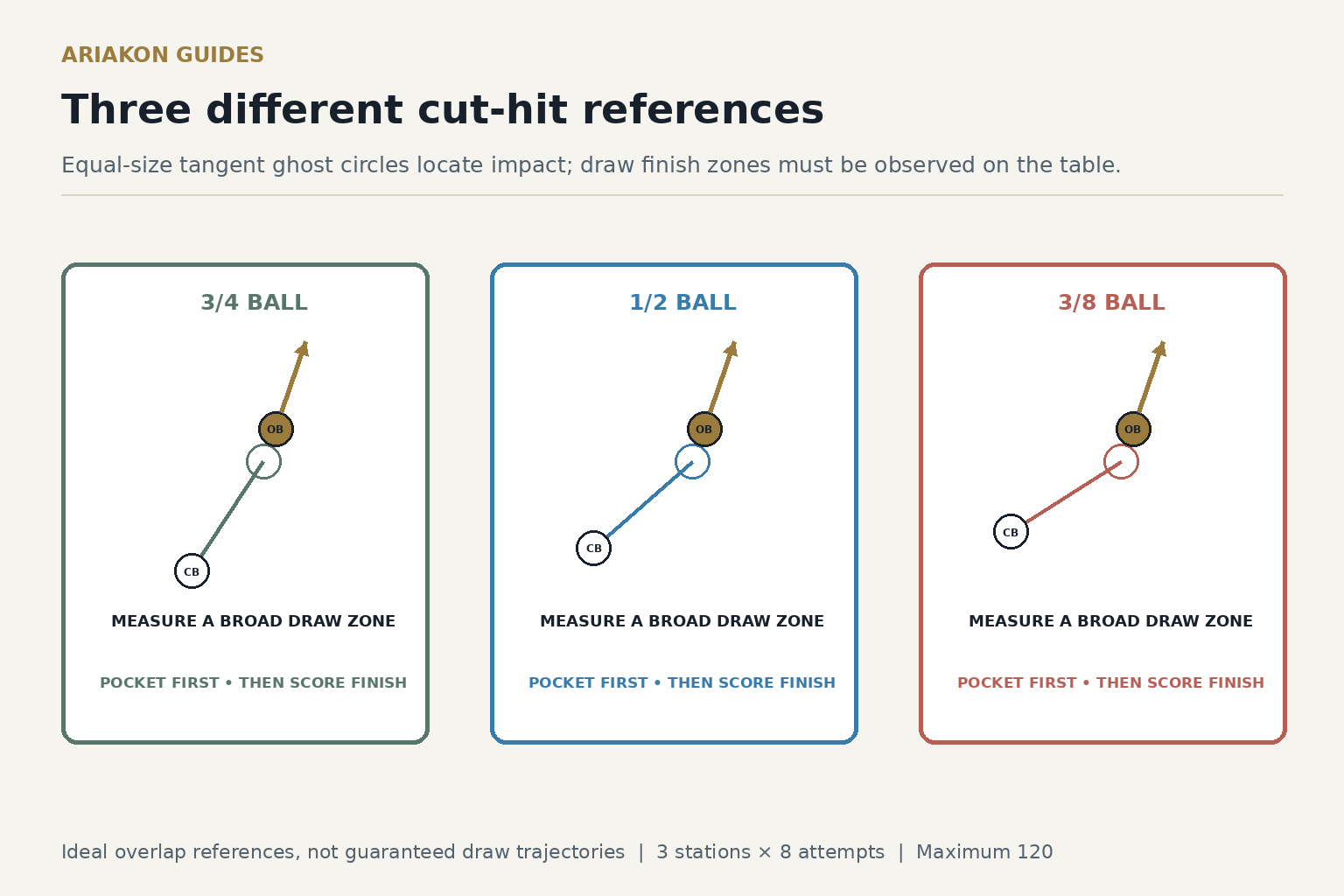
Predict a corridor instead of one perfect curve
Sight the object-ball-to-pocket line first. Then identify the tangent line through the collision point. A stun cue ball initially departs along that tangent in the ideal equal-ball picture; active backspin can bend the later route toward the draw side. Start with a physically observed route on this table, then draw a broad prediction corridor around it. Do not derive an exact finish from one cut-angle slogan.
Draw a corridor about one ball wide around the predicted route. Speed, tip height, cloth drag, cut angle and cue elevation all affect where the curve develops. A broad corridor is honest feedback; a chalk-dot target can pretend the system is more exact than the conditions allow.
Build a straight-shot draw baseline before adding a cut angle.
Map actual tip contact if the cue ball leaves the wrong side of the corridor.
Build three ball-hit stations
Use ball-in-hand to create each visual overlap while keeping the object ball and called pocket fixed. Mark the cue-ball center after the line looks correct so every attempt at that station starts in the same place. Use low-center contact and no intentional sidespin. Pick a speed that produces clear draw without a forced hit.
The overlap labels are setup references, not measured cut angles. If the pocket line is wrong during rehearsal, rebuild the station before shooting rather than twisting the stroke to save it.
| Station | Visual ball-hit reference | Attempts | Draw target |
|---|---|---|---|
| A | About 3/4-ball full | 8 | Return inside the full-hit corridor |
| B | About 1/2-ball | 8 | Cross the middle corridor |
| C | About 3/8-ball | 8 | Reach the thinner-hit corridor |
| All | Object ball one diamond from the called corner; cue ball three ball widths away | 24 | One removable marker defines each landing zone |
Score pocketing before position
Record pocket misses even when the cue ball reaches the zone. That result is not successful position play because the first task failed. Also separate a made ball with weak draw from a made ball whose route started incorrectly; the next correction is different.
| Point | Observable result |
|---|---|
| 1 | Station and called pocket confirmed while standing |
| 1 | Tip contact stays on the intended vertical axis |
| 1 | Object ball reaches the called pocket cleanly |
| 1 | Cue ball starts on the predicted side of the tangent line |
| 1 | Cue ball finishes inside the broad draw zone |
| Maximum 120 | Eight attempts at each of three stations |
Diagnose the first failed condition
| Evidence | Next action |
|---|---|
| Object ball misses consistently to one side | Restore the pocket line and reduce tip offset |
| Pocket is made but cue ball follows forward | Check actual low contact and reduce cue-ball travel distance |
| Cue ball draws but starts outside the corridor | Check unintended sidespin and cut-angle prediction |
| Only the thin station fails | Return to the half-ball station and rebuild aim before draw |
| Route varies widely at every station | Lower speed and retest a straight draw baseline |
Worked score and game transfer
A hypothetical player scores 36/40 at the fuller hit, 31/40 at half-ball and 21/40 at the thinner hit. Seven of the thin shots miss the pocket before position is judged. The next block is four thin-cut pocketing attempts at center ball, then four low-center attempts; it is not a search for more spin.
For transfer, add one next ball inside the successful draw zone. Play the cut, then pocket the next ball from the actual leave. Count a pattern success only when both balls are made. Keep the observed corridor as a table-specific planning reference and retest whenever distance, speed, cloth or ball condition changes.