
Practice · 3 min read
Design a Deliberate Pool Repetition Block With Immediate Feedback
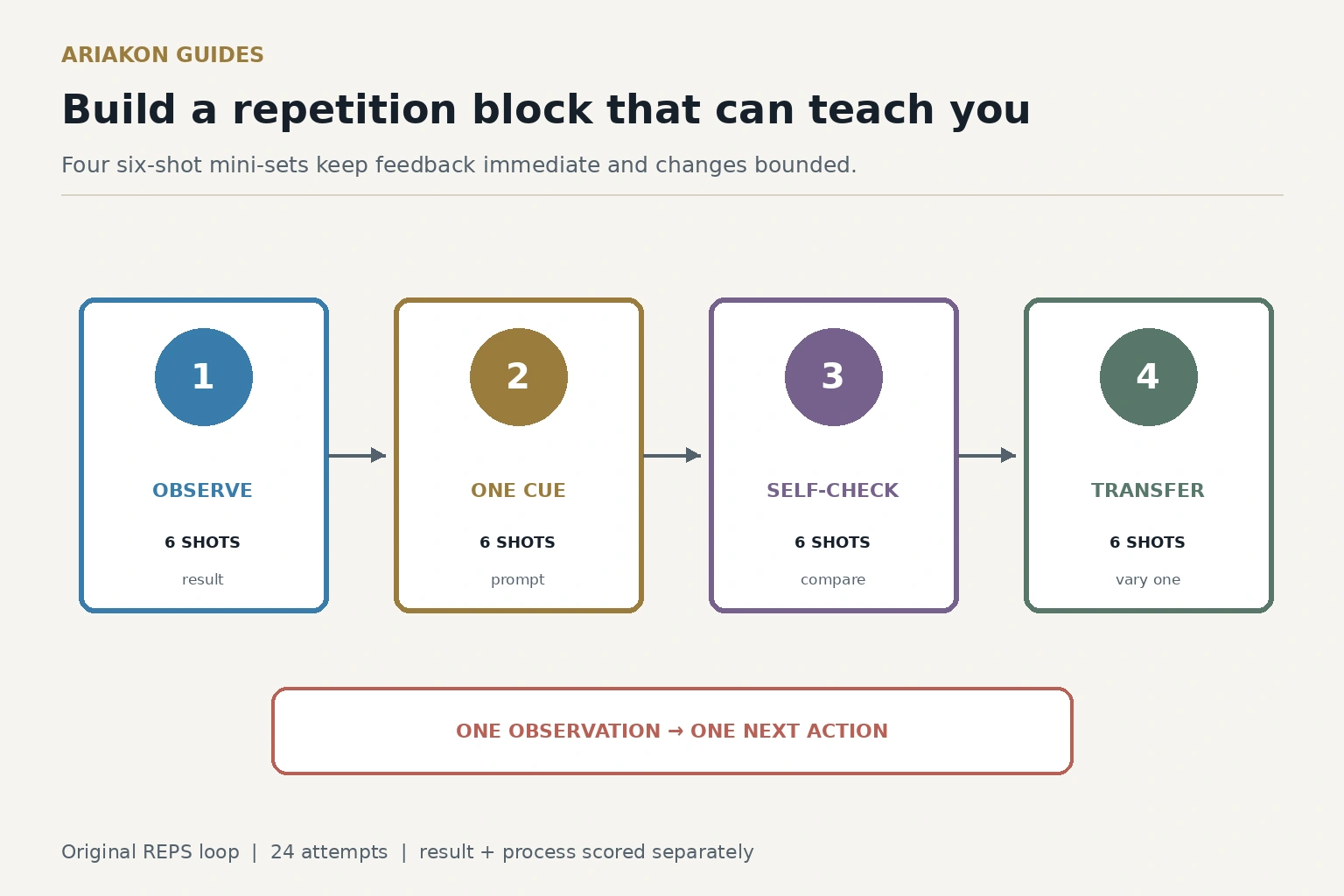
Repetition becomes deliberate when the player can reconstruct the shot, see what happened and choose a bounded response. This guide supplies the twenty-four-attempt block itself. The broader deliberate-practice guide explains why practice beats talent; this worksheet controls what happens between one attempt and the next.
Register the REPS worksheet
Choose a shot whose setup can be restored. Mark only where the room permits it, keep loose objects out of ball and player traffic, and inspect the equipment first. Do not use this block to force through pain or a damaged tip, shaft or table condition.
Write the score before choosing the prompt. Feedback should describe the result—made or missed, long or short, cue ball in or out—not become a stream of new technique theories.
| Field | Write before shooting | Example |
|---|---|---|
| R — Result | One visible outcome and one process check | Pocket plus cue ball in a one-diamond zone |
| E — Exact setup | Ball marks, pocket, contact and speed | Straight stop shot, center ball, pocket speed |
| P — Prompt | One short cue permitted in the next set | Finish through the gate |
| S — Stop rule | Evidence that ends or redirects the block | Pain, damage, or six unchanged directional misses |
Use the deliberate-practice framework to choose a skill worth isolating.
Choose a diagnostic drill when the miss has more than one plausible cause.
Run four six-shot mini-sets
Reset the original marks for the first eighteen shots. Pause only long enough to record the three fields. Set four changes exactly one condition; it tests whether the learning transfers rather than whether the player memorized the marks.
A partner may report an agreed observation, but the player decides when extra detail is useful. Record the feedback timing and content with the component score, then compare matched blocks. Do not assume that adding more prompts improves practice.
| Set | Shots | Feedback after each shot | Between-set action |
|---|---|---|---|
| 1 — Observe | 1–6 | Result, miss direction, process check | Select one repeated observation |
| 2 — One cue | 7–12 | Same three fields | Keep or remove the single prompt |
| 3 — Self-check | 13–18 | Player requests detail only when useful | Compare component totals |
| 4 — Transfer | 19–24 | Decision and result | Vary one distance or angle |
Score outcome and process separately
Each six-shot set has a maximum of twelve points; the full block has forty-eight. Also keep the raw make count and miss direction. A higher process score with lower outcomes is a warning to simplify or remove the prompt, not proof of improvement.
| Point | Award when |
|---|---|
| Outcome | The ball is pocketed legally and the cue ball reaches the named zone |
| Process | The one registered prompt is completed without adding another cue |
Worked example: stop-shot delivery
A hypothetical player scores 7/12 in Set 1: four legal pockets, three target-zone stops and repeated cue-right finishes. The only prompt for Set 2 is ‘finish through the gate.’ Set 2 scores 9/12 and Set 3 scores 10/12 after the reminder is removed. In transfer, moving the cue ball half a diamond farther back produces 6/12.
The original setup improved, but transfer did not. The next action is six more transfer attempts on another day, not a second mechanical cue. If cue-right finishes persist on both marks, use a dedicated delivery diagnostic or qualified instruction.
Choose the next action without rewriting the block
| Evidence | Next action |
|---|---|
| Outcome and process rise; transfer holds | Retain the prompt for one delayed test |
| Process rises; outcome falls | Remove or shorten the prompt |
| Directional miss repeats for six shots | Stop and diagnose instead of repeating |
| No stable pattern | Repeat the registered baseline on another day |