
Strategy · 3 min read
Compare Two Pool Players' Decisions in the Same Layout
Two players can see the same table and make different reasonable choices because their pocketing, speed and safety baselines differ. This is not a biography or a verdict about talent. It is a controlled comparison: register one layout, let each player predict two plans, alternate attempts and use the same observable scorecard.
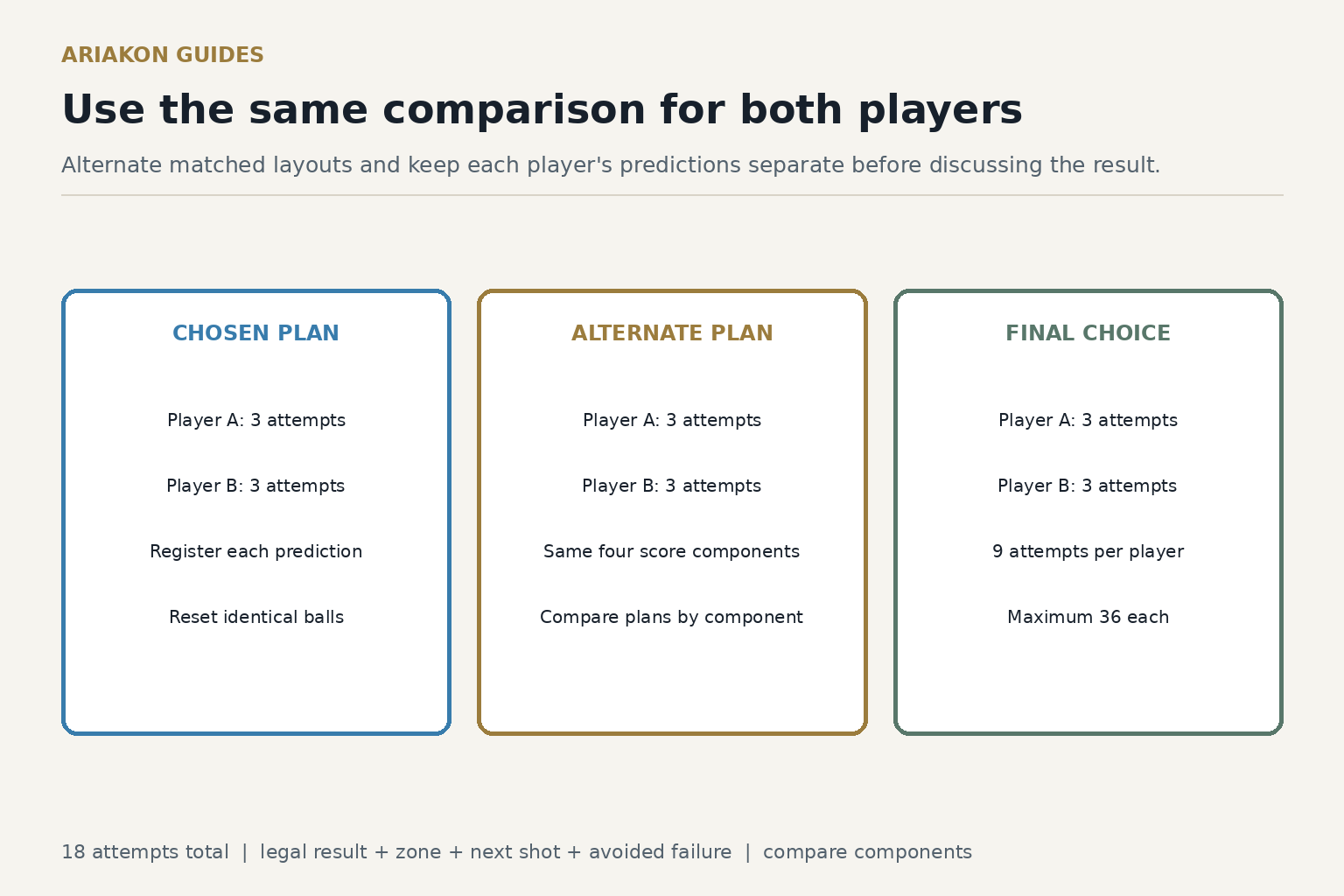
Register one layout before discussing it
Choose a layout with at least two legal plans, such as a direct 1-ball with a narrow two-rail route and a thinner 1-ball with a larger one-rail window. Use removable reinforcement rings only if the room permits them.
The existing adult-learning guide is about pacing skill development. This worksheet instead compares decisions at the same moment with matched evidence.
| Item | Fixed record | Why it stays fixed |
|---|---|---|
| Cue ball | Diamond coordinates and nearest-rail distance | Preserves the opening angle |
| Object balls | Centers of balls 1, 2 and 3 | Keeps traffic and pockets comparable |
| Game condition | Legal group, next ball and called-pocket rule | Prevents invented options |
| Target zones | Two named cue-ball windows | Makes position measurable |
| Table conditions | Table, balls and session | Avoids cross-table conclusions |
Use player-specific baselines instead of assuming equal learning rates.
Estimate choices from practice percentages before predicting a plan.
Have each player predict two plans
Do not let Player B copy Player A’s estimate. A plan that is percentage-correct for one player can be fragile for another. Predictions must come from that player’s own repeatable practice or be marked unknown.
| Field | Plan A | Plan B |
|---|---|---|
| Opening shot | Pocket and speed | Pocket or safety and speed |
| Next-ball window | Named zone | Named zone |
| Personal estimate | Makes and zones per 10 from prior practice | Makes and zones per 10 from prior practice |
| Likely failure | Miss, scratch or blocked next ball | Miss, scratch or sellout |
| Choice rule | Why this player selects it | When this player would switch |
Run an eighteen-attempt crossover
Reset every ball center. Score one point for legal completion of the opening shot, one for the cue ball entering the declared zone, one for retaining a playable next shot and one for avoiding the named major failure. Maximum score is thirty-six per player.
Alternating blocks reduces the chance that one player receives all early-table or late-session conditions. Eighteen attempts remain a small practice sample, so the result guides another test rather than proving who is the better player.
| Block | Player A | Player B |
|---|---|---|
| 1 | Three attempts with chosen plan | Three attempts with chosen plan |
| 2 | Three attempts with alternate plan | Three attempts with alternate plan |
| 3 | Three attempts with final choice | Three attempts with final choice |
| Total | Nine attempts | Nine attempts |
Read the comparison by component
Suppose Player A predicts the narrow two-rail route and scores 7/12 across the chosen-plan block; the alternate one-rail plan scores 9/12. Player B scores 10/12 on the two-rail plan and 7/12 on the one-rail plan. The useful finding is not that one route is universally correct. Each player has evidence for a different current match choice.
If both players miss the same opening pocket, the layout may be testing pocketing more than route selection. Shorten the opening shot or enlarge the zone and repeat before debating strategy.
Turn disagreement into the next test
Write the single component with the largest prediction error: pocket estimate, speed window, scratch line or next-ball access. Build a ten-shot drill for that component, then repeat the crossover on another day.
Advice becomes useful when it predicts an observable result for the player receiving it. A famous route, confident explanation or one fortunate make is not a substitute for the registered comparison.