
Position play · 3 min read
Choose the Next Cue Ball Position Before Addressing the Shot
Position errors often begin before the stroke: the player pockets the first ball, then discovers that no exact next target was chosen. This drill puts the decision at a visible boundary. The next pocket, position zone, route into that zone and speed band must be called while standing. Once the bridge lands, the job is delivery—not redesign.
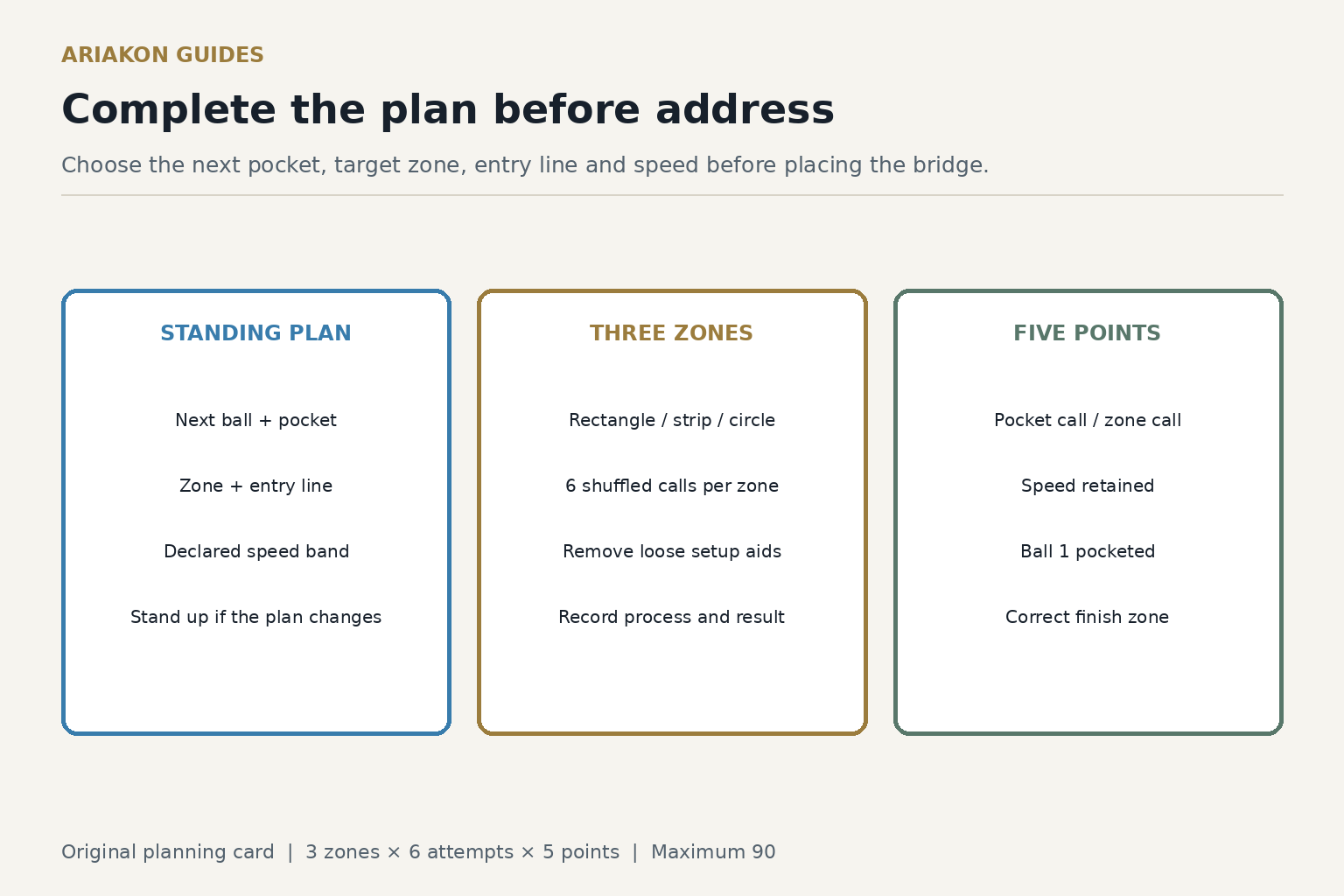
Complete a four-part plan while standing
Choosing before address does not mean refusing new information. If the picture looks wrong from the stance, stand up. The reset preserves the planning rule; steering while down breaks it.
| Decision | Example |
|---|---|
| Next ball and pocket | 2 ball to lower-right corner |
| Position target | Broad center-side rectangle |
| Entry line | Approach through the long axis of the zone |
| Speed band | Soft roll, medium or firm controlled |
| Reset rule | If any fact changes while down, stand up and restart |
Choose area, line or exact position before building the target zone.
Preserve a useful next-ball angle when the zone must avoid straightness.
Build a three-zone two-ball pattern
Place Ball 1 one diamond from a corner pocket on a mild cut. Put Ball 2 near table center with clear routes to two corner pockets and one side pocket. Mark three non-overlapping cue-ball zones: a broad rectangle for Pocket A, a diagonal strip for Pocket B and a smaller circle for Pocket C. Mark one cue-ball start.
Shuffle A, B and C cards before each attempt. The card determines the next pocket and therefore the correct zone. Call all four plan facts, pocket Ball 1 and leave the cue ball for Ball 2. Remove loose cards and markers from every path.
Run eighteen planned attempts
A stand-up restart keeps the first three process points available. Changing the plan while remaining down loses them even if the cue ball lands well. Record process and result separately so a lucky leave does not teach late improvisation.
| Point | Requirement |
|---|---|
| 1 | Next ball and pocket called while standing |
| 1 | Zone and entry line called before address |
| 1 | Speed band called and retained |
| 1 | Ball 1 pocketed |
| 1 | Cue-ball center finishes inside the correct zone |
| Maximum 90 | Six shuffled calls for each zone |
Diagnose planning before speed
| Pattern | Next action |
|---|---|
| Wrong zone called for the pocket | Review next-shot angle before stroking |
| Plan changes while down | Use a verbal reset and stand up |
| Correct line; cue ball short or long | Calibrate the named speed band |
| Cue ball crosses the zone's narrow side | Choose a longer entry line |
| Ball 1 misses while plan is complete | Simplify the position request and restore shotmaking |
Worked example and three-ball transfer
A hypothetical sheet scores 75/90 with all unmentioned points earned. The player calls all eighteen next pockets, but changes the plan while remaining down on four attempts, losing three process points on each, and misses the finish zone on three attempts. That is 90 minus 12 minus 3. The next action is six attempts with the speed call fixed and a mandatory stand-up reset, rather than a smaller zone.
For transfer, add Ball 3 and play six three-ball patterns. Before addressing Ball 1, call the Ball 2 pocket and its zone. Before addressing Ball 2, call the Ball 3 pocket and zone. Score whether each decision existed before the bridge landed. This turns the drill into a repeatable planning boundary inside a real pattern.