
Cue ball control · 2 min read
Preserve Useful Angles in Pool Position Play
Good position is not always close position. A small angle can create an easy path to the next ball, while perfect straightness can remove every simple route. Plan for a useful angle, choose a broad landing zone and send the cue ball into that zone along its long direction whenever possible.
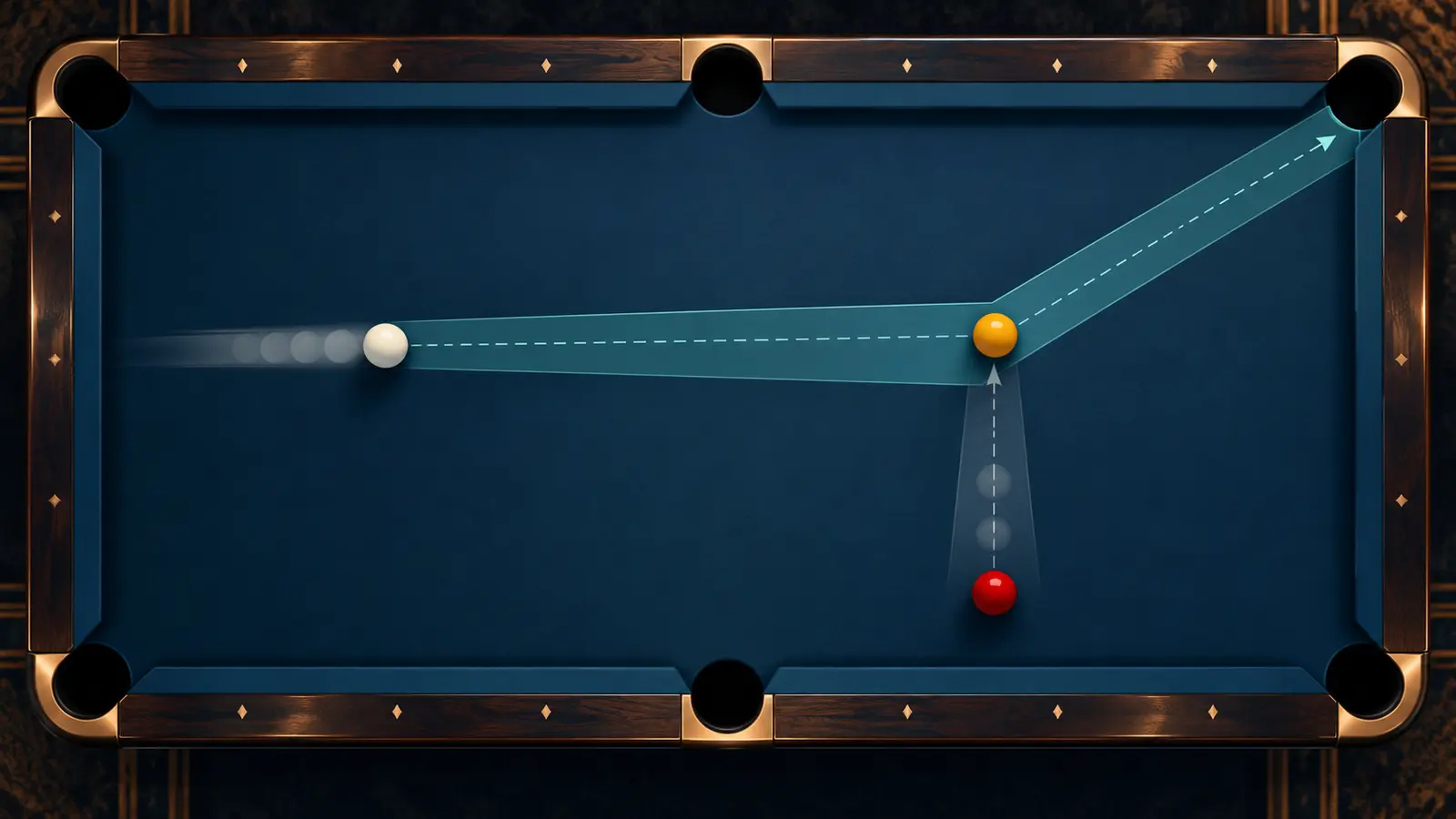
Plan from the next route backward
Stand up and decide where the cue ball must go after the next shot. Then choose which side of the next object ball supplies that route with the least speed and spin.
This turns position into a directional target. 'Below the three ball with a cut toward the center' is more useful than 'somewhere near the three.'
Avoid accidental straightness
Straight position is valuable for a stop shot, but awkward when the next route needs cue-ball travel. Preserve a modest cut angle that lets natural follow, stun or draw send the cue ball where it needs to go.
Do not manufacture a severe angle. Wider cuts reduce pocketing margin and can magnify speed errors. The useful angle is the smallest angle that still provides a comfortable route.
Enter the zone along its length
Imagine a long position corridor rather than a small spot. When possible, select a cue-ball route that travels along that corridor so a short or long finish remains playable.
Crossing the corridor at a right angle makes a small speed error move the cue ball to the wrong side of the object ball. Route choice can create more margin before stroke precision is tested.
Use natural cue-ball rules
For rolling cut shots, a roughly 30-degree deflection from the incoming line can be a useful first estimate for many moderate cuts, not all cut fractions; for stun shots, the 90-degree tangent line supplies another. These are reference patterns, not substitutes for table calibration.
Choose center ball, follow, stun or draw first. Add sidespin only when the rail route or landing zone clearly requires it, then adjust for squirt, swerve and throw.
Practice both sides of the line
- Place two object balls with a clear next-shot route.
- Mark a broad position corridor for the first cue-ball finish.
- Score two points for the preferred side and one for the playable side.
- Record straight or wrong-side finishes separately.
- Repeat with follow, stun and draw routes.
- Finish with random layouts and name the desired angle aloud.