
Practice · 3 min read
Choose Productive Repetition Instead of Replaying Easy Pool Shots
Repetition is productive when it answers a question. Replaying an automatic shot may warm up the stroke, but a long string of unrecorded hangers can stop providing new information. This progression keeps an easy baseline, introduces one controlled challenge and then interleaves both so the player must read the layout again. It does not assign a universal success percentage or treat struggle itself as proof of learning.
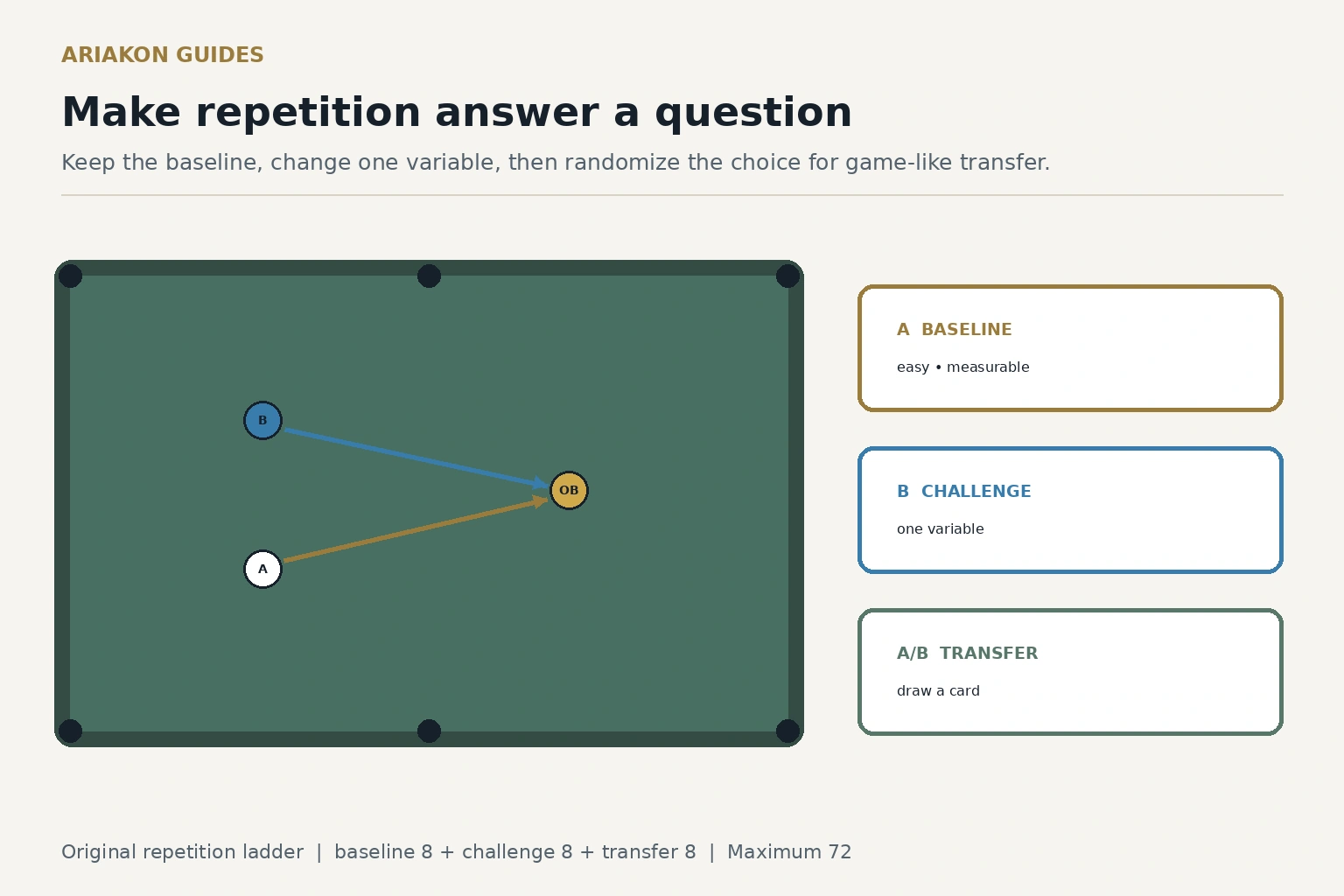
Choose a question before choosing a shot count
| Question | Productive answer |
|---|---|
| What am I testing? | One observable result: pocket, speed zone, contact or route |
| What stays fixed? | Pocket, balls, cue, spin and most of the geometry |
| What changes? | One variable: distance, cut angle, speed or target-zone size |
| What ends the block? | A fixed attempt count, not a make streak |
| What follows a miss cluster? | A named diagnosis and one easier retest |
Turn pool practice into skill for the broader case for structured deliberate work.
Set measurable practice goals when the target is not yet observable.
Build a baseline and one-variable challenge
Choose a foot corner. Baseline A: place the object ball one diamond from the pocket on a near-straight line and the cue ball one diamond behind it. Challenge B: keep the object ball and pocket fixed, move the cue ball one diamond sideways to create a moderate cut. Mark both cue-ball centers and the object-ball center. Use center-ball cueing and one comfortable speed.
Shoot four unscored trials to confirm both shots are safe and physically comfortable. If Challenge B is already nearly automatic, move its cue-ball mark half a diamond farther away—not closer to a table edge or into an awkward reach. If it is nearly impossible, reduce only the lateral offset.
Shoot twenty-four scored repetitions
Do not shoot an immediate correction ball after a miss. Reset, write the miss code and begin the full routine. Block C matters because a game does not label the shot as easy or hard before you see it. Random order tests recognition as well as execution.
| Block | Attempts | Task |
|---|---|---|
| A: baseline | 8 | Easy start; pocket and hold the cue ball in a broad stop zone |
| B: challenge | 8 | Moderate cut; pocket and reach the same broad position zone |
| C: transfer | 8 | Draw a shuffled A/B card; identify the mark before approaching |
Score information, not just makes
Code misses thick, thin, speed-short, speed-long or unknown. Worked example: baseline scores 23 of 24, challenge 15 with four thin misses, and randomized transfer 17 with two shots started from the wrong mark. The next block should keep the same challenge and emphasize standing identification plus aim confirmation. Making the baseline even easier would not answer either failure.
If Challenge B scores near zero and miss directions vary, reduce the lateral offset. If it matches baseline immediately, increase only one variable. The useful difficulty is personal and can change as evidence accumulates.
| Point | Requirement |
|---|---|
| 1 | Correct A or B setup was identified and used |
| 1 | Object ball was pocketed in the called corner |
| 1 | Cue-ball center finished in the called zone |
| Maximum 72 | Twenty-four attempts |
Transfer to a game decision
Place three ordinary object balls with one clearly easy shot and two moderate choices. Before each turn, say baseline, challenge or new task and explain the single variable that supports the label. Play six layouts, scoring one point for correct classification and one for completing the selected shot's process. Maximum twelve.
The goal is not to avoid easy balls; easy balls win racks. The goal is to stop using only easy repetition as proof that a harder, strategically relevant task has improved.