
Practice · 3 min read
Choose Pool Reading That Leads to a Specific Table Exercise
Pool reading is useful when it changes what you can observe at the table. Save one claim, translate it into a controllable setup and decide in advance what result would earn another block. This resource is narrower than the off-table-practice guide: it begins with a specific passage and ends with a physical table exercise.
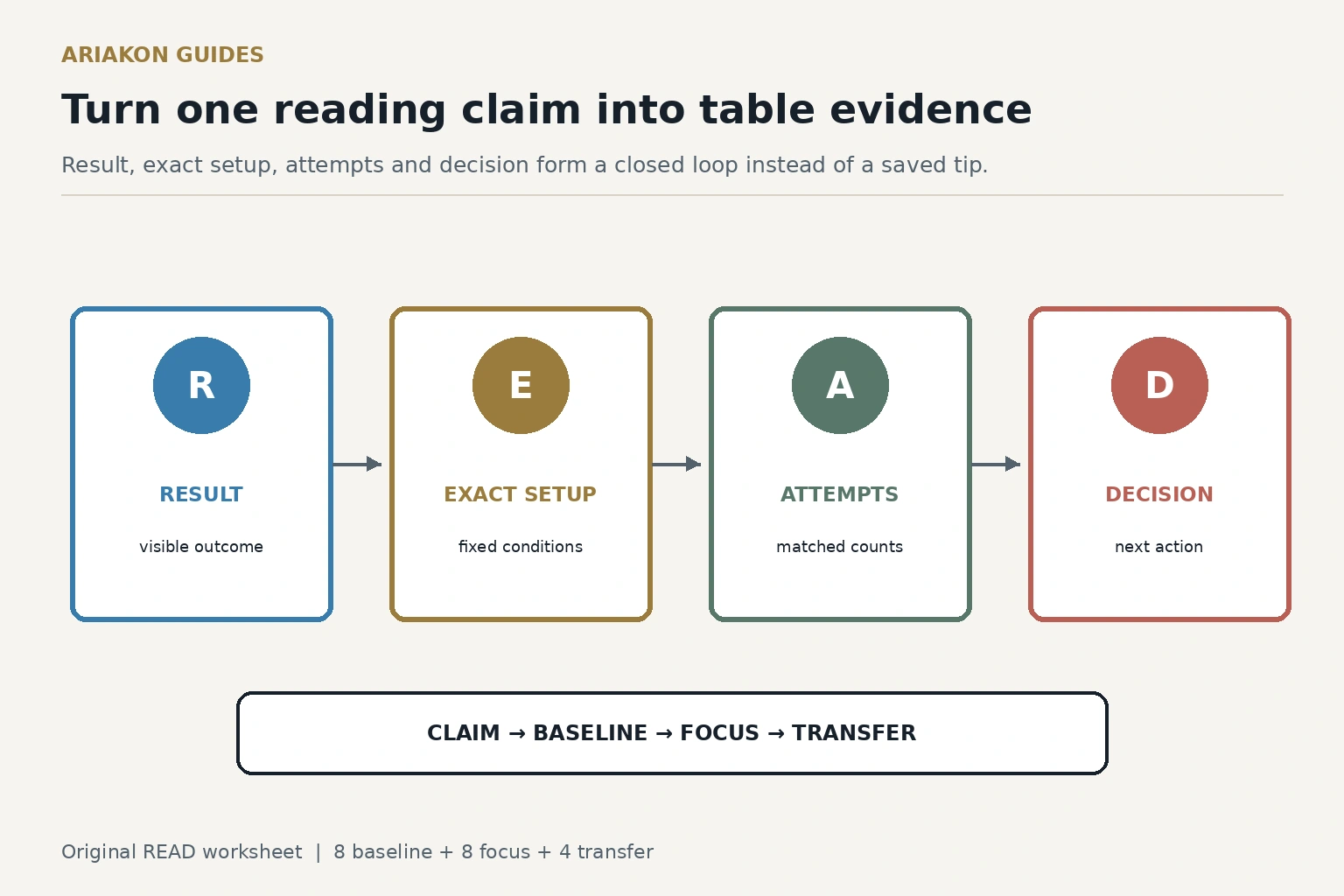
Use the READ filter before saving advice
Reject a passage for this exercise if it supplies only motivation, an equipment endorsement or a result that cannot be observed. It may still be enjoyable reading, but it is not yet a table assignment.
Copy no more than the minimum note needed to remember the idea and retain the source link. Write the exercise in your own words. A claim from a book, article or video is a hypothesis to test, not proof that it works for every player or table.
| Step | Question | Required entry |
|---|---|---|
| R — Result | What visible outcome should change? | Make count, miss side, cue-ball zone or decision |
| E — Exact setup | Can the balls and conditions be repeated? | Ball marks, pocket, contact, speed and permitted tools |
| A — Attempts | How much evidence will you collect? | At least 8 baseline and 8 focused attempts |
| D — Decision | What will the score tell you to do? | Retain, narrow, reject or seek instruction |
Plan useful off-table pool practice when the source is observation or imagery rather than a drill.
Choose the right diagnostic drill when the claim contains several possible causes.
Translate one sentence into table controls
Choose only one row or create an equivalent. If both aim and speed change, the result cannot say which mattered. If a source gives a universal promise, rewrite the test around the conditions you can actually control.
| Reading claim | Keep fixed | Change | Score |
|---|---|---|---|
| A softer bank may open the pocket | Object-ball mark, cue-ball mark, rail and tip contact | One declared softer speed for the eight-shot focus block | Make plus long/short miss |
| A quieter finish may improve delivery | Straight shot, stance and speed | Finish hold for two counts | Pocket, cue-ball corridor and hold |
| A simpler route may reduce risk | Three-ball layout and rules | Route choice before lowering | Completion plus next-shot quality |
Run baseline, focus and transfer blocks
Reset every ball for the first sixteen attempts. In transfer, vary one distance or angle and award a decision point for correctly rejecting the advice when its conditions do not fit. Reading should improve selection as well as execution.
Do not declare a technique solved from one short comparison. The block is a screening tool: it tells you whether the idea deserves a second matched session.
| Block | Attempts | Job |
|---|---|---|
| Baseline | 8 | Use the familiar method and record the same components |
| Focus | 8 | Apply only the selected claim |
| Transfer | 4 | Choose whether the claim applies in a varied layout |
Worked example: a bank-speed claim
A hypothetical reader extracts the claim that speed changes a bank's rebound and pocket acceptance. The player marks one one-rail bank, uses center-ball contact and records eight familiar-speed attempts: three makes, three long misses and two short misses. Eight softer trials produce five makes, one long miss and two short misses.
The focus score is promising but not conclusive. The player retains the softer speed for a second matched block, then tests four nearby bank angles. If long misses decrease only on the original marks, the useful lesson is a table reference rather than a universal aiming rule.
File the result with one next action
| Evidence | Next action |
|---|---|
| Clear component gain in two matched blocks | Add a six-shot transfer set |
| Same score, but a repeatable miss appears | Narrow the next test to that component |
| No repeatable result | Archive the claim without forcing it |
| Pain, unsafe movement or equipment damage | Stop and consult an appropriate professional |