
Cue-ball control · 3 min read
Calibrate Cue Ball Speed Across One, Two and Three Rails
One number such as soft or medium does not describe every cue-ball route. Cushions change speed and direction, so a delivery that lands well after one rail may finish short or long after two or three. This drill builds three table-specific references without pretending that the example bands are universal measurements.
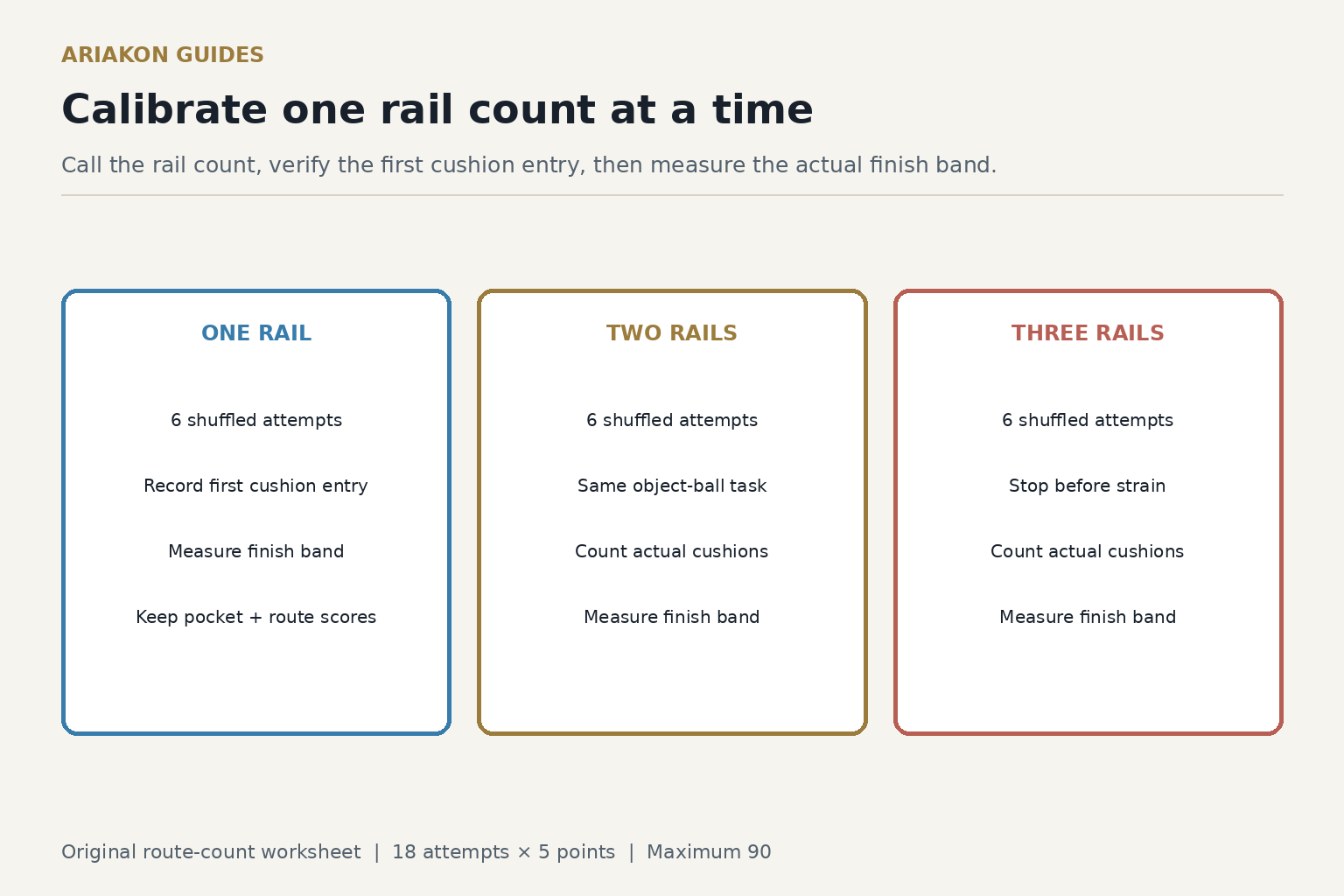
Mark one repeatable shot and three route bands
Place an object ball one diamond up the long rail from a corner pocket. Put the cue ball near table center so the shot is a comfortable cut into that corner and the cue ball naturally travels across the table. Mark both ball centers with removable flat markers and remove anything that could interfere before shooting. Use the same vertical-axis tip contact and the same pocket for every scored attempt.
Choose a one-rail target band on the first long-rail return, a two-rail band after the cue ball reaches the next short rail, and a three-rail band on the following long rail. Each band is one diamond long for the baseline. The goal is not to force one stroke to follow three routes; it is to learn the delivery speed required for each declared rail count on this table.
Calibrate cloth speed and small sidespin first when the table is unfamiliar.
Build a four-zone rolling baseline if basic distance control is not yet repeatable.
Find one honest reference for each rail count
Take no more than four unscored attempts per route. Write a plain-language reference such as compact backswing, normal transition or longer finish. Do not write miles per hour unless a calibrated instrument measured them. If the cue ball misses the expected first cushion entry by more than half a diamond, reset alignment before changing speed.
| Route | Starting delivery | Change after a miss |
|---|---|---|
| One rail | Pocket speed | Change speed only; keep contact and line |
| Two rails | One clear band firmer | Use the same one-rail entry point |
| Three rails | Firm enough to reach the third band | Stop if speed requires losing contact control |
Score eighteen shuffled attempts
Write six cards for each route, shuffle all eighteen, and declare the route before addressing the shot. Reset both centers exactly. A route card is skipped and returned to the deck if the setup is wrong; a poor stroke still counts.
| Point | Observable result |
|---|---|
| 1 | Route and landing band called while standing |
| 1 | Object ball pocketed |
| 1 | Cue ball contacts the declared number of rails |
| 1 | Cue ball stops inside the declared band |
| 1 | First long-rail entry is within half a diamond of the baseline |
| Maximum 90 | Six attempts at each rail count |
Diagnose the first changed variable
| Evidence | Next action |
|---|---|
| Object ball misses | Repair line and contact before judging speed |
| Correct rails, consistently short | Increase delivery one small band |
| Correct rails, consistently long | Reduce delivery one small band |
| First entry point varies | Stabilize cut contact and vertical-axis hit |
| Three-rail route requires strain | Choose a simpler route in play |
Worked example and three-ball transfer
A hypothetical player scores 26/30 on one rail, 22/30 on two and 15/30 on three. Four three-rail attempts enter the first cushion correctly but finish short. The next session keeps the line and adds one small delivery band only to the three-rail route; the player does not add sidespin to rescue it.
For transfer, place three object balls in an easy rotation pattern. Before every shot, call whether the cue ball needs zero, one, two or three rails to reach a one-diamond next-shot zone. Play three complete patterns and score the call and zone separately. Institutional drill libraries separate rail-only lag references from pocketing exercises, so this transfer block keeps the called route and the pocketed object ball in the same scored pattern.