
Strategy · 2 min read
Buy Another Turn With a Simple Pool Safety
A useful safety is not a trick shot and it is not an attempt to embarrass an opponent. It is a percentage decision that improves your chance of returning to the table. The simplest versions control one ball precisely, use distance or blockers, and avoid selling out an easy reply.
Decide what the safety must remove
Identify the opponent's easiest offensive route. Your safety may need to hide the legal object ball, create long distance, freeze a ball to a cushion or remove a natural angle.
Choose one primary job. A shot that tries to hide the cue ball, move three clusters and send the object ball four rails often adds risk without adding meaningful control.
Control the easier ball
Before getting down, decide whether cue-ball speed or object-ball speed is easier to predict from the hit. A thin hit moves the object ball less but can send the cue ball farther; a fuller hit does the opposite.
Use the ball you can stop in the largest useful zone. The other ball only needs to finish far enough away or behind enough traffic to reduce the reply.
Use distance before spin
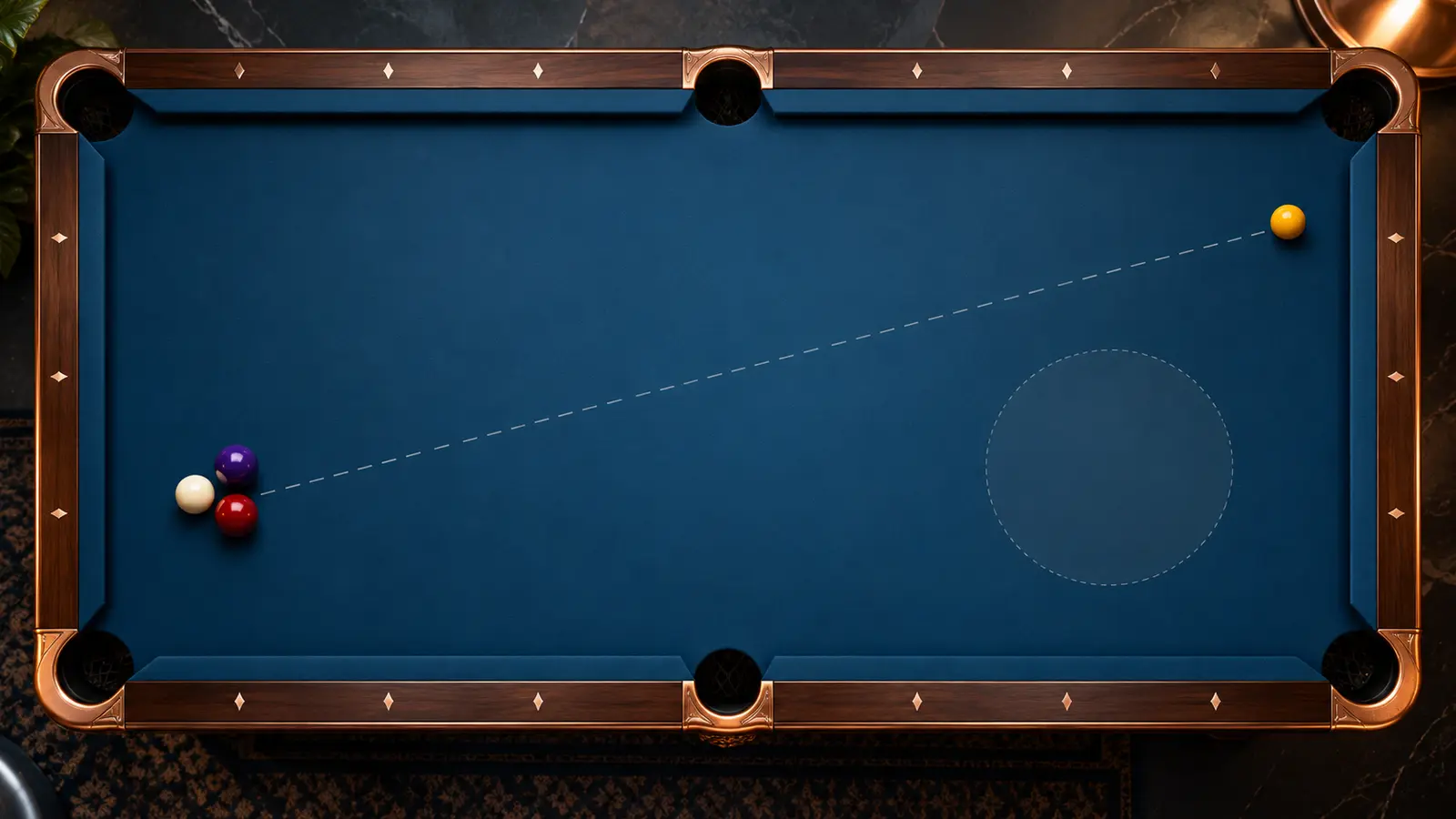
Sending the cue ball and object ball toward opposite ends of the table can be effective even without a full snooker. Distance narrows speed tolerance and makes the next player's cueing less comfortable.
Start with center-ball or a small amount of natural running spin. Heavy sidespin is valuable only when it creates a larger landing zone than the simpler route.
Check the return shot
Walk to the opponent's side of the table before committing. Look for direct pockets, easy containing safeties and natural kicks. A safety that looks hidden from your chair may offer a simple escape from the other angle.
Current WPA rules differ by game, so confirm the legal first contact, rail requirement, call-shot procedure and consequence of a foul for the format you are playing.
Practice the result, not the story
- Place one legal object ball near the center of the table.
- Add two blocker balls and define a hand-sized cue-ball target.
- Score one point for legal contact and one for the target.
- Add a third point only when the direct path is fully blocked.
- Move the layout after five attempts so the drill stays perceptual.
- Track scratches and easy return shots as failures.
Sources and further reading
References support the specific factual information above. The practical checklists are Ariakon editorial guidance.