
Practice · 3 min read
Build Pool Pocketing Confidence With Short Shot Practice
Confidence is more useful when it points to evidence: a shot you have practiced, a routine you can repeat and a score you can describe honestly. Short shots reduce the size of the task so you can collect that evidence without pretending the pocket is larger than it is. The purpose is not to avoid hard shots forever; it is to establish a stable base and lengthen it deliberately.
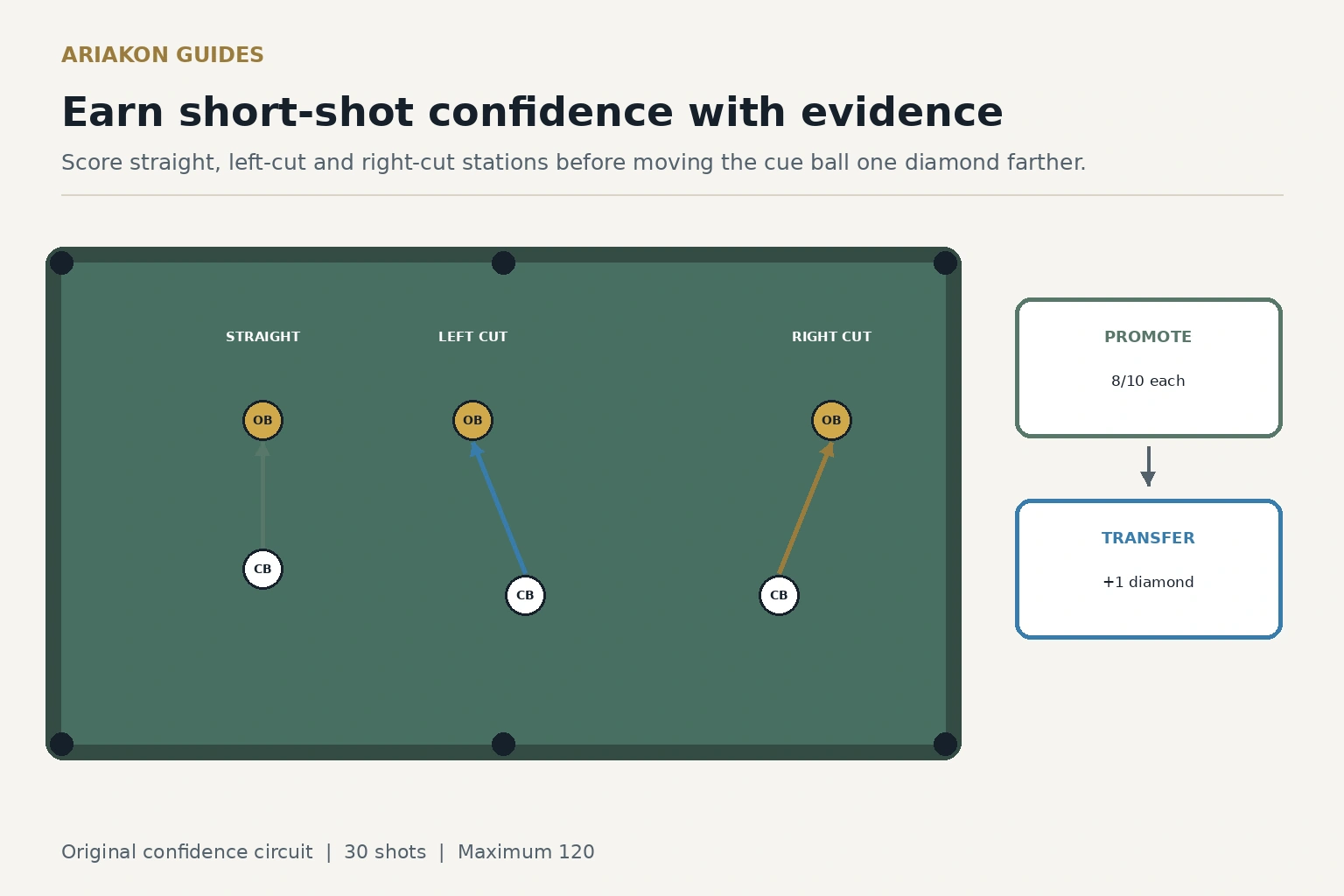
Build three short stations
Station 1 is straight: object ball one diamond from a corner and cue ball one diamond behind it. Stations 2 and 3 use the same object-ball distance with comfortable left and right cuts of roughly a half-ball hit. Mark all centers, call the pocket and use center-ball speed that leaves the cue ball controlled. Remove loose markers before shooting.
Use the same standing plan, approach and final pause at all three stations. A make with a rushed routine is not the evidence this exercise is meant to collect. A miss with the complete routine stays in the denominator and gives a specific next observation.
Build cue-delivery confidence from center ball if short shots curve or miss both sides.
Use practice evidence to build confidence for converting records into a match cue.
Score a thirty-shot confidence circuit
Shoot five straight, five left and five right, then repeat the circuit in a shuffled order. This provides a blocked half and a selection half. Promotion requires at least eight makes at each station, at least twenty-five complete routines and no more than two uncontrolled cue-ball finishes overall. Keep the threshold fixed before starting.
| Point | Requirement |
|---|---|
| 1 | Pocket called before approach |
| 1 | Object ball pocketed |
| 1 | Cue-ball center finishes inside a two-ball-wide control zone |
| 1 | Routine completed or player stood up and restarted |
| Maximum 120 | 30 attempts; record miss side and routine break |
Turn the score into a truthful confidence statement
Do not replace the denominator with ‘I made most of them’ or convert one clean session into a promise under every condition. Table, pressure and layout differ. The statement is useful precisely because it names the practiced situation and the remaining limit.
| Part | Example |
|---|---|
| Situation | Short center-ball shots to a corner |
| Evidence | 26 makes from 30; 28 complete routines |
| Limit | Right cut missed twice to the near jaw |
| Match cue | See line, settle cue, finish still |
| Next action | One right-cut block, then transfer distance |
Worked example: confidence follows the weak station
A player scores 112 of 120 with makes of 10 straight, 9 left and 7 right. Routine completion is 29, but the right cut fails the promotion rule and all three misses hit the near jaw. The player does not repeat the easy straight shot to inflate the total. The next action is eight right-cut attempts with the same marks, checking the standing contact picture.
The follow-up right-cut block makes seven of eight with complete routines. The player now repeats the full circuit on a later day. Promotion depends on that full denominator, not the repair block alone. This keeps confidence connected to representative evidence rather than a favorite station.
Transfer one variable at a time
After promotion, move the cue ball one diamond farther from each station while keeping the object ball, pocket, contact type and routine unchanged. Shoot eighteen attempts—six per station—and score the same four points. A transfer score of at least 60 of 72 with four makes at each station supports another small distance change. Otherwise return to the last reliable distance.
In a rack, use the match cue from the evidence statement on one ordinary short shot. Do not narrate the score or demand confidence as a feeling. Complete the routine and accept the result. If fear still changes the approach, practice the easy and difficult pictures as matched pairs.
Practice difficult shots without changing your routine for the next pressure-safe progression.