
Stroke fundamentals · 4 min read
Build Cue Delivery Confidence With a Center Ball Baseline
Confidence is not measured by how forcefully a player commits to a doubtful line. A useful cue-delivery baseline is observable: center-ball contact, a stable setup, a straight cue path and a signed result. This thirty-shot progression starts without an object ball, adds a straight stop shot and finishes with small cuts. The score informs the next practice action; it does not diagnose a person or promise a match outcome.
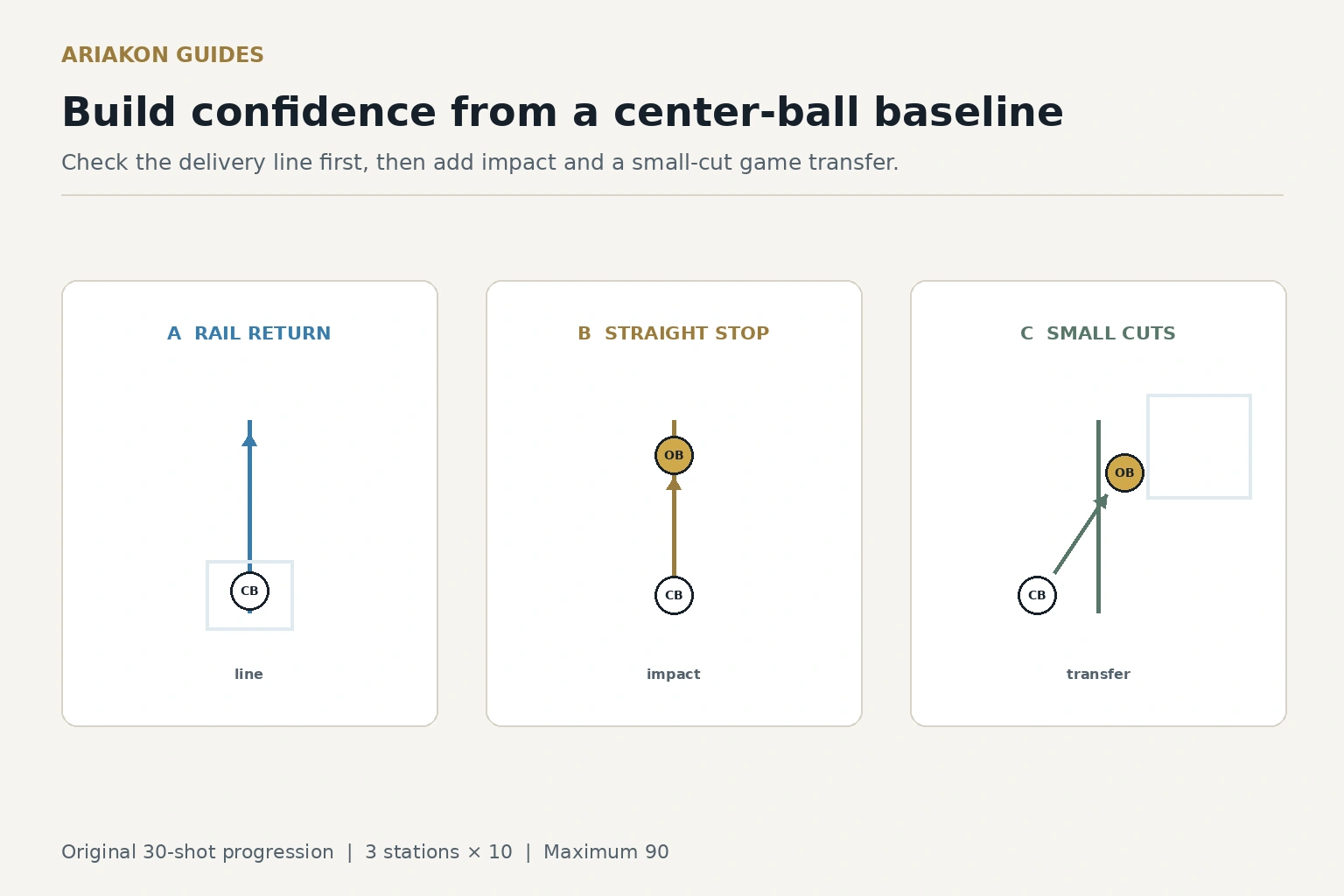
Mark the actual center-ball line
Use a striped cue ball with the stripe vertical if available. From the foot spot, aim center ball at the center diamond on the head rail and place a removable start gate around the cue-ball center. Chalk a full, even tip; set the tip close enough to see the intended contact point before the final stroke.
Vision-center alignment matters because a physically straight shot must also look straight from the head position. If the target line looks distorted, rebuild while standing rather than steering during delivery.
Review the full stroke process for stance, vision, bridge, grip and tempo foundations.
Run three ten-shot stations
For any straight stop-shot score in this guide, center the finish window on the cue-ball center at object-ball contact: one ball diameter behind the object-ball center on the incoming line. The cue-ball starting position is not the stop destination. Keep the window size fixed before the block.
| Station | Setup | Attempts | Primary evidence |
|---|---|---|---|
| A Rail return | Foot spot to center diamond and back | 10 | Return crosses start gate |
| B Straight stop | Object ball one diamond from corner; cue ball one diamond back | 10 | Pocket plus stop window |
| C Small cuts | Five slight left and five slight right cuts | 10 | Pocket plus called center-ball route |
Score evidence, not certainty
Define the called inner window and a larger near window before the block. Score 3 only for the inner window and 2 only for the larger window outside it; all other legal target contacts use score 1. The two windows must not overlap as scoring categories. Score 0 for a miss of the required first target or a foul.
| Points | Line result | Cue-ball result | Record |
|---|---|---|---|
| 0 | Foul, miscued or wrong target | Any | First failed event |
| 1 | Target contacted or legal object-ball hit | Misses called window | Left/right |
| 2 | Target line or pocket succeeds | Near the called window | Signed finish |
| 3 | Target line or pocket succeeds | Called window succeeds | Clean attempt |
Use one script after a match miss
Between turns, use: ‘Name the fact. Recall the baseline. Choose the next shot.’ The fact is neutral—‘the object ball missed left’—not a character judgment. The baseline is one process cue supported by practice, such as ‘see center, settle, finish.’ The next shot gets a fresh decision instead of a compensating steer.
Do not perform a drill during an opponent's turn or delay the match. The script is a brief seated or standing reset consistent with event etiquette. Use the thirty-shot baseline later in practice to test the observed direction.
Diagnose the first stable pattern
| Pattern | Inspect first | Next block | Avoid |
|---|---|---|---|
| Rail return misses one side | Head alignment and delivery line | Ten rail returns | Aim compensation |
| Rail holds; stop shot misses | Object-ball line and speed | Five closest straight stops | Adding spin |
| Straight holds; cuts miss one side | Cut picture and throw baseline | Five mirrored pairs | Changing stroke cue |
| All results scatter | Setup and tempo | Shorten distance; restore routine | Several changes |
Keep a baseline you can compare
Thirty attempts have a maximum of 90. Keep three station totals out of 30 and record left/right finishes. Repeat on a second day before treating a four-point station change as persistent. These points describe this local progression and must not be converted into an external examination score or playing rating.
A worked log might show A 26, B 24 and C 17, with four right-side misses on left cuts. The next action is five mirrored cut pairs using the same center-ball delivery, not a wholesale stroke change. Re-run Station C after that block and keep the adjustment only if the signed pattern narrows.