
Stroke fundamentals · 3 min read
Build a Relaxed Pool Cue Grip That Stays Stable
A useful pool grip is secure enough that the cue does not wander, but relaxed enough that the forearm can swing without the hand steering the last few inches. The goal is not to copy one finger pattern. It is to find the lightest stable hold that keeps the cue supported through warm-up strokes, contact and finish.
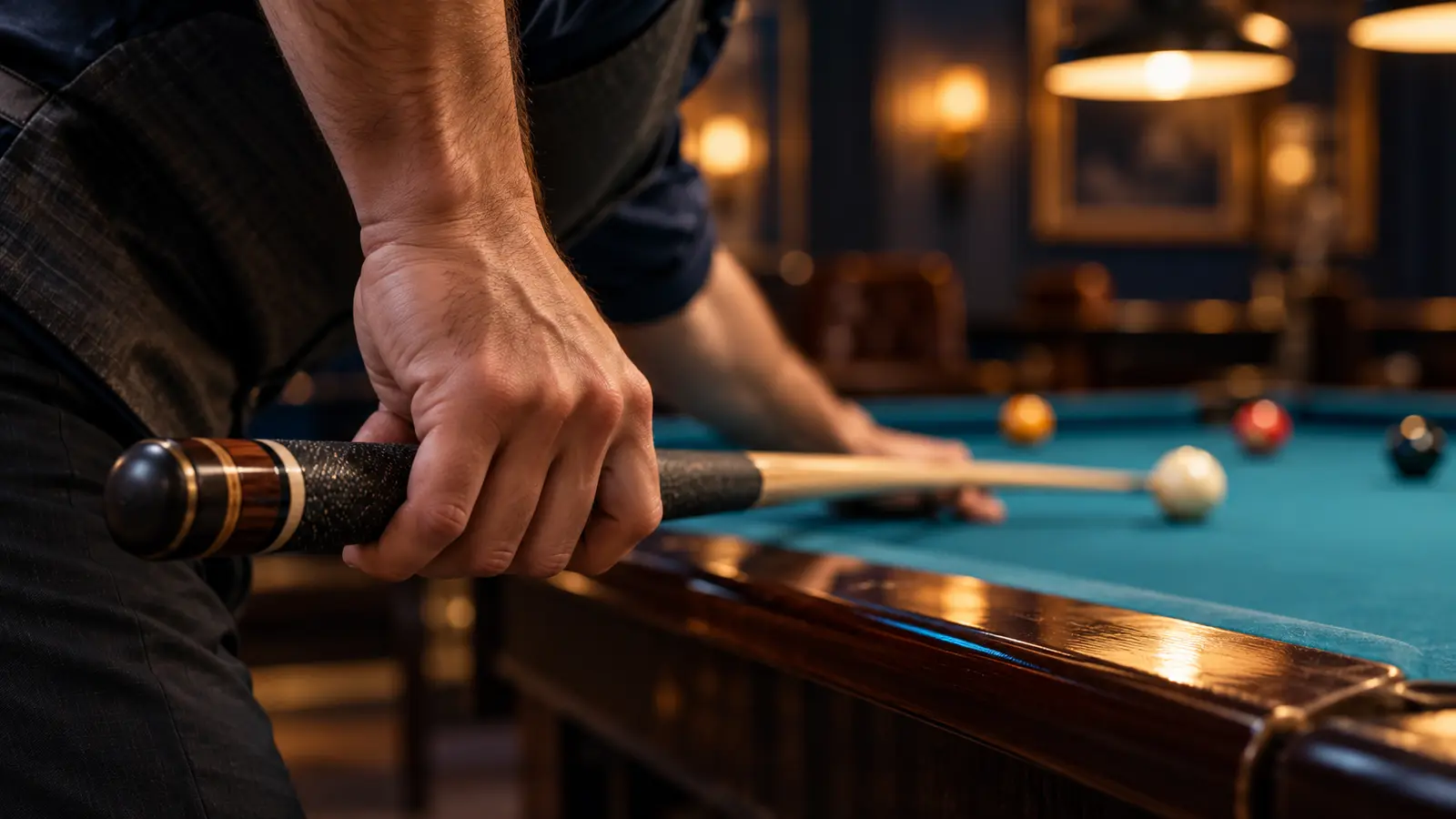
Hold the cue instead of squeezing it
Let the cue rest across the fingers and close the hand only enough to prevent slipping. The thumb can meet the index finger without pinching the wrap or forcing the palm tightly against it.
A death grip tends to recruit the wrist and forearm. An extremely open hand can make the cue shift unpredictably. Start in the middle, then reduce pressure until stability begins to disappear and add back only what is needed.
Place the hand under a hanging forearm
At cue-ball address, the forearm should be able to hang and swing without the elbow chasing the cue forward. Grip location changes with stance, bridge length and cue balance, so use the position that lets the forearm approach vertical near contact without crowding the body.
If the butt hits the ribs or the wrist bends sharply sideways, rebuild the stance before changing finger pressure. A grip cannot correct a body position that blocks the stroke path.
Let the fingers respond to the swing
During the backswing, the cue may settle slightly deeper into the fingers. During the forward swing, the fingers can close naturally as long as they do not snap the butt off line.
Do not force every knuckle to remain frozen. Judge the grip by cue direction, tip contact and repeatability rather than by whether the hand looks identical in every video frame.
Test pressure at three speeds
Shoot a straight stop shot softly, at normal pocket speed and firmly. Keep the same setup and note whether firmer speed makes the hand tighten before contact or the tip finish to one side.
If speed changes the delivery, shorten the shot and rebuild. The correction may be less hand pressure, a shorter backswing or a more stable stance—not an attempt to hold the cue even tighter.
For any straight stop-shot score in this guide, center the finish window on the cue-ball center at object-ball contact: one ball diameter behind the object-ball center on the incoming line. The cue-ball starting position is not the stop destination. Keep the window size fixed before the block.
Use feedback you can see
Place a removable paper reinforcement ring as the cue-ball target and check where the cue ball finishes after a straight shot. Slow-motion video from behind the cue can reveal a wrist twist or grip squeeze that is hard to feel.
Change one feature at a time and use sets of five. A comfortable grip that repeats over several days is more valuable than a dramatic change that works for two shots.
Run a grip-pressure ladder
- Shoot five soft straight shots with a light stable hold.
- Shoot five at normal pocket speed without adding pressure.
- Shoot five firm stop shots while keeping the wrist quiet.
- Record cue-ball finish and any visible tip drift.
- Reduce speed if the hand starts steering.
- Keep the lightest pressure that stays stable in all three sets.