
Mental game · 4 min read
Practice Difficult Pool Shots Without Letting Fear Change Your Routine
A difficult shot can change behavior before it changes the result: extra warm-up strokes, a rushed pause, a new aim decision while down, or standing up late. This matched test compares an easy and difficult version of one shot while scoring the same four routine checkpoints. The goal is not to remove normal nerves. It is to notice whether perceived difficulty changes the process you chose to trust.
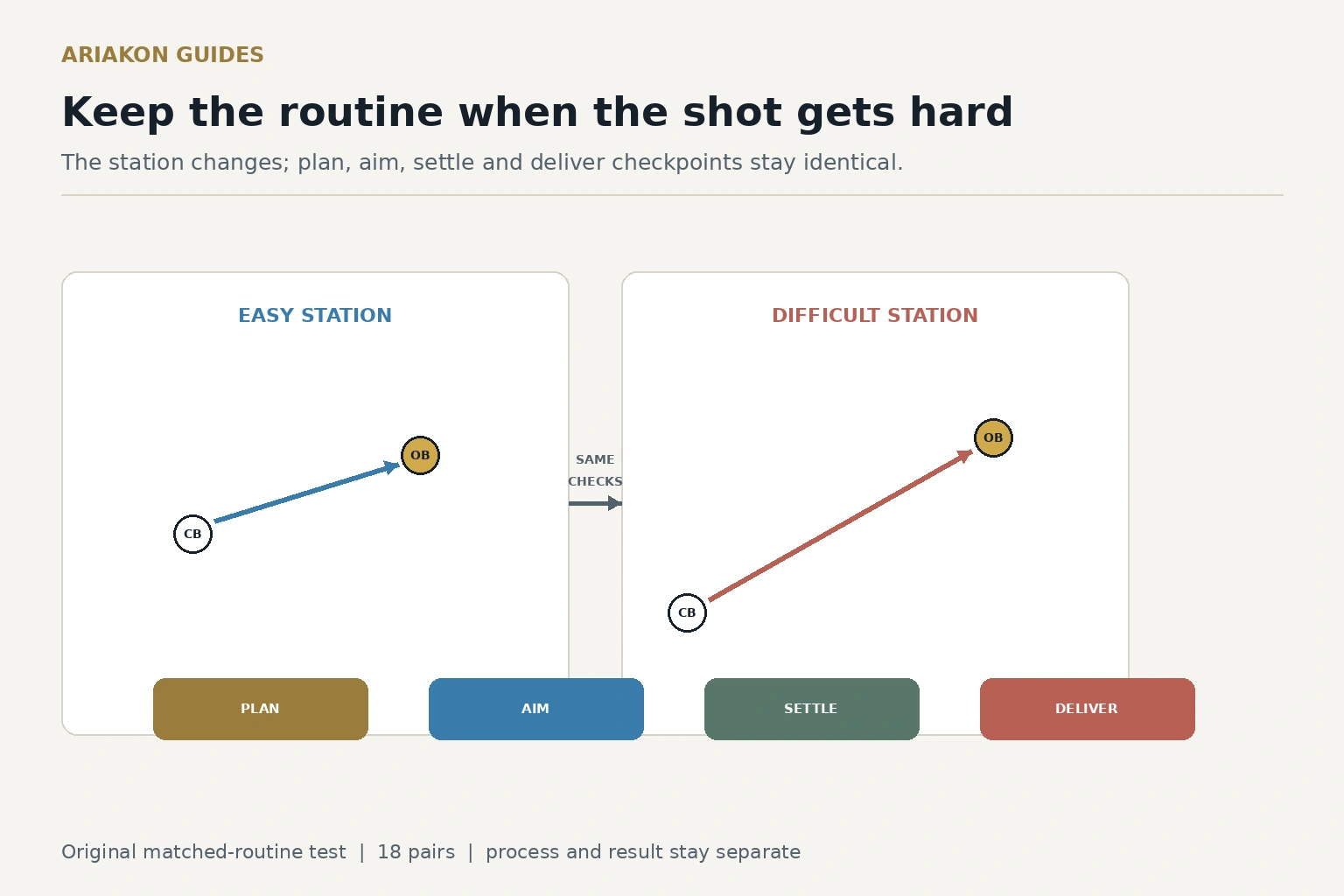
Write a four-checkpoint routine you can observe
| Checkpoint | Observable action | Fail signal |
|---|---|---|
| Plan | Name pocket, cue-ball action and speed while standing | Decision changes after stance begins |
| Aim | Set the chosen line before the final settle | Repeated search or steering while down |
| Settle | One normal pause or still point | Rush or unusually long freeze |
| Deliver | Commit or stand up before the forward stroke | Half-commitment, jab or late steering |
Build the routine before testing pressure if the four checkpoints are not yet defined.
Use the broader composure plan for breathing, between-shot recovery and match context beyond one difficult shot.
Build an easy and difficult station from one shot
Choose one cut to a corner pocket. Station E uses a cue-ball position where you normally expect to make the shot. Station D moves the cue ball one diamond farther away or makes the cut one step thinner—but not both. The object ball and called pocket remain fixed. Mark both cue-ball positions.
Difficulty is personal and session-specific. During four unscored calibration shots, adjust Station D so it demands attention but remains safe and plausibly makeable. Do not label a percentage or borrow another player's definition of hard.
Shoot eighteen matched pairs
Each pair contains two independent shots. Replace the balls, step away from the table and begin the routine from standing. Do not shoot the difficult station again immediately after a miss; that would turn the test into blocked correction practice.
| Round | Pairs | Order | Reset |
|---|---|---|---|
| 1 | 6 | Easy then difficult | Walk away between every shot |
| 2 | 6 | Difficult then easy | Reverse order to reduce sequence bias |
| 3 | 6 | Coin or card selects station | Call station before approaching |
Score process and result in different columns
Also mark the first changed checkpoint—plan, aim, settle or deliver—when a process point is lost. The made ball never restores a missing process point, and a missed ball never removes a completed routine point.
| Points | Requirement |
|---|---|
| 0–4 | One point for each completed routine checkpoint |
| 0–1 | One point for pocketing the called ball legally |
| Maximum 90 per station | Eighteen attempts; process maximum 72, result maximum 18 |
Use a reset rule before the next shot
If the plan changes while down, tension spikes, vision becomes unclear or commitment disappears, stand up before the forward stroke when rules and time allow. Step back, take one normal breath, restate the plan and restart once. The reset is a safety valve, not an unlimited delay tactic; comply with the event's shot clock and referee instructions.
After the shot, use a neutral note: checkpoint changed, result made or missed, next routine begins. Do not diagnose character, courage or future performance from one result.
Read the matched evidence
Worked example: Easy process scores 67 of 72 with 14 makes. Difficult process scores 54 with 8 makes; ten lost points occur at settle. The next session keeps the same geometry and uses six matched pairs with one familiar pause cue. It does not add a new aiming system or promise that fear will disappear.
| Pattern | Interpretation | Next block |
|---|---|---|
| Process scores match; difficult results fall | Routine survives; execution challenge remains | Practice the difficult geometry normally |
| Difficult process loses aim points | Difficulty changes visual commitment | Six pairs with the same standing aim call |
| Difficult process loses settle points | Tempo changes under perceived difficulty | Six pairs with one familiar pause cue |
| Both stations lose process points | Routine is not stable yet | Return to easy station only |
| Scores vary by order | Sequence may influence behavior | Repeat with randomized order another day |
Transfer the routine without manufacturing pressure
Finish with a race to three against the table using ordinary racks or a simple three-ball pattern. Before each shot, score only the four routine checkpoints; the rack result remains separate. Do not use punishment, money, public embarrassment or unsafe consequences to create pressure. If distress is persistent or extends beyond ordinary sport nerves, seek support from a qualified health professional.