
Mental game · 3 min read
Use Practice Evidence to Build Pool Confidence
Useful confidence is specific. A player may trust a short stop shot and still be uncertain about a thin cut on unfamiliar cloth. Practice evidence cannot guarantee a match result, but it can replace a vague feeling with a relevant record: what was practiced, under what conditions, how it scored and which process held up. This is a performance routine, not mental-health diagnosis or treatment.
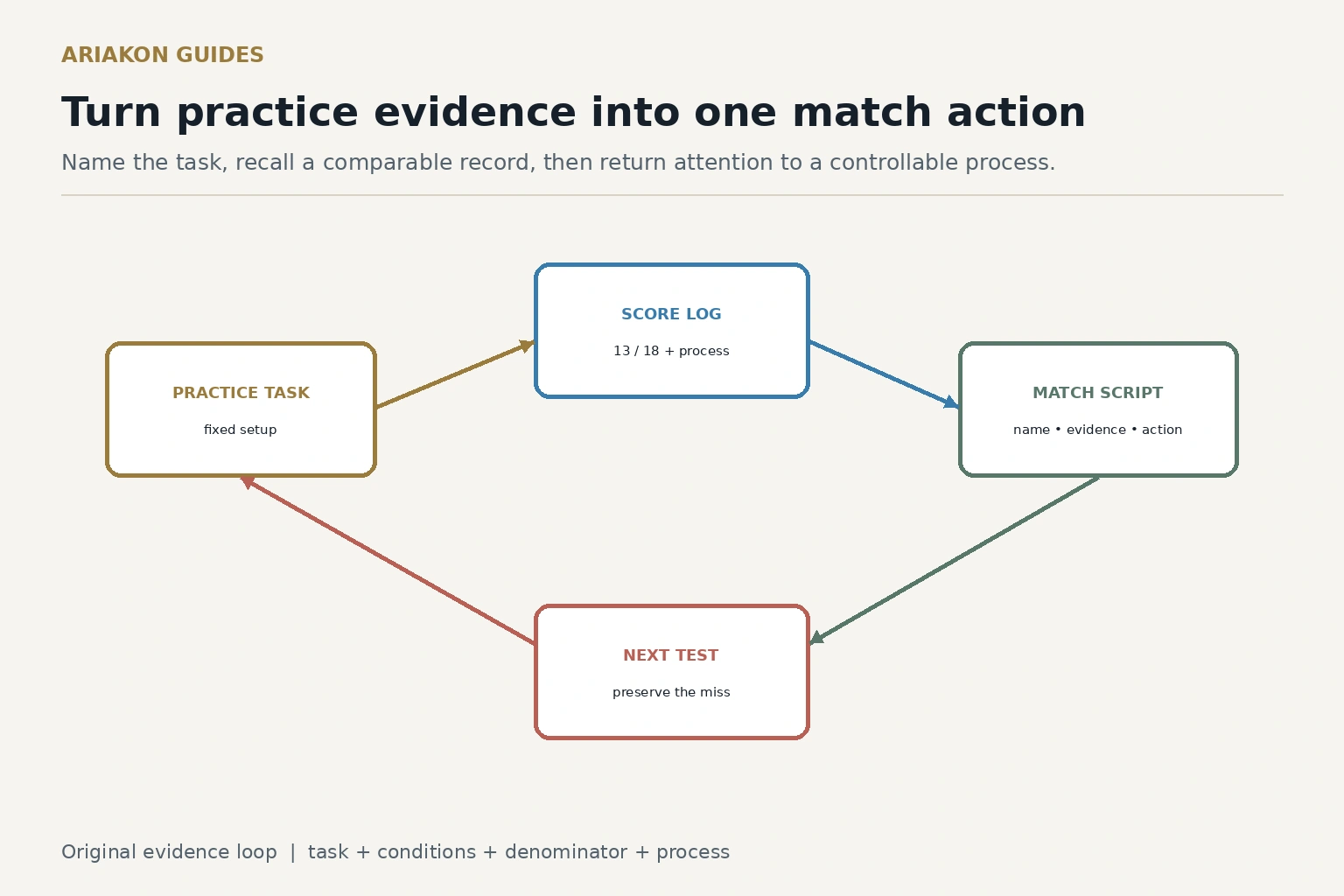
Record evidence that resembles the match task
Keep outcome and process columns separate. A missed ball can still show a complete routine and committed speed; a made ball can hide a rushed decision. Preserve the fixed setup, attempt count and failed attempts instead of recording only best streaks.
| Task | Conditions | Attempts and result | Process evidence |
|---|---|---|---|
| Example: medium cut to corner | Same side; medium room speed; center ball | 18 attempts; 13 pocketed | Routine completed on 16; called speed on 15 |
| Your task | Distance, angle, speed, spin, table | Fixed attempts; observable score | One or two actions you controlled |
Build pool confidence with a three-shot ladder when you need an easier-to-harder scoring structure.
Build calm competitive composure for emotional regulation and next-shot attention.
Write a three-line evidence script
Use the evidence as orientation, not prediction. Avoid I always make this, I cannot miss or I am a confident player. Those statements are easy to contradict and add pressure. The script should take only a few seconds while standing and end with one controllable action.
| Line | Prompt | Example |
|---|---|---|
| Name | What is the present task? | Medium cut, center ball, one-rail route |
| Evidence | What comparable practice fact is relevant? | I pocketed 13 of 18 and completed the routine on 16 |
| Action | What happens now? | See the line, call medium speed, finish the stroke |
Practice the script in a concrete match simulation
Set a medium cut to a corner with a one-rail cue-ball route into a broad position zone. Mark the starts. Shoot three blocks of six: silent baseline, evidence script before every attempt, then randomize between the original shot and a slightly longer version. Score one point for the pocket, one for the position zone and one for completing the named process. Maximum fifty-four.
Before the session, write the prior evidence you will use. After each block, record score and whether the evidence truly matched the task. If the longer version changes the angle or speed enough that the old record no longer applies, say new task and rely only on the action line. Honest limits make the script more credible.
Worked match scenario
At hill–hill, the player faces the familiar medium cut after missing a thin ball in the previous rack. The first thought is I am losing the line. the player stays standing and uses the card: medium cut, center ball, one rail; thirteen of eighteen in the recorded station, routine sixteen of eighteen; see the line, call medium, finish. The script does not erase the previous miss or guarantee this shot. It directs attention to evidence that actually matches.
the player completes the routine but misses thick. After the match, the log gains one match attempt, not an invented success. Video or observation shows the called speed was delivered but the stance entered across the line. The next practice action is six approach-and-reset rehearsals before another eighteen-shot block.
Audit confidence claims once a week
If confidence concerns are persistent, severe or extend beyond ordinary performance uncertainty, this drill is not a substitute for qualified care. Its purpose is narrow: connect recorded pool practice to a repeatable next-shot process.
| Question | Keep or revise |
|---|---|
| Is the denominator present? | Keep only records such as 13 of 18, not made a bunch |
| Does the setup resemble the match task? | Label distant or different tasks as indirect |
| Are misses and failed routines preserved? | Reject highlight-only records |
| Is the sample recent enough for current conditions? | Retest after equipment, table or technique changes |
| Does the script end in one action? | Shorten any motivational speech that delays the shot |