
Strategy · 4 min read
Build a Two Way Pool Shot With a Planned Miss Side
A two-way shot is not a hopeful pot with a safety story added afterward. The player commits to a legal offensive route, identifies the most useful realistic miss and chooses speed that leaves a difficult reply without ruining the make. The broad two-way strategy guide explains when the idea is valuable; this drill teaches how to build and score one planned miss side.
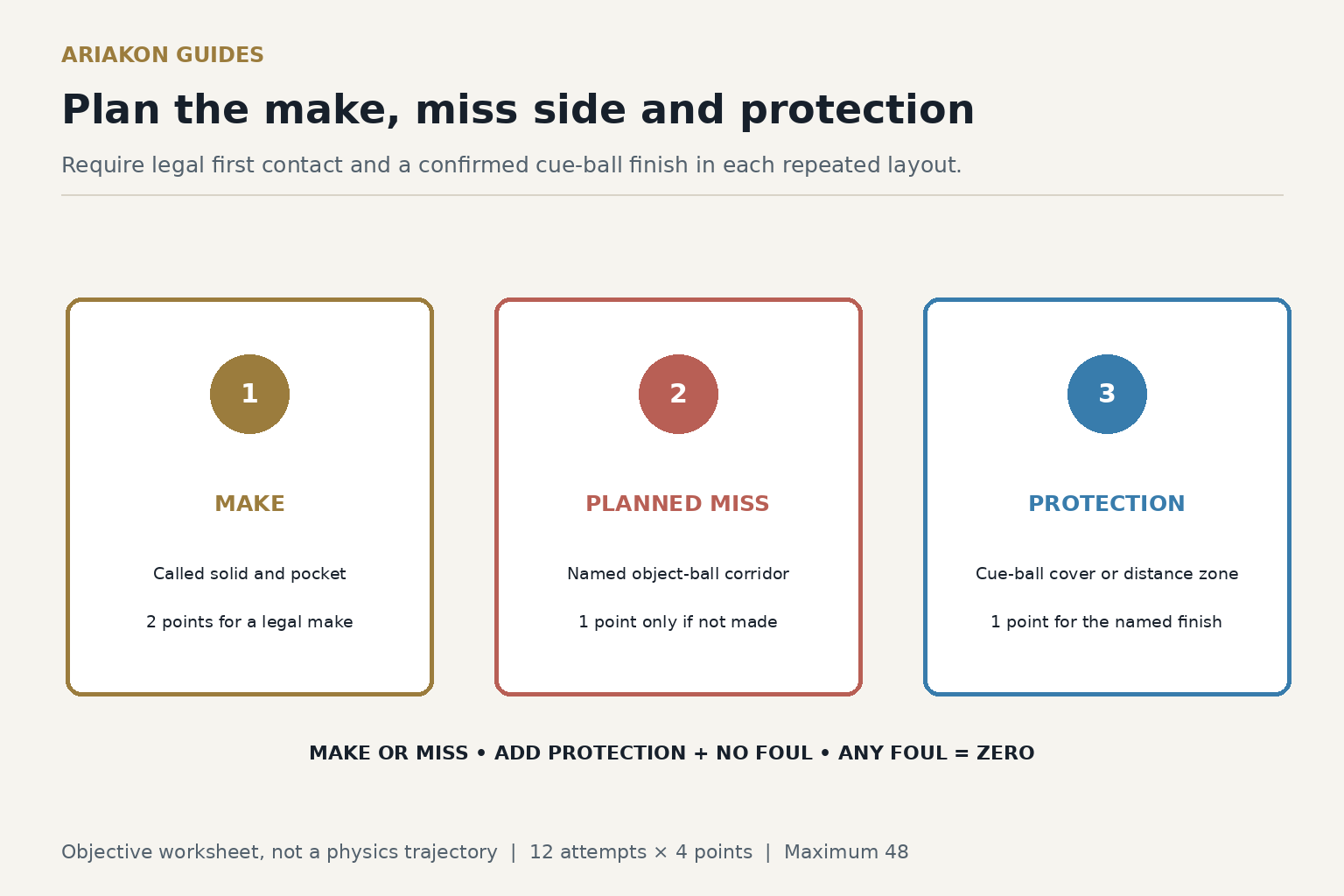
Name three routes before getting down
Check the rules of the actual game before using a two-way idea. WPA rules distinguish called-shot requirements and safety declarations by discipline; a tactically useful leave never excuses a foul or an incorrectly called shot.
Plan from the most common error, not the prettiest diagram. If your usual miss is thick, design protection around that thick-side corridor. A miss on the opposite side is recorded as unplanned even when the opponent is fortunate enough to be safe.
| Route | Question | Observable answer |
|---|---|---|
| Make route | Which pocket and object-ball line? | Called corner pocket through the near half |
| Miss route | Which miss is acceptable? | Object ball finishes on the long rail beyond the side pocket |
| Cue-ball route | Where does protection come from? | Cue ball reaches the blocker or long-distance zone |
| Failure route | What loses immediately? | Scratch, open short-side miss or easy return |
Review broad two-way shot strategy before isolating a planned miss side.
Practice three-part safety control when protection matters more than the pot.
Mark one repeatable table layout
Use an eight-ball practice layout with the shooter assigned the target solid; the blocker is an opponent stripe, and any remaining required balls are tracked. Place the target one diamond from a corner and one diamond off the long rail, with the cue ball roughly two diamonds away on a moderate cut. Position the blocker near center only after testing a legal first-contact route into the desired cover area. Do not assume a drawn line proves the cue ball can reach cover. If no controllable make-and-cover option exists, select a different layout before marking and scoring it.
Define a safe-side corridor along the long rail from the side pocket to the far corner and a cue-ball cover zone about one diamond wide behind the blocker. Adjust the starting marks if the intended pot is too easy or impossible for your present level; preserve the same marks for the complete set.
Score twelve attempts by outcome
Shoot four attempts at pocket speed, four at a medium speed and four at the slowest speed that still completes the cue-ball route. Record make, miss side, protection and foul separately. Make and planned-miss points are mutually exclusive. A foul scores zero for the entire attempt. The maximum is four per attempt and forty-eight across twelve attempts; component counts matter more than the total.
Keep the make route unchanged during the block. If protection improves only because the pocket line was abandoned, you are practicing a safety, not the intended two-way shot.
| Component | Points | Evidence |
|---|---|---|
| Legal make | 2 | Object ball enters the called pocket |
| Planned miss | 1 | If missed, object ball finishes in the named corridor |
| Protection | 1 | Cue ball reaches cover or the named distance zone |
| No foul | 1 | No scratch, illegal contact or other foul |
| Unplanned miss | 0 for miss component | Wrong side, open return or undefined finish |
| Maximum 48 | 12 × 4 | Legal make 2 OR planned miss 1; plus protection 1 and no foul 1 |
Progress from map to game transfer
Do not force the two-way option in the transfer stage. Award one decision point for correctly rejecting it when the likely miss sells out or when the cue-ball path creates a scratch. Recognition is part of the skill.
| Stage | Attempts | Advance when |
|---|---|---|
| Map | 12 from fixed marks | At least 9 legal contacts and one outcome clearly repeats |
| Mirror | 6 from the opposite side | Miss-side label is updated before every shot |
| Transfer | 6 three-ball situations | Player chooses offense, two-way or safety while standing |
Worked example and next action
A hypothetical block produces five makes, four planned long-rail misses, three wrong-side misses, eight cue-ball zone hits and no fouls. The make line is viable and the protection route is repeatable, but the wrong-side misses remain exposed. The next block keeps the setup and uses one lower speed, rather than moving the blocker to make the score easier.
If the object ball misses both sides without a pattern, return to a simpler cut-shot baseline. If the object-ball corridor is consistent but the cue ball never reaches cover, isolate speed and cue-ball route before calling the shot two-way ready.
Sources and further reading
References support the specific factual information above. The practical checklists are Ariakon editorial guidance.