
Practice · 3 min read
Ask a Pool Instructor a Question They Can Actually Diagnose
An instructor can diagnose more efficiently when the question names one task, reproduces the setup and separates observations from explanations. Build a compact evidence package, ask for the first variable to test and record the assigned experiment. The practical-training guide organizes a week; this worksheet prepares one answerable coaching question.
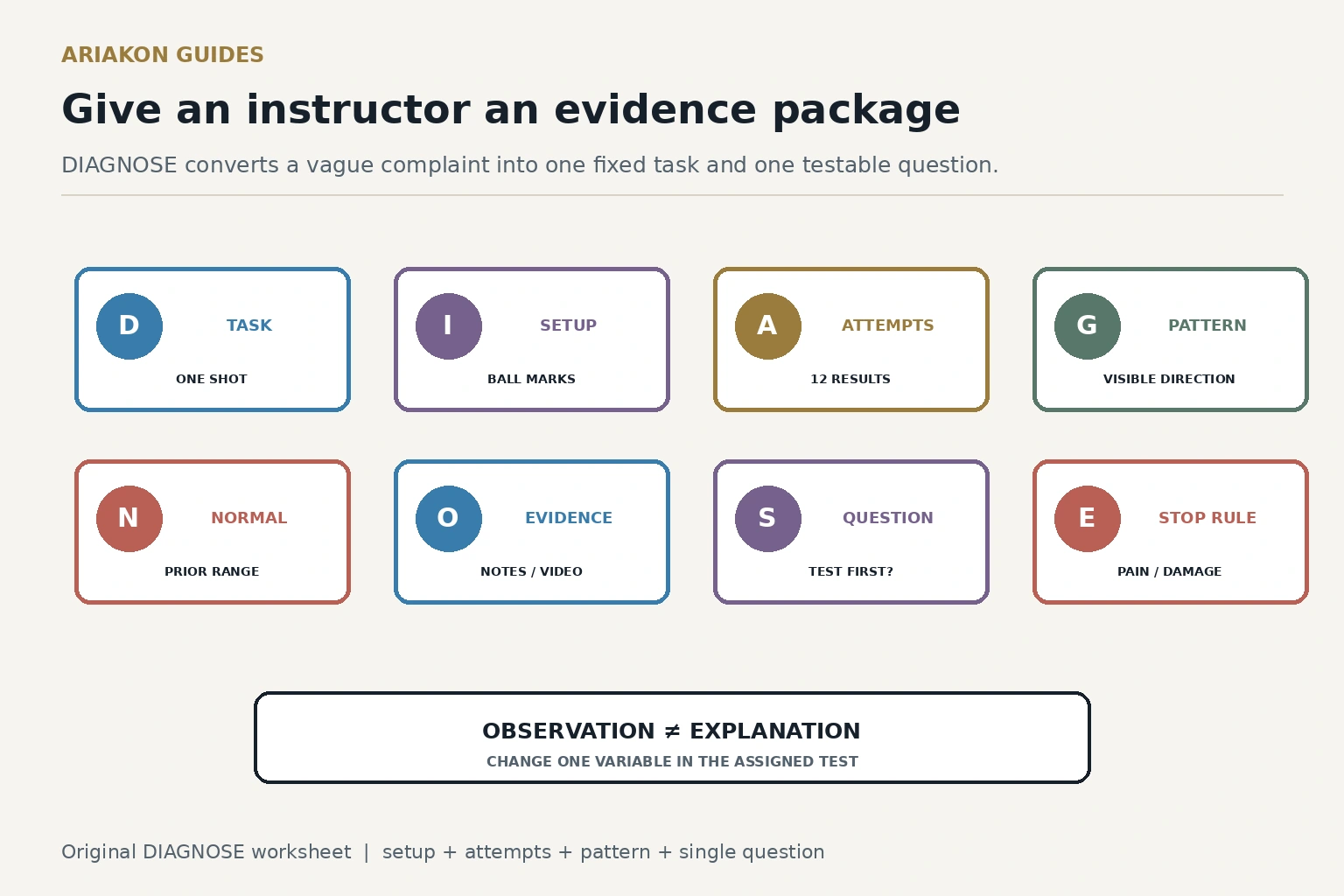
Complete the DIAGNOSE worksheet
| Field | Write | Example |
|---|---|---|
| D — Define task | Game, shot and intended result | Straight stop shot to lower corner |
| I — Identify setup | Ball marks, distance, speed and equipment | Object ball one diamond out; cue ball three diamonds away |
| A — Attempts | Completed trials and score | 12 attempts; 8 legal pockets |
| G — Group pattern | Repeated observable direction | 5 cue balls finish right of line |
| N — Name normal | Matched baseline or prior range | Usually 10/12 on same marks |
| O — Offer evidence | Diagram, notes or consented video | Side and rear clips, normal speed |
| S — Single question | One testable request | Which variable should we test first? |
| E — End condition | Pain, damage or scope limit | Stop for wrist pain or equipment issue |
Build the broader training week after the instructor assigns the priority.
Record useful pool video evidence before sharing a clip.
Collect a twelve-attempt baseline
Choose a shot that is safe and reproducible. Mark the object ball one diamond from a corner and place the cue ball three diamonds away on the same line. Name pocket speed and a cue-ball stop corridor. Warm up, then record twelve attempts without inserting a new mechanical fix after every miss.
Log legal pocket, cue-ball finish direction and whether the ordinary routine was completed. If video is allowed, frame the full cue and relevant body landmarks, ask permission from everyone visible or audible, and follow venue policy. Keep the unedited clips that show the pattern, not only the best and worst shots.
Separate observation from explanation
An observation can support several causes. Let the instructor choose the first test. Pain, numbness, vision change or other health concerns are outside ordinary stroke diagnosis and deserve appropriately qualified help.
| Observation | Premature explanation |
|---|---|
| Five cue balls finish right of the line | My elbow is definitely the cause |
| The miss appears on nine-foot tables but not the home table | I cannot play on large tables |
| The tip makes contact outside the intended center mark on video | I need a tighter grip |
| Three attempts stopped because of wrist pain | I should practice through it |
Worked rewrite: from vague to diagnosable
Vague: ‘Why do I keep missing straight shots?’ Diagnosable: ‘On this marked straight stop shot, I made 8 of 12. On five attempts the cue ball finished right of a two-ball-wide corridor, including three makes. The same right finish appears in the rear video. My usual matched score is 10 of 12. Which one variable would you test first, and what result would support or reject it?’
The instructor assigns a visible finish gate and one delivery cue for a second twelve-attempt block. The player records the same three outcomes. Changing stance, grip, bridge, head position and aiming method together would destroy the comparison.
Close the loop with one assigned experiment
A short block can guide the next test; it cannot establish a universal cause. Take the completed worksheet and raw results back to the instructor.
| Before | During | After |
|---|---|---|
| Write the hypothesis and one changed variable | Run the stated number of attempts | Compare the same components |
| Define the stop condition | Do not add a second cue | Report result without claiming proof |
| Schedule follow-up | Keep setup and evidence | Retain, revise or reject the hypothesis |