
Strategy · 4 min read
A Pool Skills Workbook: Patterns and Match Decision Progressions
A missed runout can begin with a poor choice or with a good choice executed badly. Treating both as 'I missed' makes the next practice block vague. This original workbook scores the table read, route commitment, execution and review separately across four rebuilt layouts.
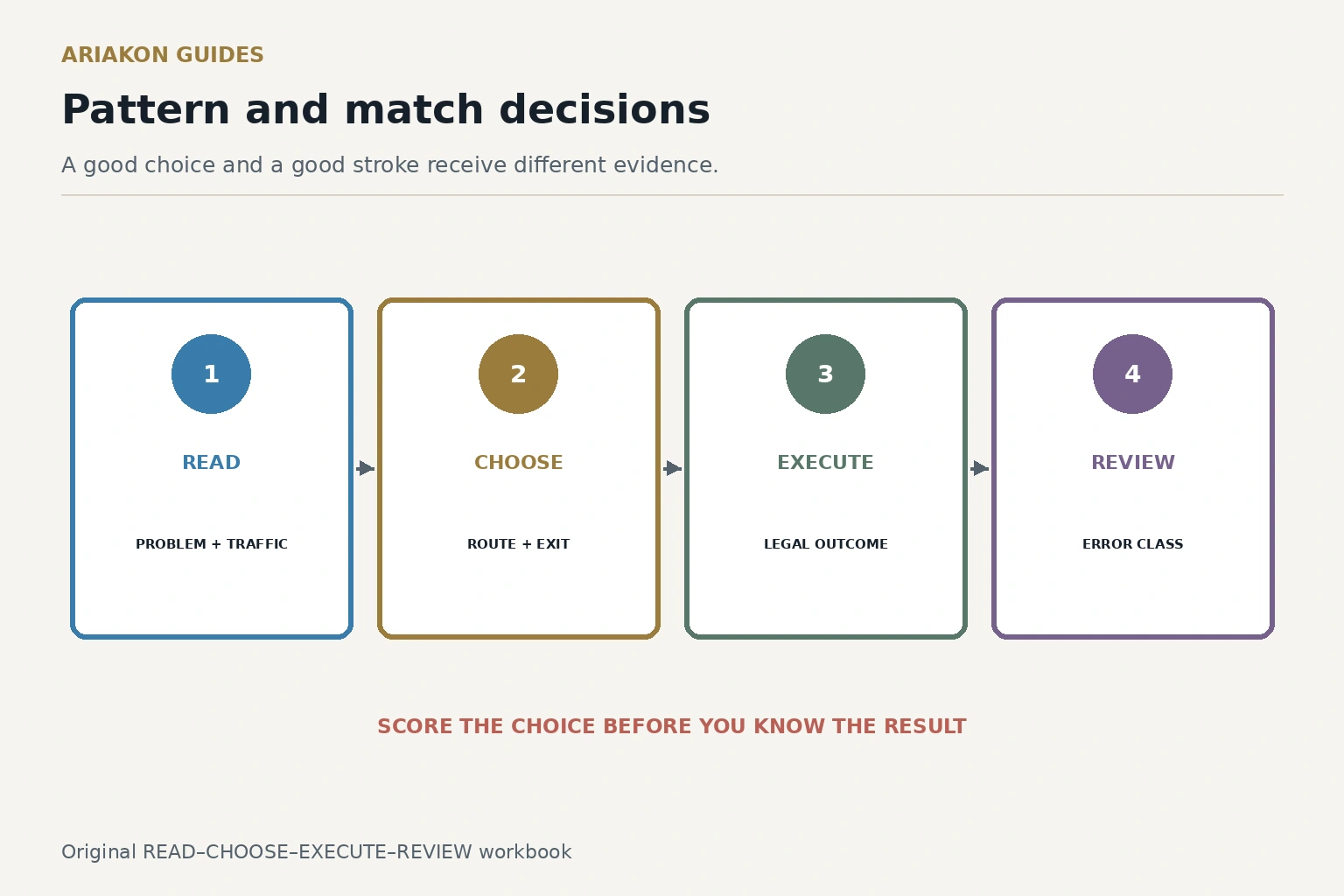
Score the choice before the stroke
The WPA rules govern legal outcomes. This workbook separately records a table read, a prospective route choice, its first stroke and an immediate review. Keep its decision-quality points attached to these layouts; they are not an official competition rating or an external examination score.
Use removable ball-position markers approved for the table, or reconstruct from diamond coordinates on a paper diagram. Do not mark cloth permanently.
| Part | Question | Point |
|---|---|---|
| READ | Did you identify the key problem ball, cue-ball traffic and one credible miss consequence? | 1 before shooting |
| CHOOSE | Did you write one route and one speed plus an exit if position fails? | 1 before shooting |
| EXECUTE | Did you pocket legally or complete the called safety/escape outcome? | 1 after shooting |
| REVIEW | Did you classify the loss as choice, speed, contact, pocketing or rules? | 1 immediately after |
| No rewrite | Do not award READ or CHOOSE after seeing the result | Protects prospective scoring |
| Ruleset | Name the game and current rules before every layout | A legal choice depends on the game |
Use three questions for nine-ball planning as a quick prerequisite for route, angle and miss-side thinking.
Estimate runout risk before committing when the layout offers a safety alternative.
Progress through four rebuilt layouts
Score one designated decision and its first stroke per attempt. Four layouts times five attempts give 20 scored decisions, so each column has20 possible points and the total is 80. Additional continuation shots are unscored. For the recovery layout, pause after an unscored setup stroke, move the cue ball only during this declared practice reset, then score the new decision; never move it during a live rack.
Each attempt is worth four points: READ, CHOOSE, EXECUTE and REVIEW. A legal miss can still earn three points when the read, prospective choice and review are sound. A made ball after an undocumented guess earns only the execution point.
For Layout D, use a real legal starting position under the named game. If a card creates an impossible or illegal state, redraw it; do not bend the rules to preserve the drill.
| Layout | Ball map | Required decision |
|---|---|---|
| A — Three-ball route | Object balls at foot spot, table center and head spot; cue ball one diamond off the long rail beside the foot spot | Choose pocket order, next-ball side and final cue-ball zone |
| B — Blocked route | Keep A; add a blocker halfway between center ball and its easiest pocket | Choose alternate pocket, breakout or safety before shooting |
| C — Recovery | Start A, then intentionally move cue ball one diamond to the wrong side after the first ball | Use the written exit: recover, accept distance or play safe |
| D — Match card | Draw one of five cards: open runout, tied-up ball, no direct shot, ball in hand or one-rack lead | Name rules, score context and offense/safety choice |
Turn the score into a practice decision
Worked example: the player scores READ 18/20, CHOOSE 11/20, EXECUTE 15/20 and REVIEW 19/20. The total is 63/80. Pocketing is not the weakest column. The next session is a no-shooting choice exercise: two candidate routes, one written exit and one commitment on ten layouts.
A strong choice can still fail, and a poor choice can occasionally work. Preserve both facts. Over several sessions, the ledger should reward decisions that remain defensible before the result is known.
| Lowest column | What the evidence says | Next session |
|---|---|---|
| READ | Important constraints were not identified prospectively | Ten layouts with no shooting: mark problem ball, traffic and miss consequence |
| CHOOSE | Reads occurred but no committed route or exit was recorded | Write two candidates, compare, then commit to one |
| EXECUTE | Plan quality exceeded shot completion | Practice the first failed shot outside the layout |
| REVIEW | Results are recorded without a usable error class | Use only choice, speed, contact, pocketing or rules for one session |
| D drops but A–C pass | Match context is changing decisions | Repeat D with a fixed score card and a short reset routine |
| All columns stable | Current layouts no longer discriminate skill | Move one ball half a diamond; retain scoring |
Sources and further reading
References support the specific factual information above. The practical checklists are Ariakon editorial guidance.