
Practice · 3 min read
A Pool Skills Workbook: Cueing and Pocketing Progressions
Improvement becomes actionable when the setup can be rebuilt and the score changes one variable at a time. This four-station workbook progresses from cue delivery to straight pocketing, then fixed cut angles and mixed-distance choice. Its local practice scores do not certify competitive level or convert into an external examination result.
Set up the same practice environment
Local tables differ, so this workbook uses repeatable references rather than assuming one universal pocket geometry. Record the table and pocket with each score.
The progression is an original Ariakon practice resource. It is not an official institutional exam, rating or diploma.
| Control | Exact instruction | Reason |
|---|---|---|
| Reference | Use table diamonds; record a metric measurement if diamonds are unavailable | Rebuild the same distance |
| Use one corner for a full session; mirror the next session | Avoid changing pocket and cut together | |
| Balls | Clean cue ball and one object ball; use removable reinforcement marks | Reduce setup drift without marking cloth |
| Speed | Call soft, medium or firm before each block | Separate speed choice from a reaction to a miss |
| Routine | Stand, choose line and speed, approach, settle, deliver and remain still | Make the process observable |
| Record | Log pocket, cue-ball finish and miss side immediately | Replace memory with evidence |
Use the practical pool training guide to schedule this workbook inside a broader plan.
Measure pocketing by distance and cut angle for a deeper baseline method.
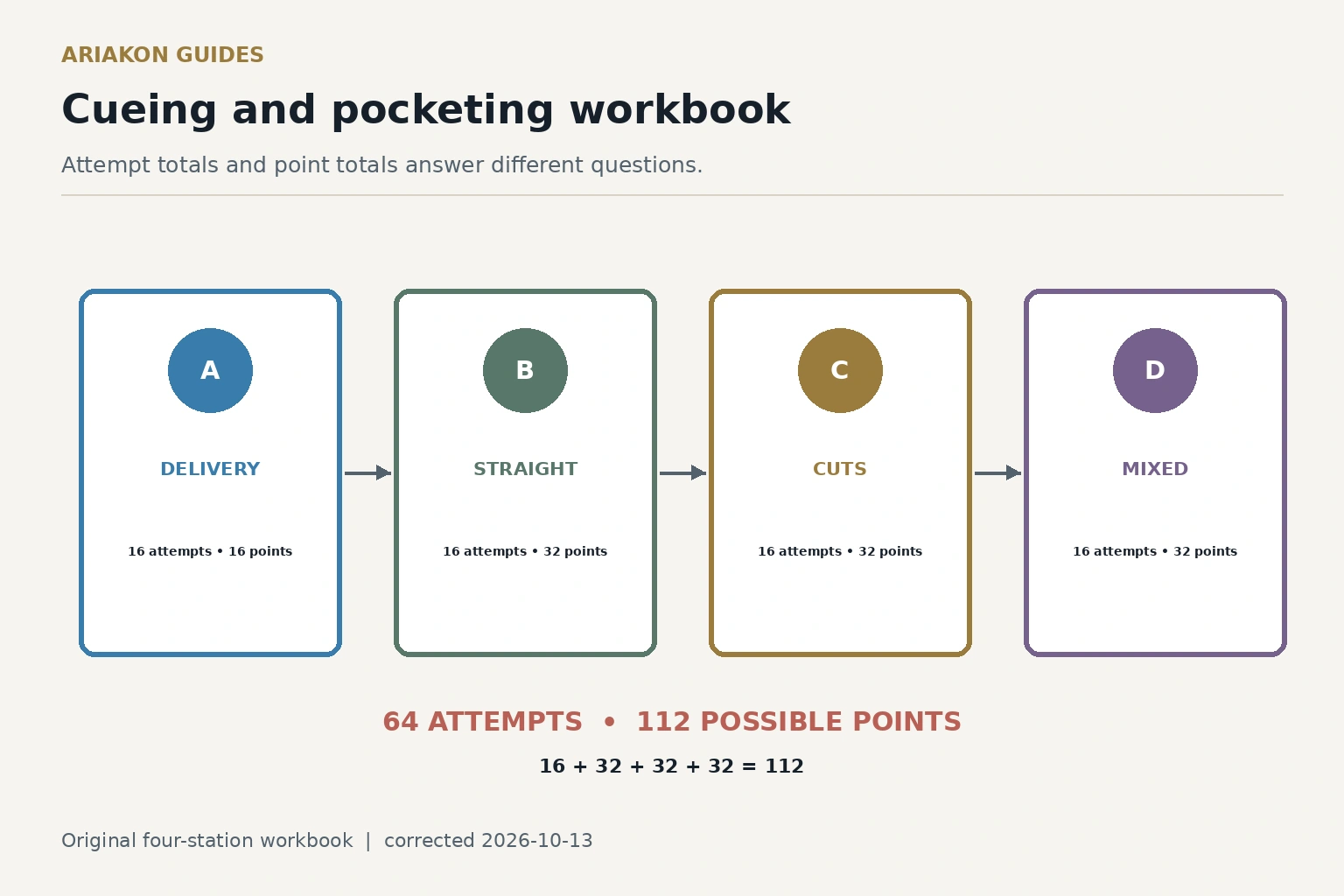
Complete 64 attempts for 112 possible points
Station A has 16 one-point attempts. Stations B, C and D each have 16 two-point attempts. The workbook therefore contains 64 attempts and a maximum of 16 + 32 + 32 + 32 = 112 points.
Define each cut at the object ball between the incoming cue-ball center line and outgoing object-ball center line. Establish rays with a removable guide beside the cloth, then remove it before shooting.
| Station | Exact setup and attempts | Points and graduation |
|---|---|---|
| A — Delivery line | Cue ball on foot spot; roll through a one-ball-wide gate at head spot. 8 soft + 8 medium center-ball strokes | 1 gate point each; /16, graduate at 14 twice |
| B — Straight ladder | Object ball one diamond from a corner on its diagonal; cue ball straight behind at 1, 2, 3 and 4 diamonds. Four shots each | 1 pocket + 1 one-ball-radius stop; /32, graduate at 26 twice |
| C — Cut ladder | Object ball one diamond from a corner; build 15°, 30°, 45° and 60° center-line cuts. Four shots each | 1 pocket + 1 finish in called half; /32, graduate at 24 twice |
| D — Mixed call | Use eight cards: 2 distances × 2 cuts × left/right. Play every card twice in shuffled order | 1 pocket + 1 pre-called zone; /32, graduate at 22 twice |
Diagnose the first failing station
Worked example: the player scores A 15/16, B 27/32, C 19/32 and D 17/32, for 78/112. Delivery and straight distance pass; cut angle is the first failing station. The next session uses twelve mirrored shots at the first failing cut, followed by one unscored mixed block.
Graduate only after a threshold is met in two sessions on different days. Write the date, table, pocket and ball condition beside every score.
| Two-session pattern | Interpretation | Next 12-shot block |
|---|---|---|
| A below 14/16 | Delivery varies before pocketing is tested | Repeat A at soft speed |
| A passes; B drops with distance | Distance-speed routine is unstable | Use only the first failing distance |
| B passes; C misses one side | Setup or systematic contact error is possible | Recheck geometry, then mirror left/right |
| C passes; D falls | Random-order choice costs points | Shuffle the same cards; do not add harder geometry |
| Pocket points pass; position falls | Pocket and position goals need separation | Hold angle; enlarge then shrink the finish zone |
Sources and further reading
References support the specific factual information above. The practical checklists are Ariakon editorial guidance.