
Practice · 3 min read
A Pool Skills Workbook: Cue Ball Speed and Spin Progressions
Cue-ball control improves faster when each station changes one variable and every finish window fits on the real table segment. This workbook uses a 4 × 8 diamond-coordinate model, exact ball centers and a named pocket so the rolling, stun, follow and draw routes can be rebuilt and checked.
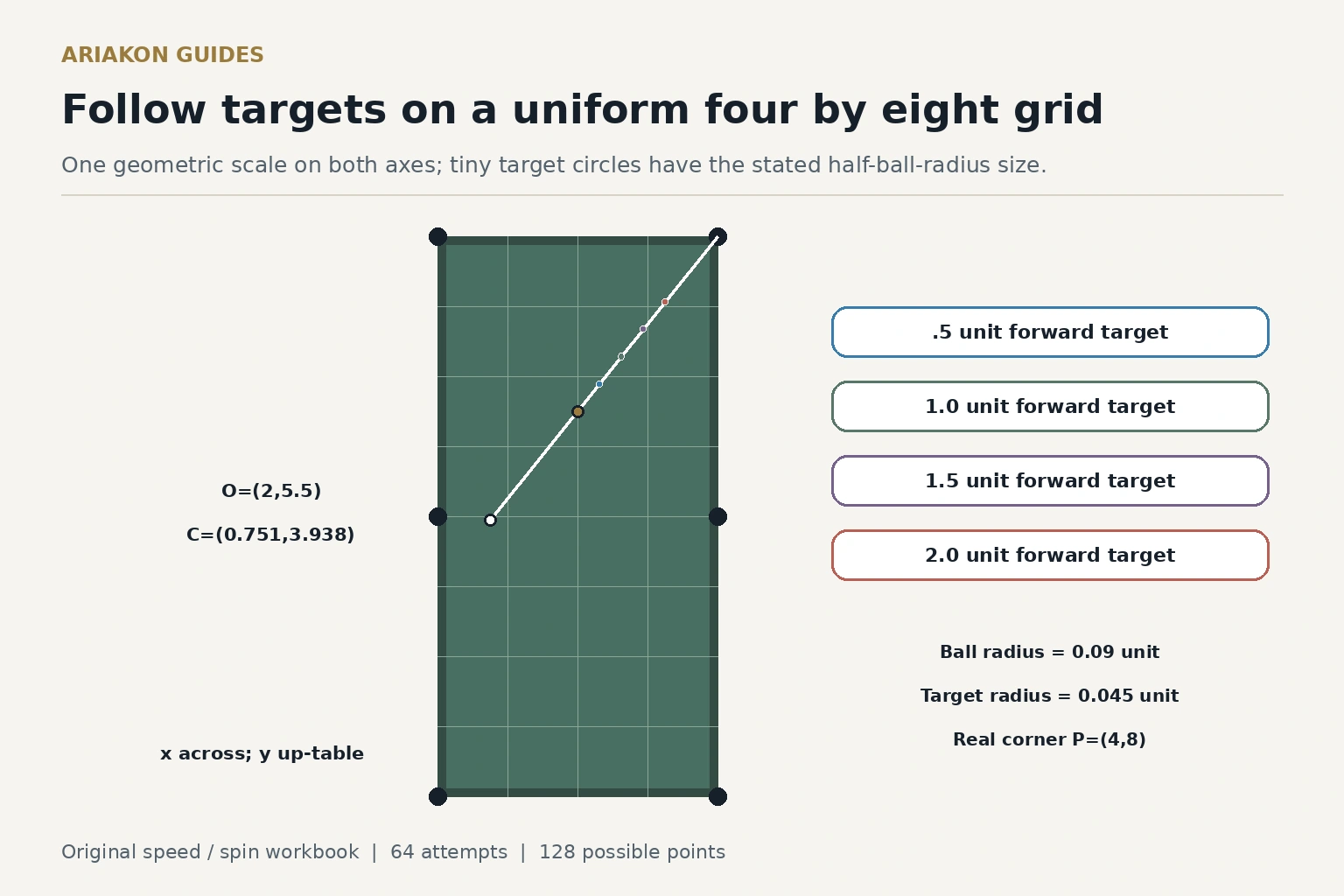
Build one legal reference line
Ball centers, not ball edges, define every coordinate. Use removable marks and confirm that the local side-pocket opening leaves room for the farthest center window; shorten all forward windows together if it does not.
Shoot without sidespin. If the object ball misses the named pocket, record zero for pocket and position even when the cue ball happens to stop in a window.
| Element | Center or boundary | Purpose |
|---|---|---|
| Playing surface | x = 0 to 4 across; y = 0 to 8 from foot to head | One coordinate unit equals one diamond interval |
| Head-right corner | pocket center at (4.000, 8.000) | Real destination pocket |
| Object ball | center at (2.000, 5.500) | Leaves 3.202 diamond units to the pocket |
| Cue ball | center at (0.751, 3.938) | Straight two-diamond approach |
| Shot vector | unit direction u = (0.625, 0.781) | Object ball travels to the named corner |
| Forward targets | (2.312, 5.890), (2.625, 6.281), (2.937, 6.671), (3.249, 7.062) | Centers are 0.5, 1.0, 1.5 and 2.0 units beyond the object-ball center |
Practice cue-ball control with progressive drills for supporting technique.
Use the cueing and pocketing workbook when delivery or pocketing fails before position can be judged.
Score four sixteen-attempt stations
Station A has no collision and isolates delivered rolling speed. Station C uses the pocketing shot, holds the chosen medium-speed routine and changes the forward-rotation result. They do not share a score or infer one skill from the other.
For Stations B and D, measure one ball diameter in local diamond units. The cue-ball impact center is one ball diameter behind the object-ball center along −u. Mark that point; do not substitute the object-ball center, which is occupied before contact.
Use a half-ball-radius target around each called center. When neighboring windows would overlap on the local table, reduce the radius equally; never move a target after seeing the result.
| Station | Four center targets | Attempts and score |
|---|---|---|
| A — Rolling speed | Cue ball only from (0.500, 1.000) through a one-ball gate at y = 2.000 to centers (0.500, 3.000), (0.500, 4.000), (0.500, 5.000), (0.500, 6.000) | Four each; 1 gate + 1 finish inside a half-ball-radius window; /32 |
| B — Stun/stop | Cue-ball starts 1.0, 1.5, 2.0 and 2.5 units behind the object ball on −u; call a stop inside one-ball radius of the measured impact center | Four each; 1 pocket + 1 stop gate; /32 |
| C — Follow | Centers (2.312, 5.890), (2.625, 6.281), (2.937, 6.671), (3.249, 7.062) | Four each; 1 pocket + 1 called forward window; /32 |
| D — Draw | From the measured impact center, call 0.25, 0.50, 0.75 or 1.00 unit back along −u | Four each; 1 pocket + 1 called return window; /32 |
Graduate by station, not by total alone
Worked example: the player scores A 27/32, B 28/32, C 23/32 and D 14/32. Follow is one point below its threshold and draw is the lowest score, but progression starts with the first failing station: twelve attempts at the nearest follow window. Draw remains queued until follow clears.
Record cloth, ball condition, date and miss direction. The result describes this layout on this table; it is not an official playing rating.
| Pattern | Next practice | Do not add |
|---|---|---|
| A below 24/32 | First failing rolling-speed window | Spin |
| A passes; B below 24/32 | Shortest stun window | A steeper cut |
| B passes; C below 24/32 | Nearest follow window | More speed |
| C passes; D below 22/32 | Shortest draw return | Long draw or sidespin |
| All pass twice | Mirror the line or shrink windows | A second variable in the same session |
Sources and further reading
References support the specific factual information above. The practical checklists are Ariakon editorial guidance.