
Strategy · 4 min read
A Pool Skills Workbook: Banks, Kicks and Safety Progressions
A bank asks an object ball to reach a pocket; a kick asks the cue ball to reach an object ball; a safety asks the next player to inherit a worse problem. Mixing all three in one success label hides the skill that failed. This original workbook separates them into four repeatable stations with contact-side notes and route corrections.
Map exact centers and real contacts
For the 100 by 50 inch example bed and2.25inch balls, radius is0.09unit. Reflect P=(0,8) across the object-center cushion line x=3.91 to M=(7.82,8). The line O=(2,3) to M crosses x=3.91 at y=3+5(1.91/5.82)=4.6409. Its unit direction u=(5.82,5)/sqrt(5.82²+5²). Put C=O-1.5u, approximately(0.8622,2.0225), with full-contact center G=O-0.18u. This creates an incoming cue line that actually drives the object toward the bank cushion. The cushion nose is x=4; ball-center contact is x=3.91. Real speed, friction and throw require unscored calibration before marks are frozen.
Before scoring Station D under competition conditions, verify the applicable current rules for legal object-ball contact and cushion requirements.
| Station | Ball centers and named contacts | Successful route |
|---|---|---|
| A: One-cushion corner bank | Object O=(2,3), cue C=(0.8622,2.0225); real pocket P=(0,8); cushion-center line x=3.91 | Reference contact R=(3.91,4.6409), then upper-left corner; confirm actual response in unscored trials |
| B — One-rail kick | Object (3.0, 6.0), cue (1.0, 2.0); cue ball contacts left long cushion at a marked trial point | Cue ball contacts called full or half of object ball |
| C — Two-rail escape | Object (3.0, 6.0), cue (1.0, 2.0); cue ball must contact foot rail then right long rail | Legal object-ball contact after both named cushions |
| D: Safety hide | Use a real permitted blocker ball, a legal first object ball and marked cue/object landing zones from a rehearsed local safety | Legal shot includes required cushion; final blocker actually prevents a direct cue-ball line to the legal response ball |
Learn the diamond system for pool for route vocabulary and measured references.
Plan a pool safety shot for the choice process behind Station D.
Score four defensive stations
Use center ball initially. Rehearse each route before freezing its exact marks and actual blocker placement. A drawn zone cannot block a ball. Choose a legal practice state, such as an eight-ball solids safety with a stripe as blocker, and ensure the first-contact ball belongs to the shooter. Judge visibility with a ball-radius corridor rather than a centerline alone; no straightedge may touch balls. This is a practice measurement, not an in-match aiming aid.
Record pocket/contact and leave separately. A successful bank with a poor leave is different from a miss with the intended cue-ball finish.
| Station | First point | Second point | Graduate twice at |
|---|---|---|---|
| A — Bank | Called pocket | Cue ball in called half-table | 18/24 |
| B — One-rail kick | Legal object contact | Called full/half contact | 18/24 |
| C — Two-rail escape | Both named cushion contacts then legal object contact | Called arrival side | 16/24 |
| D — Safety hide | Legal shot and called object-ball rail | After the legal shot, a real blocker prevents the opponent’s direct line to the legal object ball | 18/24 |
Measure the speed response before choosing a correction
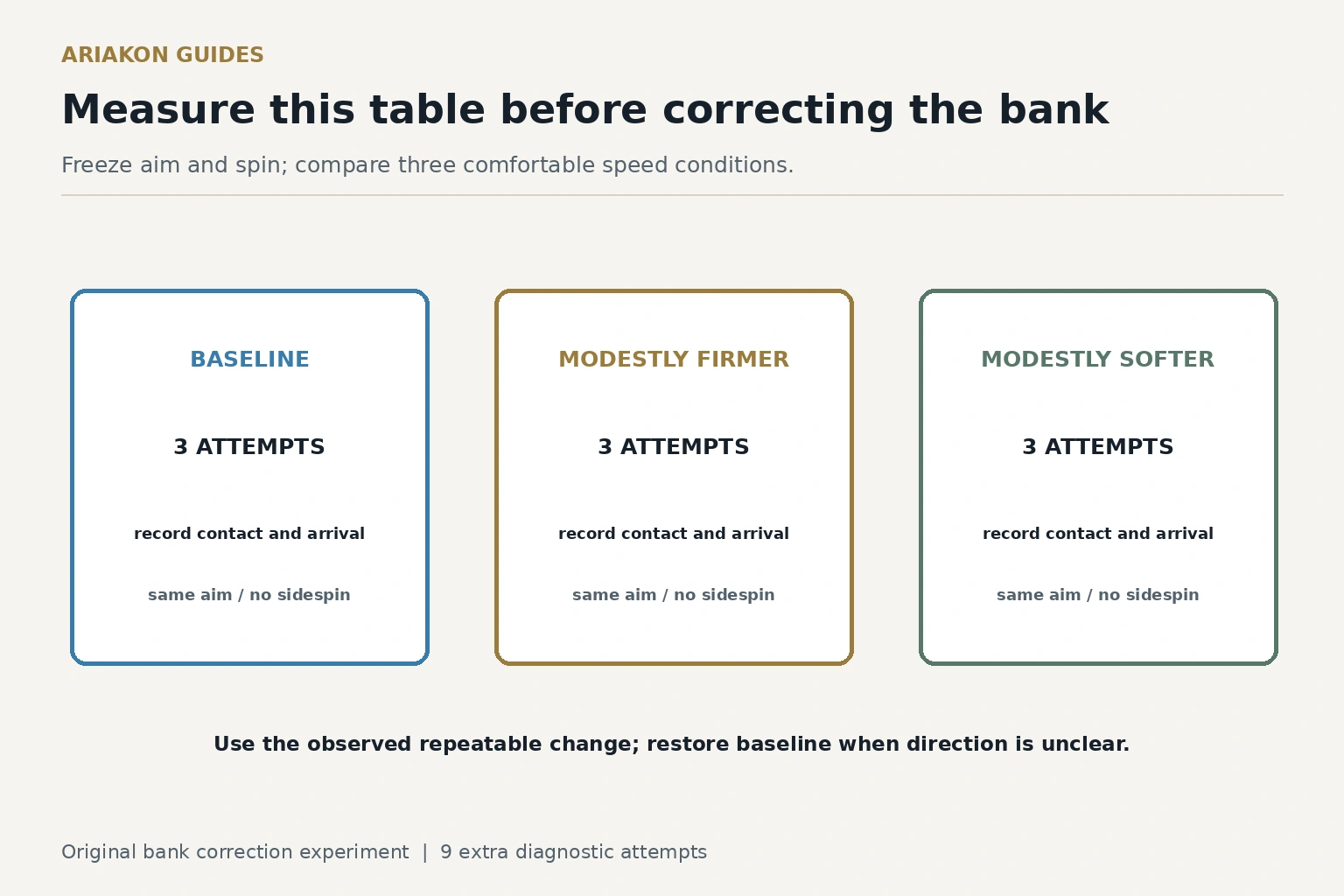
This nine-shot correction comparison is extra diagnostic work, separate from the four twelve-attempt station scores. Cushion response depends on the actual speed, spin, cloth, ball condition and contact. Observe which change moves this bank in the desired direction. If no direction repeats, restore the comfortable baseline and investigate the contact marks rather than escalating speed.
Worked example: the player scores 19/24 on the bank, 14/24 on the one-rail kick, 11/24 on the two-rail escape and 17/24 on the hide. The first failing station is the one-rail kick. The next block is twelve center-ball one-rail attempts with exact cushion-contact and arrival-side notes.
| Repeated result | Usual center-ball baseline | Retest rule |
|---|---|---|
| Bank arrives long | Run three baseline, three modestly firmer and three modestly softer attempts | Keep aim and spin fixed; compare actual contact/pocket-side results |
| Bank arrives short | Use the same nine-attempt speed comparison | Record whether either change improves the arrival, not an assumed direction |
| Result does not move as expected | Restore baseline and move the cushion-contact mark slightly | Log cloth, rail, cut and ball condition |
| Kick misses one side | Move only the recorded cushion-contact point | Hold speed and center-ball hit |
| Safety loses the hide | Enlarge the blocker zone before changing spin | Preserve the same legal contact route |
Sources and further reading
References support the specific factual information above. The practical checklists are Ariakon editorial guidance.