
Fundamentals · 3 min read
Verify Pool Fundamentals With a Maintenance Session
Fundamentals need periodic verification, not constant reinvention. A maintenance session asks whether your stance, bridge, cue path, contact, stop control and routine still produce observable results in simple layouts. Keep the geometry easy enough that one failing component is visible, then change only the station that earns evidence for change.
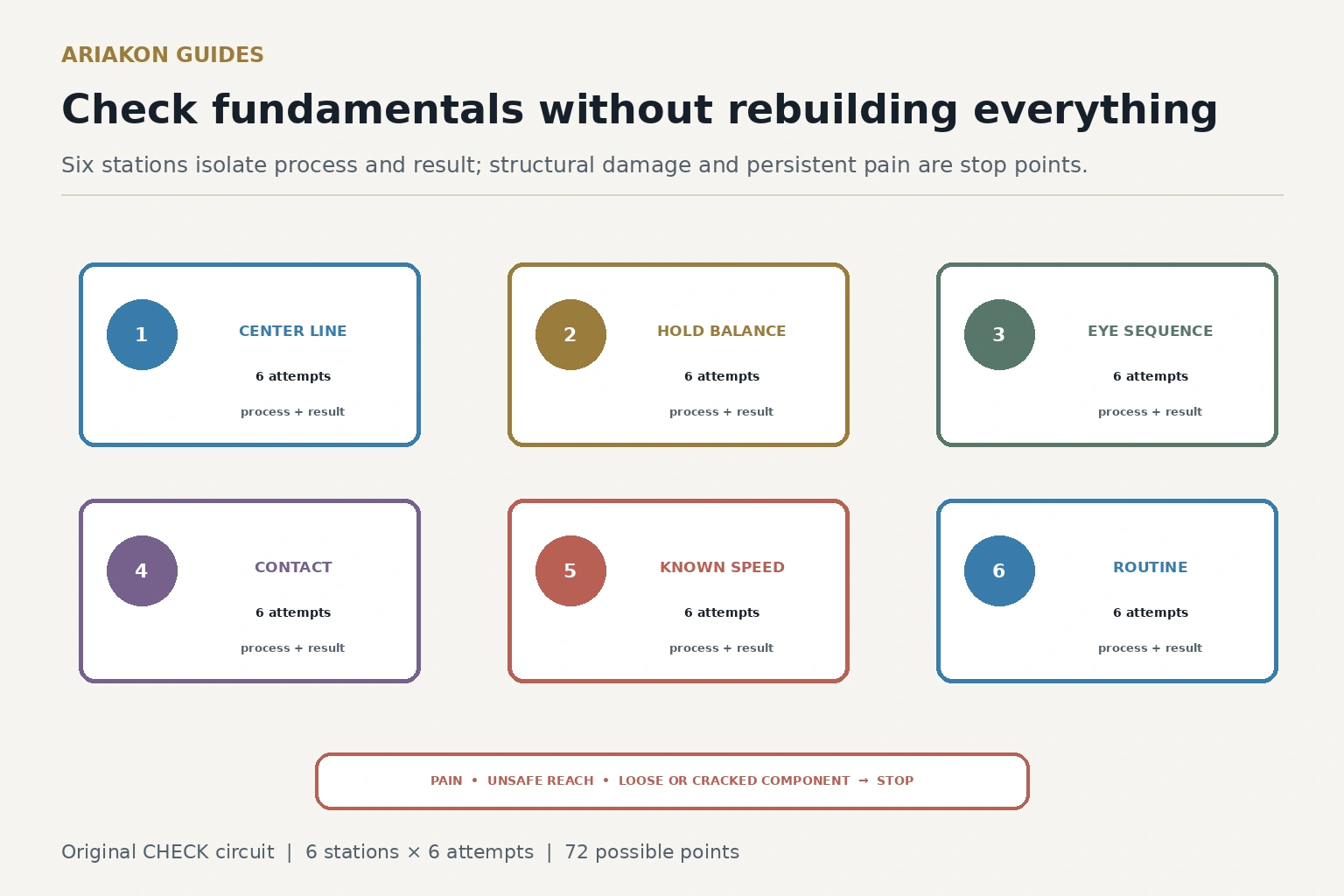
Set six CHECK stations
Use simple, marked setups and count every attempt. The first four stations use a straight shot at comfortable distance. Known speed uses three target distances. Routine uses one repeatable three-ball pattern. Maximum is 72 points across 36 attempts, but the station split matters more than the total.
Keep the six station totals attached to this maintenance circuit and its recorded setups. The total selects a component to inspect; it is not an external examination result, handicap or certified playing rating.
| Station | Process point | Result point |
|---|---|---|
| C — Center line | Cue finishes through a safe marked gate | Straight ball pockets in declared target |
| H — Hold balance | Feet and bridge remain still through finish | Cue ball stays on the intended line |
| E — Eye sequence | Standing line and final target are completed before delivery | No late steering or head lift is observed |
| C — Contact | Chalk mark lands in declared center/vertical zone | Cue ball response matches stop, follow or draw call |
| K — Known speed | Speed is named before descent | Cue ball finishes in a six-inch distance zone |
| Routine | Decide–align–settle–pause–finish is complete | Three-ball pattern reaches the declared next shot |
Review advanced fundamentals in depth before changing a mechanical component.
Use a diagnostic practice process when one station repeatedly fails.
Protect the setup and equipment boundary
Inspect the cue before the session. Routine chalking and a dry wipe are different from structural repair. Follow the actual shaft and cue maker's care instructions; unknown material or damage is a stop point, not a reason to experiment with abrasives or solvent.
| Observation | Action | Boundary |
|---|---|---|
| Marks or balls move | Reset and repeat; do not score | A changed layout is not comparable |
| One process step fails | Repeat six attempts with that step only | Do not rebuild five mechanics |
| Pain, unsafe reach or loss of balance | Stop and change the setup | No score justifies unsafe posture |
| Loose tip, cracked ferrule/joint or damaged shaft | Tag out and seek qualified service | Do not diagnose structure by shooting |
| Persistent delivery problem | Save video/notes for a qualified instructor | The worksheet cannot identify every cause |
Work the score instead of chasing the total
Hypothetical result: the player scores Center 11/12, Hold 12/12, Eye 10/12, Contact 7/12, Known speed 8/12 and Routine 9/12 for 57/72. Five contact marks are higher than declared, and four speed misses follow those marks. Her next action is six vertical-axis contact attempts at one speed; she keeps stance, bridge and routine unchanged.
Repeat only the lowest evidence-based station after a short break. Schedule the full circuit again in four weeks or after a meaningful equipment or technique change. Improvement means a sound process remains stable and the targeted station moves under the same conditions—not that every monthly total must rise.