
Cue-ball control · 3 min read
Use Sidespin for Two Rail Pool Position Routes
Isolate cushion response before adding an object-ball collision. This cue-ball-only calibration holds the start, first cushion target and speed intention fixed while comparing three modest spin conditions. Then test the observed response in a separate position-play layout. A geometric sketch supplies a reference direction; it cannot predict a real table’s spin response.
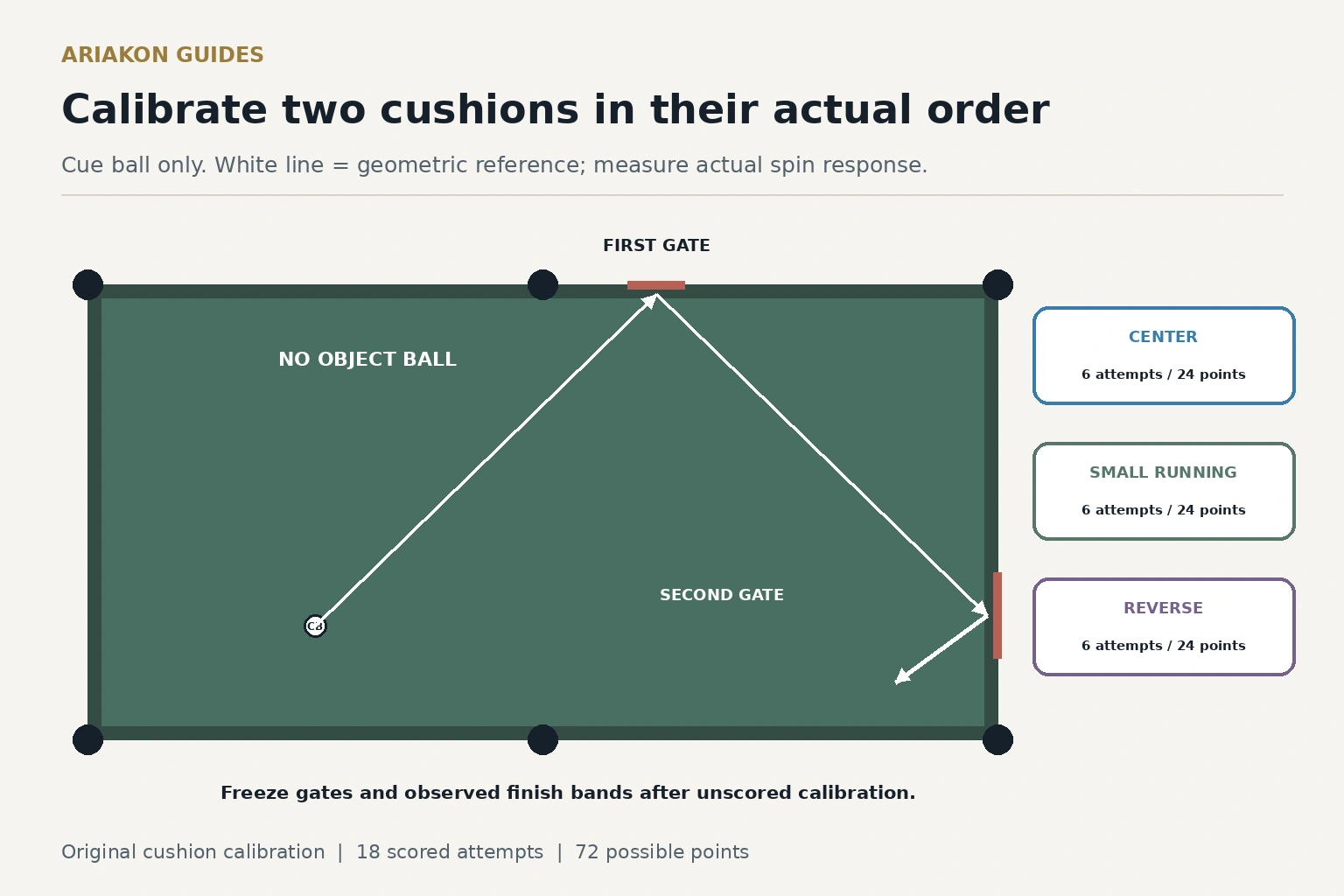
Mark a cue-ball-only cushion calibration
Use a 100 by 50 inch example playing surface with 2.25 inch balls. Coordinates are ball centers in 12.5 inch units: x runs 0 to 8 along the length and y runs 0 to 4 across the width. Place the cue ball at C=(2,1), with no object ball. Its radius is 0.09 unit. Aim toward a first long-cushion gate centered at the ball-center contact R1=(5,3.91), away from the side pocket at (4,4). The physical cushion-nose target is (5,4). Use a gate half a unit wide along x.
For an ideal equal-angle center-path reference, reflect the outgoing line from R1 toward the right short cushion. It reaches the ball-center contact R2=(7.91,1.0873). Mark a second gate 0.75 unit wide along y, then use a broad finish zone after that cushion. This is an initial geometric reference, not an exact cushion-response prediction. Take unscored trials and move both gates together if the actual center-ball baseline requires it; freeze them before scoring.
Compare center ball, your smallest repeatable running-spin offset and your smallest repeatable reverse-spin offset. A spin direction is running when it assists travel along the contacted cushion; label left or right from your actual shooting view after testing.
Before each block, take two unscored trials, declare a finish band from the observed route and keep it fixed for the six scored attempts. Use the same speed intention; record unavoidable speed differences. Bands must fit fully on the bed with ball-radius clearance. No maximum offset or universal tip fraction is prescribed.
Calibrate a single-cushion route first if first-rail results are not repeatable.
Decide when sidespin is actually useful before adding it to a game route.
Review squirt, swerve and throw when the object-ball line changes.
Score 18 attempts in three blocks
Run six scored attempts in each condition and reset the exact start. Log gate, cushion order, final center and scratch separately. On another day reverse the block order. A scratch receives zero route and finish points; retain the declared process point if earned. Do not move a gate or band around a successful shot.
Diagnose the first mismatch: a missed first gate concerns starting aim, delivery or speed; a first-gate pass followed by a different rebound concerns cushion response and incoming spin; a matching route with a long or short finish calls for speed calibration. This drill does not test object-ball throw or pocketing.
| Point | Observable condition |
|---|---|
| 1: Declaration | Spin, speed and finish band stated before stance |
| 1: Rail 1 | First cushion contact inside the fixed first gate |
| 1: Rail 2 | Second cushion contact inside the fixed second gate, in that order |
| 1: Finish | Cue ball stops in the declared band without a scratch |
| Maximum | 24 per six-attempt block; 72 over eighteen attempts |
Worked result and game transfer
Hypothetical totals: center 19/24, running 18/24 and reverse 11/24. Five reverse attempts miss the first gate. Repeat six reverse attempts at a smaller comfortable offset and the same declared speed before making the route more difficult.
For transfer, set six different three-ball position layouts with a legal first contact and a clear pocketing line under the named game. Before shooting, compare a center-ball option with a two-cushion route and mark a generous next-shot zone. Score the choice and pocketing separately from the cushion calibration. Rebuild the incoming object-ball contact for each layout; never copy the cue-ball-only starting line as a post-collision route.