
Match process · 4 min read
Use a Temporary Pool Match Adjustment Without Rebuilding Your Stroke
A match is a poor place to rebuild a stroke. When a repeatable miss appears, the useful question is narrower: can one reversible change improve the next few decisions without creating a second problem? This guide builds a temporary patch from observable evidence, tests it on twelve shots and states when to stop. Use diagnostic practice later to investigate the cause.
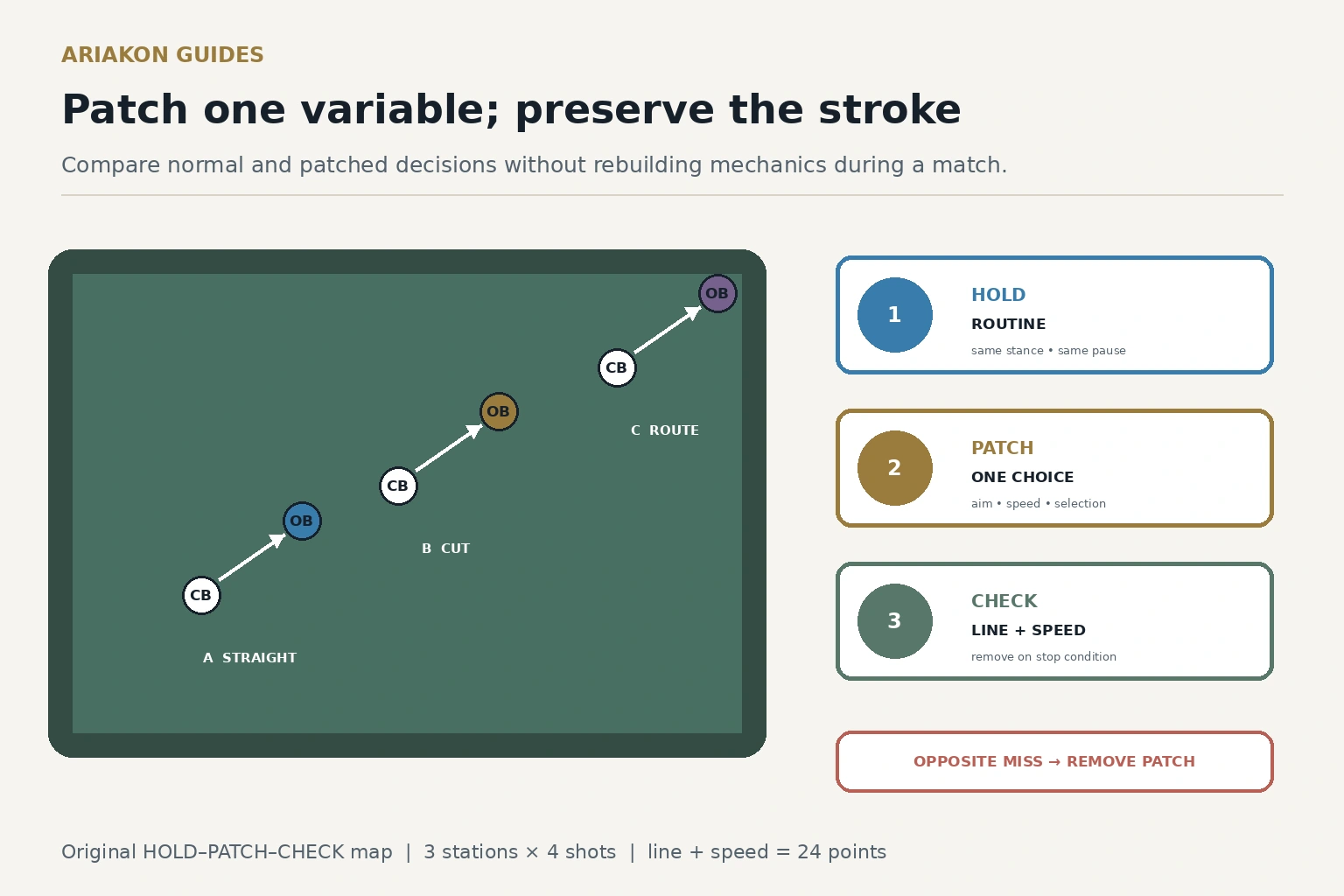
Separate a patch from a rebuild
| Temporary patch | Practice rebuild |
|---|---|
| Changes one visible choice: aim reference, speed band, bridge length or shot selection | Changes mechanics, timing or alignment through repeated practice |
| Must be reversible in one sentence | May require video, coaching and many sessions |
| Judged by a short calibration and match transfer | Judged by a larger baseline and delayed retest |
| Expires after the match unless later evidence supports it | Becomes a trained routine only after verification |
Run diagnostic practice after the match when the miss pattern needs a cause test.
Stabilize the pre-shot decision first when the choice, not the stroke, may be wrong.
Name one symptom and one patch
Write the symptom without explaining it: “three medium cuts missed thick,” “speed repeatedly finished long,” or “I stood up on difficult shots.” Do not diagnose grip, vision or nerves from a few outcomes. Choose one patch that is directly observable and legal: favor a fuller pocket entry, move one speed band softer, lengthen the landing zone, or select a safety below a confidence threshold.
Keep stance, warm-up strokes and final pause unchanged. If the proposed fix requires several mechanical instructions, it is a rebuild and belongs in practice.
| Field | Write before testing |
|---|---|
| Symptom | Observable miss or finish pattern |
| Patch | One changed choice |
| Hold constant | Routine, cue and table conditions |
| Success signal | Start line, pocket entry or broad finish zone |
| Stop condition | Opposite miss, loss of speed control or new uncertainty |
Run the twelve-shot HOLD–PATCH–CHECK calibration
Mark three common stations: A is a straight stop shot from three diamonds, B is a medium cut with the cue ball two diamonds from the object ball, and C is the same cut with a one-diamond-wide cue-ball finish zone. Adapt distances to the available table but record them. At each station shoot normal, patch, normal, patch in that order. Each condition therefore gets six attempts across the three stations.
Score each attempt before retrieving balls: one point for the intended object-ball start line and one for the intended cue-ball speed or zone. The maximum is 24. Also mark miss side; points alone can hide a new directional error.
Run this calibration only during permitted warm-up or a separate practice session. Do not practice on another table during an active match unless the event explicitly permits it, and do not delay the match to manufacture twelve trials.
| Evidence | Match action |
|---|---|
| Patch gains at least three points and creates no opposite miss | Use it only on the matching shot family |
| Difference is zero to two points | Keep the normal choice and simplify patterns |
| Patch creates an opposite miss or worse speed | Remove it immediately |
| Pain, equipment damage or changing table conditions | Stop the test and address the condition |
Transfer the patch with a short script
Use the same four-line script while standing: “This is the matching shot family. My temporary patch is ____. My broad success zone is ____. If ____ appears, I remove it.” Then choose the shot and run the normal routine. The script keeps the patch attached to a condition instead of turning it into a running technical monologue.
A pre-performance routine is a consistent set of task-relevant thoughts and actions, but no routine guarantees a result. The patch should make the decision simpler, not add more things to control during delivery.
Worked example and post-match handoff
A hypothetical player sends three medium-speed position shots beyond the intended zone. The player tests one softer speed band while holding aim and routine constant. Baseline attempts score 6 of 12 available points; patched attempts score 10 of 12, with no new short-side miss. During the match the player uses the softer band only when the route and cloth speed resemble the test.
Afterward, the player records the layout, score and stop condition, then restores the normal plan for a controlled practice comparison. The match patch is not proof of a mechanical cause or a permanent fix. It is a bounded decision that reduced uncertainty for one condition.