
Decision making · 3 min read
Test Pool Shot Judgement Before Shooting the Layout
Shot judgment is a forecast made before the stroke: can the ball be pocketed, where will the cue ball finish and what is left after failure? A good result does not prove the forecast was good, and a miss does not prove it was bad. This test keeps a fixed forecast for each layout before three attempts, then scores its agreement with the small observed sample separately from execution; the runout-risk guide uses calibrated judgment to choose an eight-ball pattern.
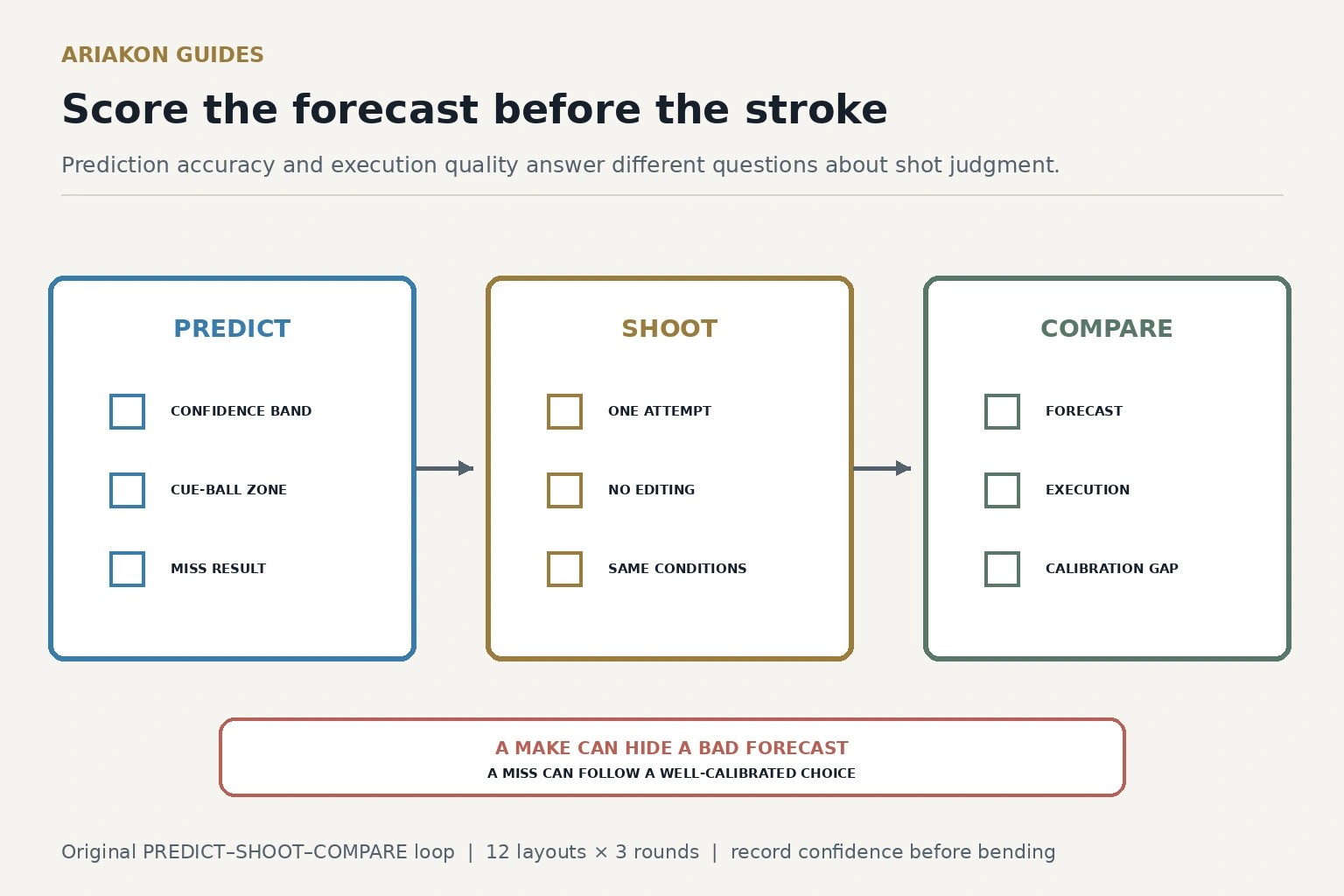
Write three predictions while standing
| Prediction | Choose one |
|---|---|
| Green / yellow / red confidence band | |
| Cue ball | Named broad zone or route |
| Failure | Near miss, far miss, scratch or opponent starter |
| Alternative | Simpler offense or legal safety |
| Decision | Shoot, simplify or defend |
Use the three-question shot decision for a compact match routine.
Play percentage decisions without playing scared after calibrating the forecast.
Create twelve varied but bounded layouts
Use four shot families—straight, moderate cut, rail-near cut and one-rail position. Build three distances in each family for twelve total layouts. Mark cue ball, object ball, pocket and one broad cue-ball zone. Keep speed choice explicit.
Photograph or diagram the marks if venue rules permit. Shoot each layout once per round across three rounds rather than repeating one layout until memorized.
Before the first round, predict one band for each layout and leave it unchanged through all three rounds. For this worksheet only: Green predicts three legal pots, Yellow predicts one or two, and Red predicts zero. These three-attempt bands are temporary descriptive categories, not estimated make probabilities. Write a rule before starting, such as “use the broad offense only for Green; otherwise simplify or test the safety.”
Keep the measured offensive test shot fixed for all three trials of each layout. Separately write what you would choose in a match under your evidence rule. You may mark “defend” yet shoot the safe registered offense in this practice test to observe its forecast. Do not compare a forecast for one shot with results from a different shot or safety. An unsafe or skipped test stays not run and cannot earn a forecast point.
Score forecast and execution separately
Keep the 48-point forecast review separate from execution: 36 pot outcomes and 36 zone outcomes. Award no retrospective forecast point for moving a band after seeing the results. A made ball can still take an unpredicted route; one miss does not establish a permanent probability. Record failure-side predictions as notes because a pocketed ball offers no observed miss side.
| Point | Earn it when |
|---|---|
| Pocket forecast | The original band agrees with the registered three-attempt pot count |
| Route forecast | The named route occurs on at least two of three attempts |
| Finish forecast | The cue ball rests in the named zone on at least two of three attempts |
| Decision | All three written match decisions follow the predeclared evidence rule; the measured practice shot remains unchanged |
Use calibration gaps to choose the next test
| Gap | Next action |
|---|---|
| Confidence too high, route accurate | Retest pocketing at that cut and distance |
| Pocket forecast accurate, finish wrong | Calibrate speed or tangent route |
| Failure side alternates randomly | Check alignment and delivery |
| Safety is undervalued | Run matched offense/safety trials |
| Forecast changes after getting down | Stand up and rewrite the decision |
Worked example: a make hides poor judgment
A hypothetical player labels a rail-near cut green and predicts a two-rail cue-ball finish. The ball drops, but the cue ball takes one rail and leaves no next shot. Across three rounds, only one of three balls is pocketed and none follow the predicted route. The first make does not validate the forecast.
The player moves the shot to yellow, tests a lower-speed route and adds a safety comparison. After twelve new outcomes, the written band can change again. The exercise calibrates a decision tool; it does not assign a permanent player rating.
Sources and further reading
References support the specific factual information above. The practical checklists are Ariakon editorial guidance.