
Match process · 4 min read
Use a Pool Match Checklist Without Making the Routine Rigid
A useful match checklist should prevent avoidable omissions without demanding the same response to every table, opponent or score. Keep a short core that applies every time, add written if–then branches for conditions that genuinely change the task, and review the checklist after the match. The pre-shot routine still governs individual execution; this guide governs the match around it.
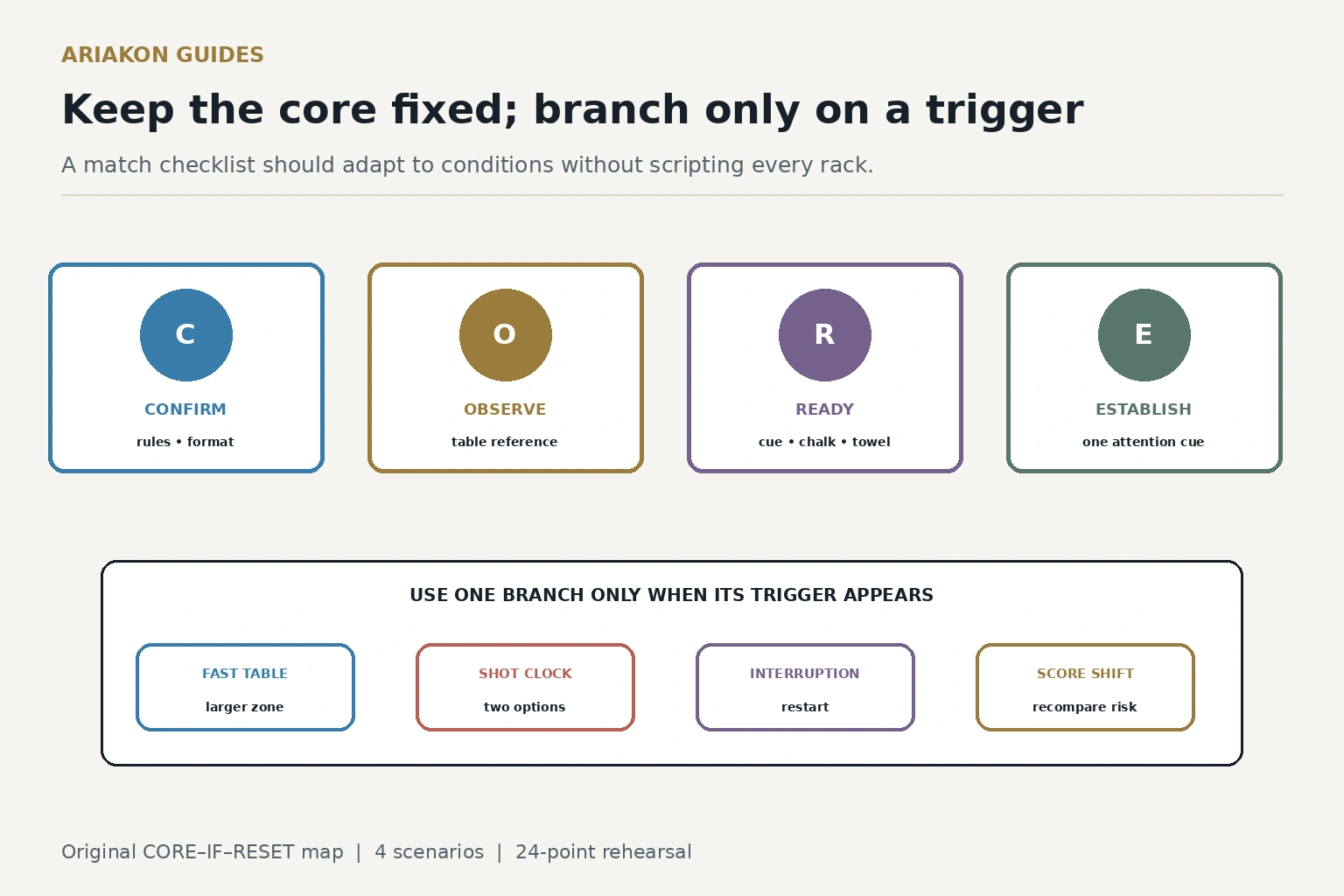
Separate the fixed core from conditional branches
| Layer | Use | Example |
|---|---|---|
| Core | Four checks completed before play | Active rules, sound equipment, one table-speed reference, one attention cue |
| If–then branch | Used only when its trigger occurs | If a shot clock starts, then simplify the standing decision by the warning |
| Reset | Returns attention after interruption or error | Name the next decision and restart the normal routine |
| Review | Edits the card after play | Remove unused items; add only an omission that actually cost a decision |
Use the repeatable pre-shot routine for planning and delivering each individual shot.
Build first-rack readiness when the main problem is the opening eight minutes.
Write a four-item CORE card
C — Confirm the discipline, race, break procedure, call requirements and any local variations from the current official source. O — Observe one usable table-speed or cushion reference when permitted. R — Ready the cue, tip, chalk, towel and legal extensions before play. E — Establish one brief attention cue such as “plan while standing” rather than a list of stroke mechanics.
A performance routine is a set of task-relevant thoughts and actions, not a promise of a particular result. Keep the card short enough to complete under the actual event schedule. If a rule is unclear, ask the authorized official before the disputed situation appears.
Add only scenario-specific if–then branches
A branch must name an observable trigger and one action. “If I feel bad, try harder” is not usable. Do not add a branch for every imagined problem; an oversized checklist competes with the decision it is meant to protect.
| Trigger | Then action | What stays unchanged |
|---|---|---|
| Table is faster than the reference | Choose larger landing zones and the verified softer band | Pre-shot sequence and cue |
| Shot-clock warning or time pressure | Choose between the two already identified options | Legality and scratch check |
| Unexpected interruption | Step away, restate the next decision, restart | No penalty story or rushed stroke |
| Equipment condition changes | Stop, inspect safely and use verified legal equipment | Do not improvise a repair during the shot |
| Score changes risk threshold | Recompare offense, safety and miss cost | Normal delivery after the choice |
Test four match scenarios before competition
Run four practice races or rack segments: normal conditions, a deliberately faster speed reference, a timed decision period and a planned interruption between racks. Before each scenario, complete the core. Use only the relevant branch and then resume normal play.
Score two points per scenario for completing all four core checks, two for selecting the correct branch, one for restarting the normal shot routine and one for recording the result afterward. The maximum is 24. A score below 20 means simplify the card before adding anything.
In the normal-condition scenario the correct branch is “none,” which earns the two Branch points when no trigger occurred. Simulated time or interruption demands belong in agreed practice only; health, consent and current event rules take precedence.
| Evidence | Points |
|---|---|
| Four-item core complete | 0 or 2 |
| Correct branch used once | 0 or 2 |
| Normal routine resumed | 0 or 1 |
| Short review recorded | 0 or 1 |
Worked example and post-match edit
A hypothetical player arrives at a table that sends the cue ball beyond the familiar landing reference. The core is complete, so the player activates only the speed branch: larger zones and the softer verified band. After a time warning later in the set, the clock branch narrows a three-option debate to the two already identified choices. The player does not change stance, grip or warm-up count.
After the match, the card shows the clock branch helped twice, while a long reminder about confidence was never used. The player keeps the clock branch, removes the vague reminder and practices one unresolved rule question before the next event. The checklist becomes more useful by getting shorter and more specific.
Sources and further reading
References support the specific factual information above. The practical checklists are Ariakon editorial guidance.