
Match process · 3 min read
Build a Two Week Pool Slump Recovery Experiment
“Slump” describes a result, not a cause. A useful response limits the question: did one chosen process change improve a repeatable task and survive a match-like transfer test over two weeks? This is an experiment, not a diagnosis or treatment. Pain, persistent distress or concerns beyond sport performance belong with an appropriate qualified professional.
Choose one performance question
Start with one costly, observable event from recent play: missing the first open shot, overrunning a one-rail route, abandoning the standing plan, or losing the pre-shot pause. State the conditions and exclude explanations you have not tested.
Write a process change that can be turned on and off. Examples include naming the cue-ball zone before bending, using a consistent final look, or choosing center-ball routes for one shot family. Do not change equipment, mechanics, practice volume and match strategy at the same time.
Use the broader slump recovery guide to separate results, process and controllable evidence.
Build a ten-skill baseline if the costly event is still unclear.
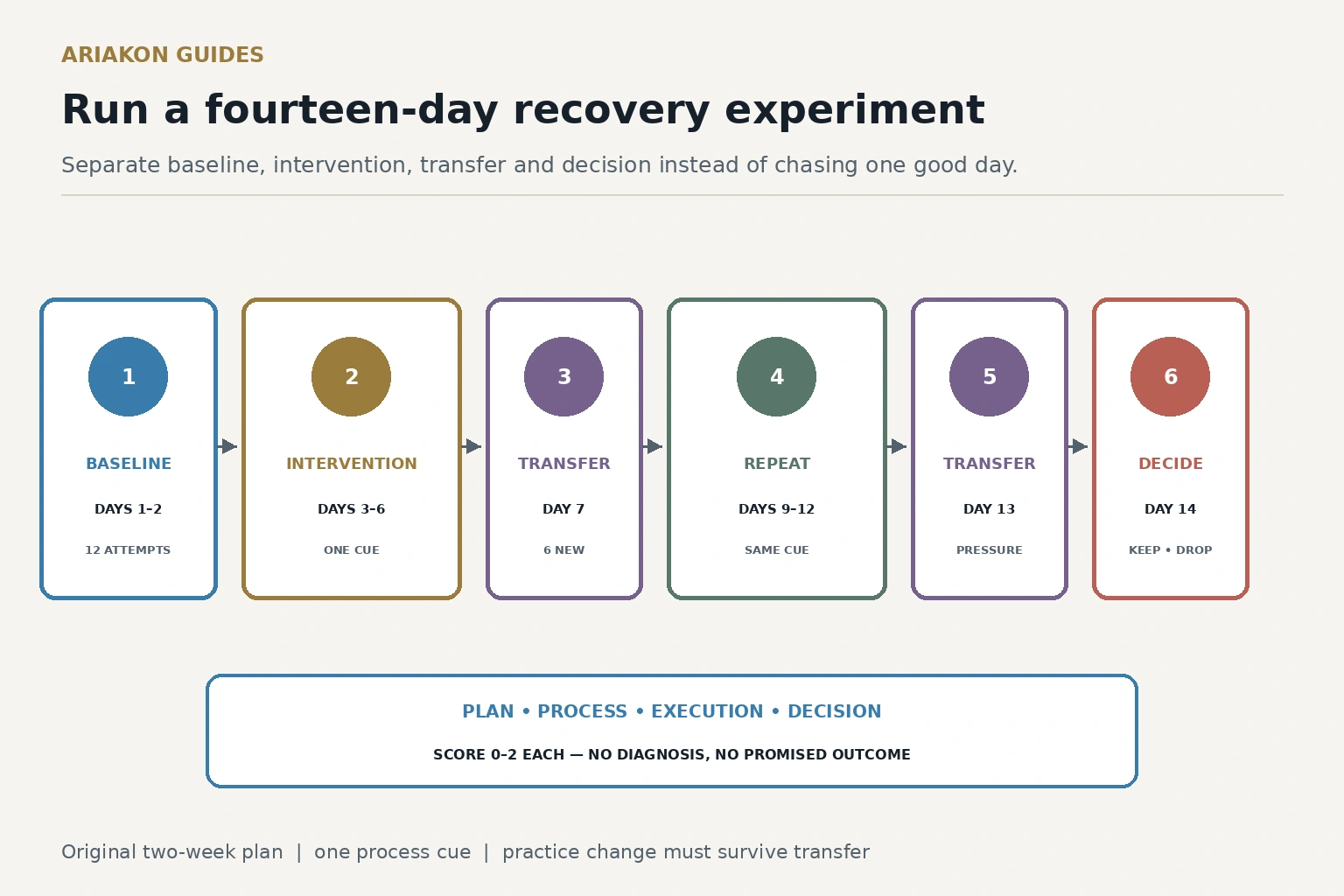
Follow the fourteen-day schedule
The first baseline phase has twelve total attempts, distributed across Days 1–2. Each intervention phase likewise has twelve total attempts, distributed across its four days, rather than twelve per day. Each transfer has six attempts; use six on Day 13 as well. Compare the same four-point Process-plus-Execution subtotal, at most 48 per practice phase and 24 per transfer, with Process alone at most 12 per transfer.
| Days | Work | Record |
|---|---|---|
| 1–2 | Baseline: 12 attempts at the chosen task, no intervention | Task success, process use, miss side |
| 3–6 | Intervention: 12 attempts with one new process cue | Same measures; no extra fixes |
| 7 | Transfer: six varied layouts, one attempt each | First-attempt process and outcome |
| 8 | Rest or light review | One sentence: keep, revise or wait |
| 9–12 | Repeat the same intervention | Same setup and scoring |
| 13 | Transfer under a race, timer or partner observation | Decision quality and first outcome |
| 14 | Compare phases and choose the next block | Keep, drop or redesign with reason |
Use a four-column practice and match log
Add a short context note—table, sleep, pain, unusual time pressure—without turning the log into a story. Outcome matters, but the experiment asks whether the chosen process was performed and whether the intended line and speed became more reliable.
| Measure | 0 | 1 | 2 |
|---|---|---|---|
| Plan | No stated plan | Shot only | Shot and cue-ball zone |
| Process | Skipped | Partial | Complete chosen cue |
| Execution | No intended start line | Line or speed | Line and speed |
| Decision | Ignored evidence | Uncertain | Choice matched evidence |
Use one response script after an error
Say: “That attempt is one data point. The next decision is ____. My process cue is ____. I will record the result after the shot.” Take one normal breath, look at the table while standing and restart the routine. The purpose is to return attention to the chosen task, not to force confidence or deny frustration.
If the script becomes another demand, shorten it to “next decision, same process.” A scripted reset is a repeatable action, not a promised emotional outcome.
Worked example: a better week is not enough
A hypothetical player misses open first shots and tests naming a large cue-ball finish zone before bending. Baseline totals 19 of 48 process-and-execution points. Days 3–6 total 31 of 48, but the first transfer Process subtotal scores only 5 of 12 because the player stops naming the zone under variety. After repeating the same cue, the second transfer Process subtotal reaches 9 of 12.
The player keeps the process for one more block because both practice and transfer improved. If only the blocked drill had improved, the honest next action would be redesigning the transfer—not declaring the slump solved. A two-week result guides the next experiment; it does not establish a permanent trait.
Sources and further reading
References support the specific factual information above. The practical checklists are Ariakon editorial guidance.