
Practice planning · 3 min read
Build a Ten Skill Pool Baseline Before Choosing Drills
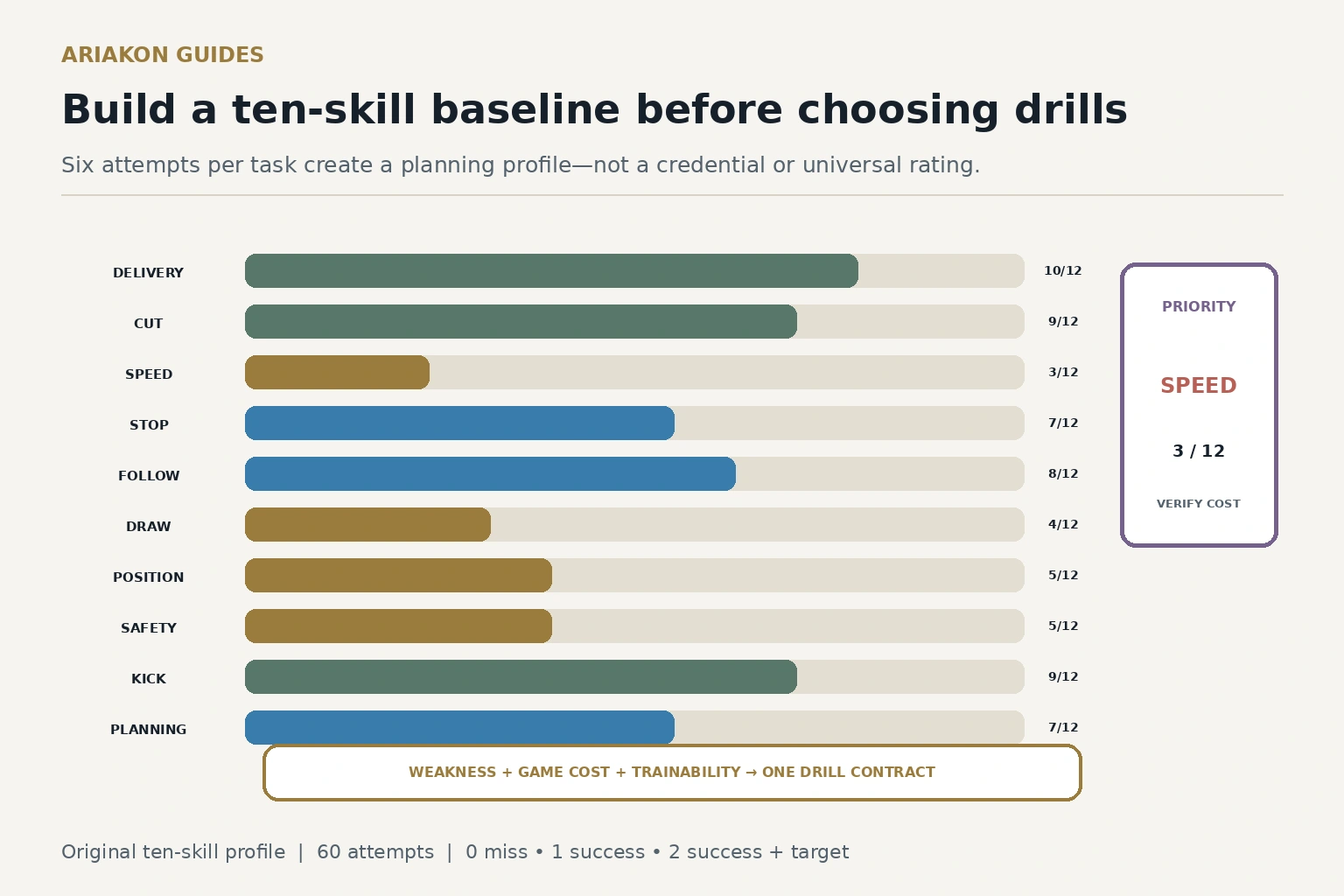
A drill is useful when it addresses a measured weakness that matters in play. This baseline samples ten skills with six attempts each, then converts the profile into one practice choice. It is shorter than a formal playing-ability exam and broader than the existing five-test dashboard, so its scores remain personal planning evidence rather than a credential.
Freeze the conditions and scoring rule
Record table, ball set, cue, date, warm-up length and any permitted markers. Each task gets six attempts. Score 0 for a failed primary result, 1 for the primary result and 2 when the primary result plus its control target are completed. Maximum is 12 per skill and 120 total.
Do not compare totals from different table conditions without noting the change. Repeated practice of a fixed worksheet measures familiarity with those tasks as well as skill. Transfer to varied first-attempt layouts is a separate check.
Build a five-test progress dashboard for a smaller recurring monitor.
Choose the next drill from observed errors after the baseline identifies a priority.
Run ten six-attempt tasks
| Skill | Primary result | Control point |
|---|---|---|
| 1 Delivery | Straight ball pocketed | Cue ball stops in line |
| 2 Cut | Moderate cut pocketed | Named pocket third |
| 3 Speed | Cue ball reaches target zone | Stops inside inner zone |
| 4 Stop | Object ball pocketed | Cue ball within six inches |
| 5 Follow | Object ball pocketed | Cue ball reaches named zone |
| 6 Draw | Object ball pocketed | Cue ball returns to named zone |
| 7 Position | Two-ball pattern completed | Correct side of next ball |
| 8 Safety | Legal contact | No full direct hit remains |
| 9 Kick | Legal object-ball contact | A rail is reached after contact |
| 10 Planning | Order named before stance | Three-ball pattern completed |
Choose priority by weakness, cost and trainability
Add the three factors. The highest total is the first candidate, but pain, unsafe movement or equipment damage is always a stop. If two skills tie, choose the one that limits more downstream tasks.
| Factor | 0 | 1 | 2 |
|---|---|---|---|
| Weakness | 9–12 | 5–8 | 0–4 |
| Game cost | Rare | Occasional | Frequent |
| Trainability now | No safe setup | Partial setup | Repeatable setup |
Write one drill contract
| Field | Required entry |
|---|---|
| Setup | Exact ball and target marks |
| Dose | Attempts per block and number of blocks |
| Score | Primary and control result |
| Feedback | One observable cue |
| Retest | Date and unchanged baseline task |
| Transfer | One game-like layout |
Worked example: low draw is not automatically first
A hypothetical profile scores draw 4/12, safety 5/12 and speed 3/12. Match notes show that poor speed creates most lost positions and also damages safety results. Speed receives 6 priority points; draw receives 4. The player chooses a three-zone rolling drill for two weeks instead of chasing the most dramatic weakness.
At retest, the original six speed attempts rise from 3 to 7 while conditions remain comparable. The next action depends on the full profile and match cost, not on total score alone.