
Practice measurement · 5 min read
Build a Pool Progress Dashboard From Five Repeatable Tests
A progress record is useful only when the setup, scoring and conditions can be repeated. This dashboard uses five compact tests worth twenty points each. It shows which skill changed and which practice decision follows, without turning one good day into a rating claim.
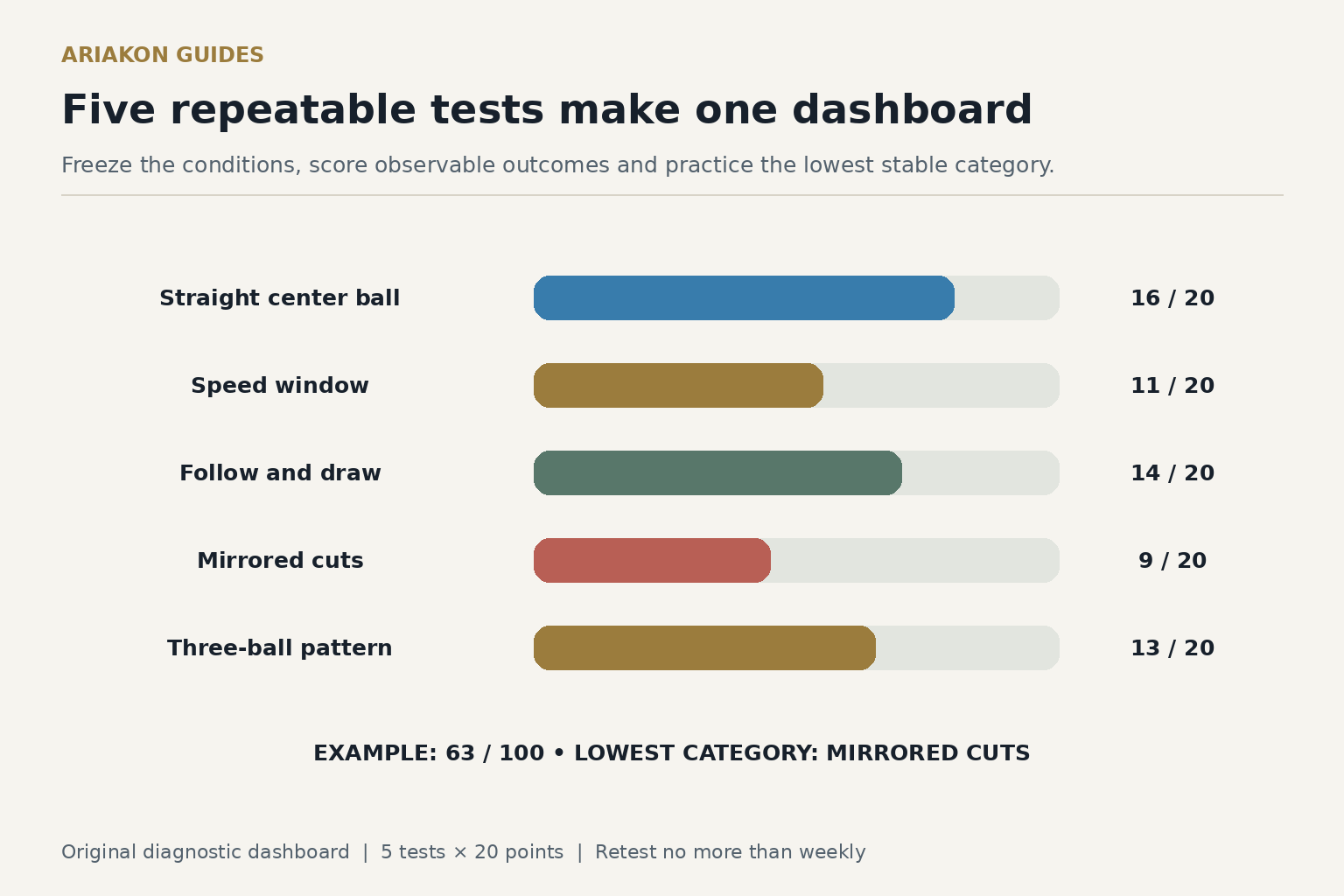
Freeze the conditions before the score
Use the same table, balls, cue, starting positions and target boundaries whenever practical. Record date, table size, cloth condition, pocket difficulty, session order and whether the balls were clean. Warm up for ten minutes, then take the tests in rotating order across different days so fatigue does not always affect the same test.
Retest no more than once each week. Practice between tests, but do not rehearse a failed test until the score rises during the same measurement session. The dashboard is meant to sample current execution under known conditions.
Set measurable pool practice goals before deciding what a score change should trigger.
Test one: straight center ball delivery
Place an object ball one diamond from a side pocket on the line through the pocket center. Place the cue ball one diamond farther away on the same line. Shoot ten stop shots at pocket speed. Award one point for pocketing the object ball and one when the cue ball finishes within one ball width of its contact position without visible sideways spin. Maximum is twenty.
Record miss direction and cue ball drift. A pocketed ball with sideways cue ball movement earns only the pocket point. This separates pocket acceptance from centered contact.
Test two: speed window control
From the head string at table center, roll the cue ball to the foot cushion and back toward the head cushion. Define a target window from the head string to one diamond short of the head cushion. Shoot ten attempts. Award two points for stopping in the window, one for stopping within one diamond beyond either edge, and zero for a scratch, missed foot cushion or finish outside the larger tolerance. Maximum is twenty.
Use center ball and the same intended stroke each week. Record short and long misses separately so the next practice is directional instead of a vague speed complaint.
Test three: follow and draw distance
Use a separate straight diagonal setup for this test. Place the object-ball center two diamonds from a corner pocket along the pocket line and the cue-ball center one diamond farther back. Mark a half-diamond-long follow target centered half a diamond beyond the object-ball contact position, leaving clear cloth before the pocket. Mark an equally long draw target centered one diamond behind the cue-ball start. Shoot five follow and five draw attempts. Award one point for the pocket and one for the cue-ball center finishing inside the called target. Maximum is twenty. Remove setup aids before shooting.
Do not change the target after a miss. If draw is unsafe for the cloth, equipment or current skill, replace it with ten stop to short follow attempts and label the modified dashboard so later scores remain comparable.
Test four: mirrored cut accuracy
Choose a corner pocket. Put the object ball one diamond from the pocket along the long rail line and the cue ball at a repeatable moderate cut position. Photograph the setup, then mirror it to the other side of the table. Shoot five left cuts and five right cuts at pocket speed. Award two for the center half of the pocket, one for a legal pocket outside the center half and zero for a miss. Maximum is twenty.
For a broader assessment, choose a documented test with fixed setups, scoring and repeat procedures. Keep its published score separate from this original local dashboard; a short diagnostic total must not be presented as a certified ability level or converted into a rating.
Test five: three ball pattern completion
Place three object balls at the head spot, table center and foot spot. Begin with cue ball in hand behind the head string and run the balls in order to any called pockets. Play five layouts. Award one point for each legally pocketed ball and one more for completing all three without a foul. Maximum is four per layout and twenty total.
This is a compact pattern test, not a claim about match strength. Record the first failed transition in each layout. A high pocketing score with repeated position failures should still lead to position practice.
Build the one hundred point dashboard
| Test | Score out of 20 | Error pattern | Repeat condition | Next drill if lowest |
|---|---|---|---|---|
| Straight center ball | Fill in | Miss and cue ball drift | Same side pocket setup | Center ball and stroke line |
| Speed window | Fill in | Short or long | Same table and target window | Speed ladder |
| Follow and draw | Fill in | Pocket or distance | Same straight target zones | Cue ball distance control |
| Mirrored cuts | Fill in | Left or right bias | Same photographed layouts | One sided miss diagnosis |
| Three ball pattern | Fill in | First failed transition | Same three spots and order | Three ball route planning |
| Total out of 100 | Fill in | Do not convert to a player rating | Retest next week | Choose the lowest stable category |
Use change rules that resist lucky sessions
Change the next week's practice only when the same test is among the two lowest scores on two measurements or when one error pattern appears in at least six of ten attempts. Improve the lowest test with two focused sessions, then retest all five. Do not alter the scoring boundaries to make the chart rise.
Keep the dashboard total attached to these five tasks and their recorded conditions. It is a short diagnostic record: do not convert it into an external assessment score, handicap or certified ability level.
Choose the next drill from observed errors after the dashboard identifies the weakest category.
Build a structured two hour practice session to combine measurement with skill work and play.