
Practice planning · 2 min read
Build a Productive Two-Hour Pool Practice Session
Two hours is enough time to train several connected skills, but only if the session has a small purpose. A useful plan moves from calibration to focused repetitions and then to game-like decisions. It does not squeeze every weakness into one visit or turn the clock into proof that learning happened.
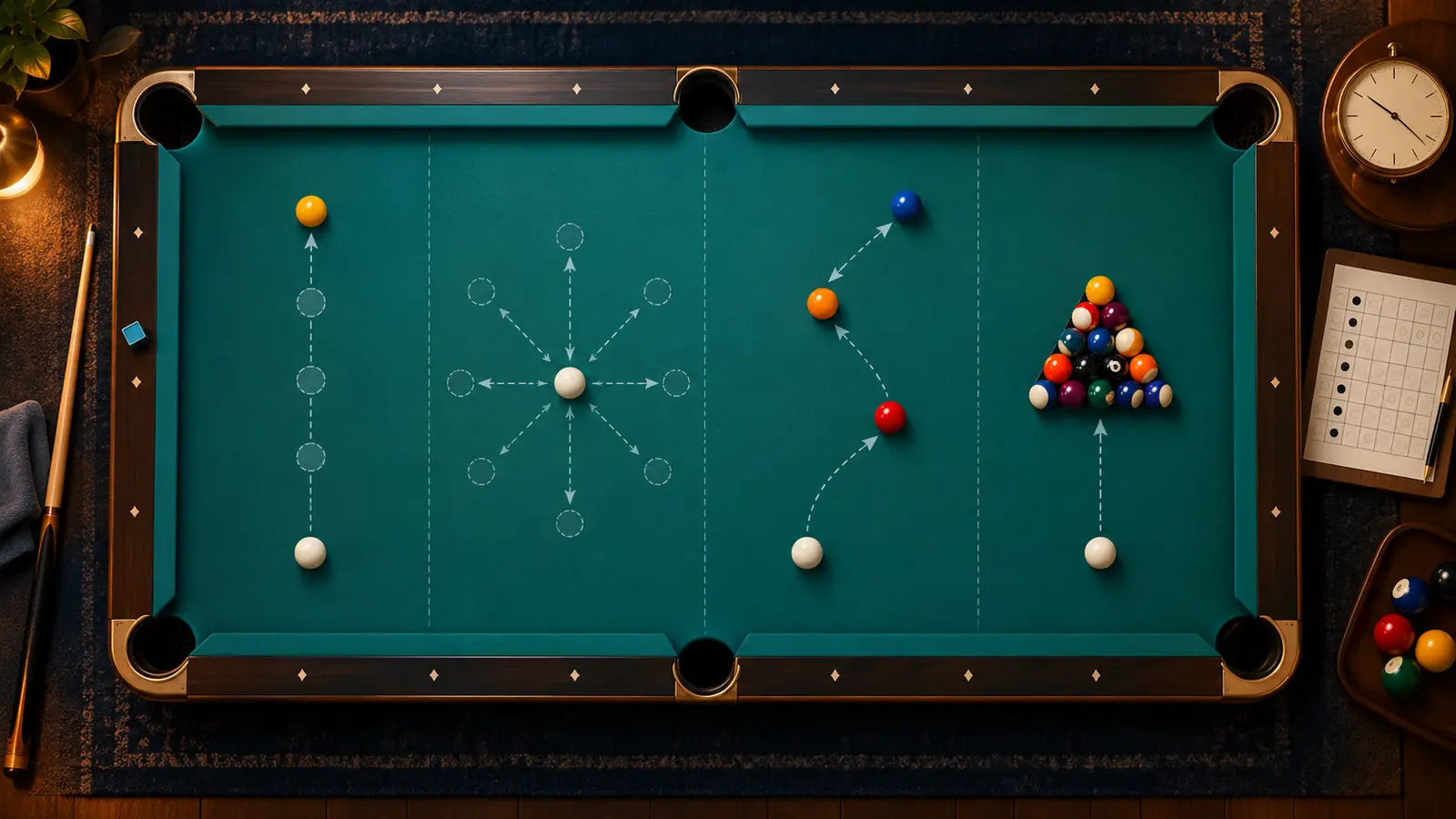
Choose one session outcome
Write one outcome before the first rack: for example, 'hold stop-shot accuracy while speed changes' or 'reduce position errors on three-ball patterns.' Make it observable and narrow enough to test today.
Keep one secondary maintenance skill, such as breaking or kicking. Everything else goes on a later-session list. This prevents two hours from becoming a tour of unrelated drills.
Use ten minutes to calibrate
Roll several balls, check the rails and pocket a few comfortable shots from both sides. Note unusual table speed, level or pocket behavior without immediately rebuilding your mechanics.
Finish with a short baseline attempt on the chosen skill. Record the result before practice so the final comparison is not based on memory.
Spend thirty minutes on one fundamental
Use a fixed layout and change only one difficulty variable, such as distance, cut angle or target size. Set the attempt count and success threshold before the block, then use the recorded result to decide whether to repeat or advance.
Work in short sets with a reset between them. If results collapse, reduce difficulty and restore clean execution instead of spending the block rehearsing misses.
Connect control to patterns for fifty minutes
Use twenty-five minutes for cue-ball destinations: stop, follow, draw, tangent-line or speed targets chosen for the session outcome. Then spend twenty-five minutes on three- to five-ball patterns that require the same control.
Score position quality as well as pocketing. A made ball with no usable next shot is important feedback, not an automatic success.
Add twenty minutes of pressure
Play a short race against the ghost, a scored safety game or another format with a clear end. Keep the difficulty close enough that both success and failure are possible.
Do not change the rules after a miss. The purpose is to see whether the practiced decision and delivery survive consequences, not to protect a perfect score.
Close the full 120 minutes
- 10 minutes: table check, warm-up and baseline.
- 30 minutes: one progressive fundamental drill.
- 25 minutes: cue-ball target work.
- 25 minutes: short patterns using the same skill.
- 20 minutes: scored game or ghost set.
- 10 minutes: repeat the baseline, cool down and record the next test.