
Equipment guides · 4 min read
Understand Pool Cue Tip Diameter, Shape, Construction and Care
Cue-tip discussions often mix four different questions: whether the tip fits the ferrule, what crown it has, how it is constructed and whether its surface is serviceable. Record those fields separately before changing anything. The tip-selection guide covers broader playing preferences; this worksheet identifies the installed tip and the tradeoffs that matter for fit, use and care.
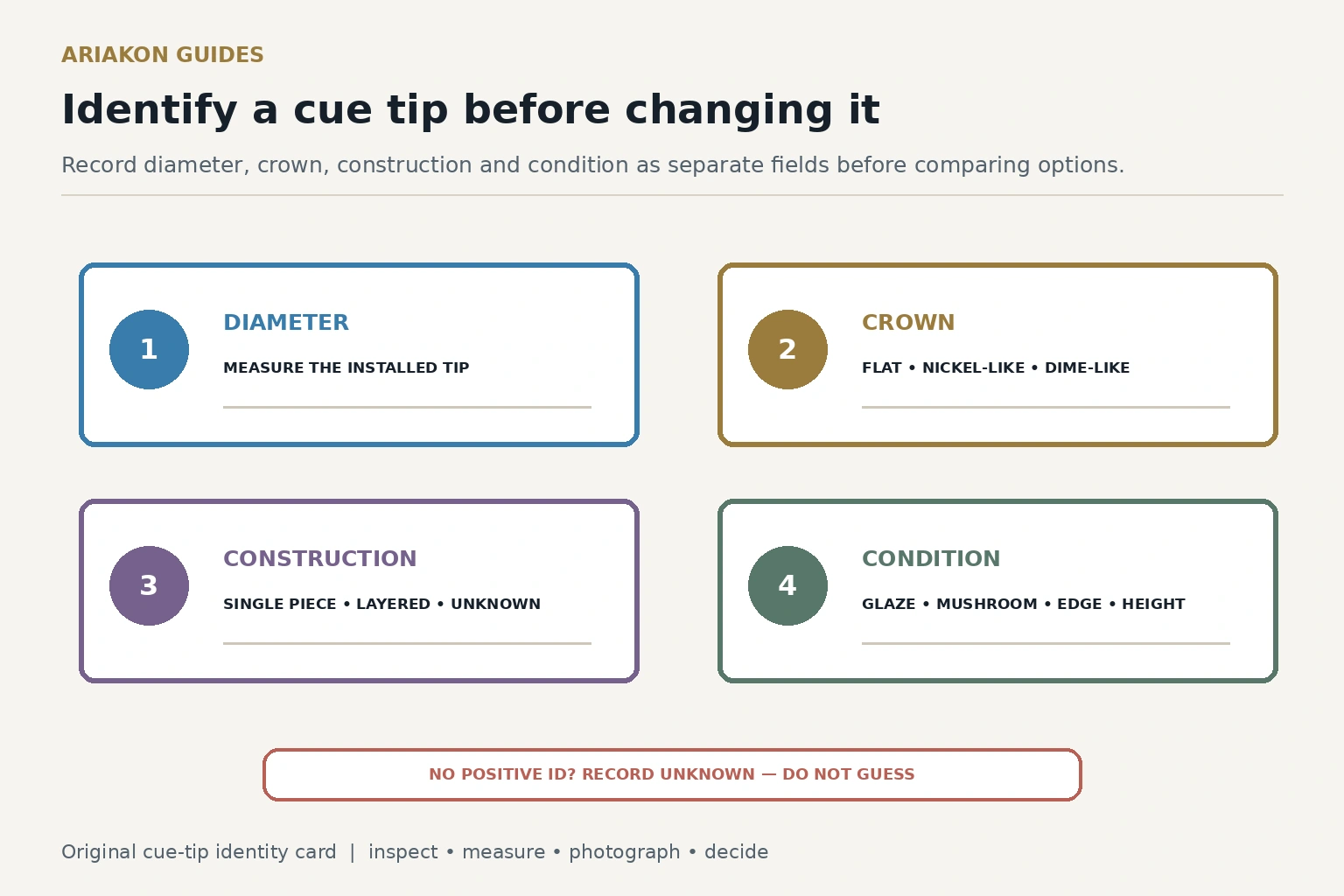
Measure the installed system, not a catalog memory
Use clean calipers only if you can avoid squeezing leather or scratching the ferrule; otherwise ask a qualified cue technician. A replacement is normally finished to the actual ferrule, not chosen from a nominal shaft label alone. The current WPA equipment specification limits cue-tip width to 14 mm and prohibits a tip material that can scratch or damage the addressed ball; event and maker requirements still control the specific cue.
| Field | Record | Why it matters |
|---|---|---|
| Finished diameter | Tip and ferrule diameter at their junction | Service fit and overhang |
| Crown | Current radius template or profile photo | Contact preparation and shape tracking |
| Construction | Single piece, layered or unknown | Care and damage clues |
| Maker grade | Exact label only if documented | Do not translate across brands |
| Condition | Glaze, mushroom, edge lift, crack, low height | Keep, service or replace decision |
Choose a pool cue tip for the broader hardness and playing-preference decision.
Plan a safe cue-tip replacement when the identity card points to service rather than routine care.
Separate diameter from shaft performance claims
| Question | Useful evidence | Do not assume |
|---|---|---|
| Will it fit? | Actual ferrule diameter and technician finishing allowance | Package diameter equals finished fit |
| Will the shaft stay within spec? | Maker minimums and authorized service instructions | More trimming is harmless |
| Will it change aim? | Matched shots before and after one documented change | Diameter alone predicts deflection |
| Is the edge sound? | Flush sidewall with no lift or gap | Overhang can be played away |
Record crown with a template, not a nickname alone
Place a clean radius template against the crown without compressing the leather and photograph the gap. Terms such as dime and nickel are convenient references, not proof that the whole surface matches a perfect arc. Record the template, date and side profile.
A smaller-radius crown is more rounded; a larger-radius crown is flatter. Neither label guarantees more spin, control or consistency. Contact point, chalk, delivery, cue elevation and shot conditions still matter. Preserve enough leather above the ferrule or pad to meet the maker's service limits.
Compare construction without inventing a ranking
Hardness labels are maker-specific categories, not a shared calibrated scale. Compare documented construction, service history and a player's matched results rather than declaring one type universally better.
| Construction | Inspect | Decision boundary |
|---|---|---|
| Single piece | Sidewall, mushrooming, glaze and remaining height | Reshape only within safe service limits |
| Layered | Layer edges, delamination, glazing and remaining height | Edge lift or separation is a replacement/technician stop |
| Unknown | Purchase record, packaging or installer note | Do not infer hardness or layers from color |
| Any tip | Bond line, ferrule/pad condition and centered fit | Loose, cracked or off-center parts stop play |
Use a care ladder with explicit stop points
| Step | Action | Stop when |
|---|---|---|
| 1 — Clean look | Inspect dry under good light | Crack, looseness or ferrule damage |
| 2 — Chalk | Apply a light even coat before play | Chalk will not adhere to a visibly damaged surface |
| 3 — Refresh | Use the maker-approved scuffing or shaping function minimally | Shape, diameter or safe height is uncertain |
| 4 — Recheck | Photograph crown and sidewall | Layer edge, bond line or sidewall changes |
| 5 — Service | Use a qualified technician or maker-authorized process | Any tool would touch ferrule or structural shaft parts |
Worked decision: the visible diameter is not the problem
A hypothetical 12.4 mm ferrule carries a flush layered tip measured at approximately the same diameter. Its crown still matches the saved template, but one layer edge catches a fingernail and the chalked surface has a diagonal crack. The worksheet does not recommend a different diameter or hardness. It routes the cue to replacement by a qualified technician.
A second tip is slightly glazed but has a sound edge, adequate documented height and no bond-line movement. The owner uses only the maker-approved minimal surface refresh, rechecks the profile and then records six ordinary center-ball shots. That is maintenance evidence, not a product ranking.
Sources and further reading
References support the specific factual information above. The practical checklists are Ariakon editorial guidance.