
Cue ball control · 3 min read
Troubleshoot a Stop Shot That Drifts Left or Right
Forward or backward cue-ball movement on a stop shot mainly describes arrival spin. Sideways movement asks a different question: was the shot truly straight, was the tip contact centered and did the cue travel on the chosen line? This guide isolates those gates before changing draw height or speed. It complements the general stop-shot and distance-calibration guides rather than repeating them.
Build a straight, visible reference
A slight cut sends a sliding cue ball along the tangent line, so sideways travel is not automatically unintended sidespin. First require the object ball to enter the center of the pocket on the registered line.
Use clean, undamaged balls and repeat from the opposite end before blaming the stroke for a table roll or equipment issue.
| Item | Setup | Tolerance |
|---|---|---|
| Corner pocket center | Use the same pocket for the first block | |
| Object ball | One diamond from pocket on its center line | Mark the center |
| Cue ball | One diamond behind object ball on the same line | Mark the center |
| Finish gate | One-ball-width left, center and right zones at contact area | Observe only; do not mark cloth |
| Stroke | Center axis, moderate speed | Change no variable during a block |
Calibrate the complete stop shot for forward and backward arrival-spin errors.
Compare four cue-ball distances after lateral drift is controlled.
Run three eight-shot gates
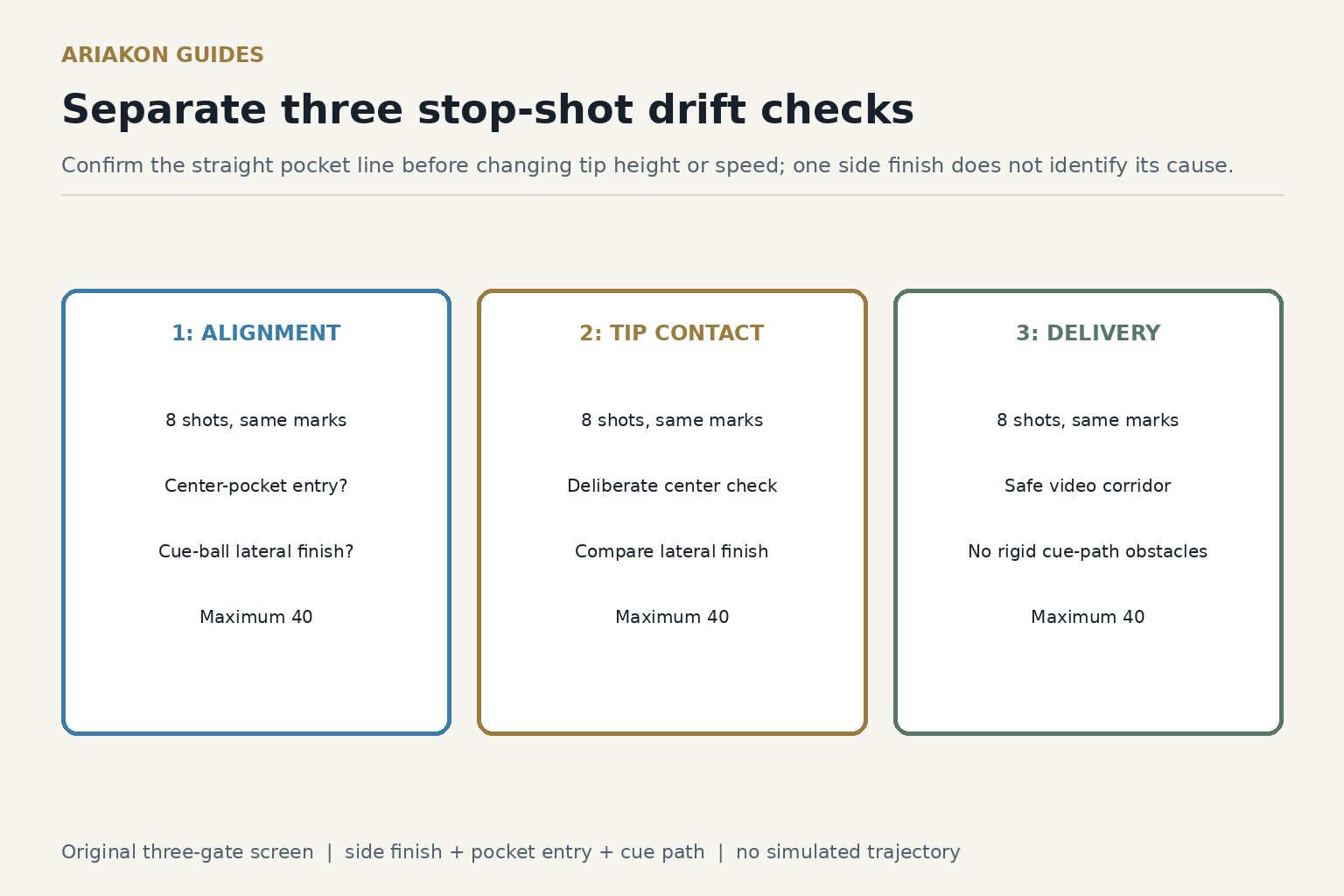
Score one point for center-pocket entry, one for cue ball stopping within one ball length forward or back, one for finishing inside the center lateral zone, one for no visible cue steering and one for completing the declared routine. Each gate has a maximum of forty.
The cue-path gates are observation references, not obstacles near the stroke. Do not place coins, chalk or rigid objects where the cue, hand or balls can strike them.
| Gate | Eight-shot condition | Question |
|---|---|---|
| 1 — Alignment | Normal routine; record pocket entry and cue-ball side | Was the shot actually straight? |
| 2 — Tip contact | Add a deliberate cue-ball center check before final look | Does lateral drift shrink when contact attention improves? |
| 3 — Delivery | Use two visual cue-path gates set safely away from the moving balls | Does the cue pass through the chosen corridor? |
Read pairs of facts, not one miss
Sidespin can change cue-ball behavior, but the amount and direction also interact with cut, speed and table conditions. Do not diagnose spin from a single finish. Look for the same pairing across several registered attempts.
| Pocket entry | Cue-ball finish | First interpretation to test |
|---|---|---|
| Center | Consistently left or right | Tip contact or cue delivery may be off center |
| Near jaw | Opposite-side drift | Small cut angle may explain the tangent direction |
| Mixed | Mixed | Setup or routine is not stable enough for diagnosis |
| Center both directions | Same table-side drift | Check level, cloth and ball condition |
| Center | Forward or backward only | Return to arrival-spin calibration |
Worked three-gate screen
A hypothetical player scores 27/40 at Gate 1: six balls enter center pocket, but five cue balls finish right. Gate 2 rises to 34/40 and only two finish right after a deliberate center check. Gate 3 scores 35/40 with one right finish and no visible corridor miss.
The evidence points first to inconsistent tip setup, not to changing tip height. The player keeps the center check for ten more stop shots on another day. If the drift returns while pocket entry stays centered, a qualified instructor can inspect delivery from rear video.
Transfer only after the center gate holds
Require at least six of eight center-zone finishes on two sessions before adding distance. Then move the cue ball half a diamond back and retain the same pocket line, speed description and scorecard.
If a cue, tip, ferrule or shaft is visibly damaged, stop the diagnostic and have the equipment inspected. A practice worksheet cannot make structural damage safe.