
Cue ball control · 7 min read
Calibrate Stop Shots Across Four Cue Ball Distances
Use this card when you can already make an ordinary straight stop but cannot yet retain useful settings across four travel distances. Keep one object and one pocket fixed, make four separate five-attempt records, and carry forward only the rows supported by observed pots and finishes. This is a distance-to-setting lookup, not a demand for harder strokes or a player rating.
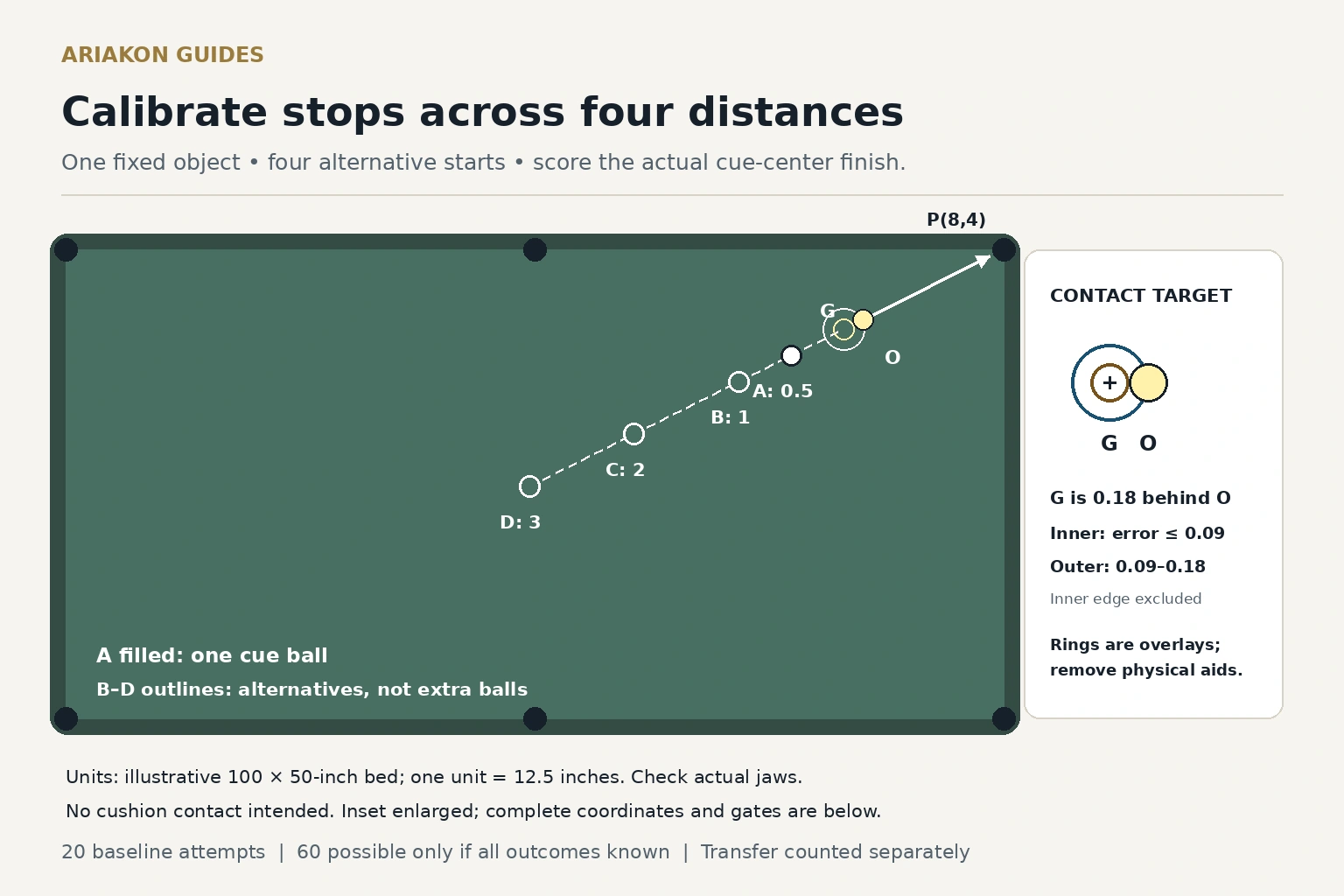
Put the stop target behind the object center
Coordinates describe ball centers on an illustrative 100×50-inch bed: x=0..8 along the length and y=0..4 across it, origin at the lower-left cushion-nose corner. One unit is 12.5 inches. Equal 2.25-inch balls have radius 0.09 and diameter 0.18 units. Intact-cushion center limits are 0.09..7.91 and 0.09..3.91; the four corners and (4,0),(4,4) are real pockets. Measure the actual bed, balls, mouths and jaws before scaling. These are reference units, not a universal diamond system.
Hold object O(6.8, 3.4) and upper-right corner P(8, 4) fixed. The unit direction from O to P is u=(2,1)/√5. The cue-center contact target is G=O−0.18u=(6.639003, 3.319502). A nominal straight stop leaves the cue center at G, one ball diameter behind O. It does not move the cue center into O.
Use a chosen inner disk of radius 0.09 about G and an outer annulus 0.09<error≤0.18. An exact 0.09 error is inner; an exact 0.18 error is outer. These are practice tolerances, not official rules. Measure resting center error from a suitable photograph or off-table reference; remove all aids before striking and never mark a competition table.
Establish a single straight stop first if pocketing and finish observation are not dependable enough for a four-row lookup.
Keep four starts in one dated setup version
The distances are cue-center travel to G, not center-to-center distance to O. For A, the starting centers are 0.68 units apart and the surface gap is 0.50 units. It is not a touching-ball setup. Use a normal near-level delivery within your comfortable range; simplify or stop if you cannot deliver safely.
Write the date, table, balls, cue, setup version, intended vertical-contact label, familiar pace label and bridge reference. Begin each row with a setting you can control; the table does not prescribe four increasingly forceful speeds or a universal low-tip offset. No intentional sidespin is requested. A personal label is a repeatability aid, not a measured tip offset or cue speed.
Reset O and the selected cue start after each strike. Leave B,C,D empty while shooting A. Complete up to five actual attempts per row and up to twenty overall. A stopped session has fewer actual strikes; unused allocations do not become misses.
| Row | Distance from G | Cue center | Five allocated attempts |
|---|---|---|---|
| A | 0.5 units | (6.19179, 3.095895) | 1–5 |
| B | 1 unit | (5.744576, 2.872288) | 6–10 |
| C | 2 units | (4.850149, 2.425074) | 11–15 |
| D | 3 units | (3.955722, 1.977861) | 16–20 |
Check the ordinary delivery baseline before interpreting a scattered distance record as a spin-setting problem.
Count the pot before awarding a finish category
A known foul or miss is 0 regardless of a hidden finish. A known pot with an unobservable cue finish retains its pot count but has unknown nested points. Record actual strikes, known legal pots, known point slots, inner finishes, unknown finishes and unused slots separately. Twenty struck, fully known outcomes permit 60 points; one unknown point slot reduces the known possible total by 3.
A five-attempt row qualifies only after all five were safely struck, at least four known legal called pots and at least three known inner finishes, with every potted finish observable and no unsafe action. A foul scores 0 and cannot earn a pot or finish. These are editorial practice gates, not an official ability scale. One strong row cannot compensate for an unresolved or failed row.
| Points | Established outcome | Cue-center error from G |
|---|---|---|
| 0 | Known miss or foul | No stop points, even if the cue rests near G |
| 1 | Known legal called pot | Greater than 0.18 |
| 2 | Known legal called pot | Greater than 0.09 and at most 0.18 |
| 3 | Known legal called pot | At most 0.09 |
| Unknown | Legality/pot unresolved, or potted finish unobservable | Do not replace missing evidence with 0 or 3 |
Read a mixed record without calling the whole map passed
The C entry means its last pot was seen but its resting finish was not. This example has 18/20 known legal pots and 44/57 known possible nested points, not 44/60 from twenty scored outcomes. Its four-row map is incomplete: B fails and C lacks required finish evidence. A percentage or attractive total cannot waive either row gate.
Retain qualified A and D with their recorded settings. Keep B as a diagnostic row and C as an observation question. Do not invent a twentieth point score, drop the final unknown or claim an observed cue-speed value from a pace label.
| Row | Five point entries | Known sum / possible | Known pots; inner; decision |
|---|---|---|---|
| A | 3,3,3,2,0 | 11/15 | 4 pots;3 inner; qualifies |
| B | 3,3,2,1,0 | 9/15 | 4 pots;2 inner; fails inner gate |
| C | 3,3,3,3,unknown | 12/12 | 5 known pots;4 inner; last potted finish hidden, not qualified |
| D | 3,3,3,2,1 | 12/15 | 5 pots;3 inner; qualifies |
| Total | 20 actual strikes;19 known point slots | 44/57 known possible | 18 known pots;12 known inner;one unknown finish |
Retest one supported change, not both knobs at once
For a repeated forward finish on verified straight legal pots, residual forward rotation is a hypothesis. For a repeated backward finish, retained backspin is a hypothesis. Lateral or alternating errors first call for checking straight alignment, actual contact and setup. A resting point alone cannot quantify impact rotation or prove a unique cause.
Choose one weak row and one small safe change: either a modest vertical-contact adjustment while keeping the pace request, or a modest pace adjustment while keeping the contact request. State the chosen variable before the next five strikes. If delivery or observation is uncertain, the next action is clarification or a simpler task, not more force.
This session allows one extra five-attempt retest: up to 25 actual strikes including the original twenty. Keep a new row version rather than replacing its earlier failures. A hypothetical B retest of 3,3,3,2,0 gives 11/15, four legal pots and three inner finishes. B now qualifies at its new setting, but C is still unresolved; the complete map still has not passed. Continue C in a later bounded record after improving observation.
Sliding contact with cloth can change translational and rotational motion; ideal collision models do not guarantee a perfectly motionless real ball. That is why this worksheet retains observed center error and conditions rather than promising a universal setting. Do not infer a quantitative spin law from these twenty attempts.
Separate mixed errors with a diagnostic probe when no single adjustment is supported by the current row.
Add a second ball only after the four rows qualify
For a separate optional transfer, name O as 1 and add object 2 at N(3, 1.5) for lower-left corner (0, 0). Its tangent cue-center target is (3.160997, 1.580498). Start the first shot at B(5.744576, 2.872288). The nominal stop G lies on the second object’s straight line to its corner. N is behind every first cue start, so it does not obstruct the first approach or O-to-P line. Inspect the actual table and route before striking.
Use five allocated two-ball runs under ordinary lowest-ball-first contact practice, not a break or push out. This is a two-object exercise, not a complete nine-ball rack or a nine-ball win. Reset only between runs. After a legal first pot, play from the actual cue leave; never move it to G. A leave inside the disk can still change the next cut, and a blocked or unsafe second task ends that run.
Keep first-shot nested points separate from second-shot pot outcomes. A first miss, foul or unresolved legality ends the run with later slots unused. Five runs have five first-shot strikes and at most five second-shot strikes, so up to ten actual strikes. Twenty baseline plus five retest plus ten transfer would be 35 only when every allocation is used and the map has qualified. Without a retest the corresponding ceiling is 30. The worked incomplete baseline above authorizes no transfer.
| Run | First-shot points | Second-shot outcome | Actual strikes |
|---|---|---|---|
| 1 | 3 | Known legal pot | 2 |
| 2 | 3 | Known miss | 2 |
| 3 | 2 | Known legal pot | 2 |
| 4 | 0 | Unused after first miss | 1 |
| 5 | 3 | Shot made; result unobservable | 2 |
| Total | 11/15 first-shot points | 2 pots /3 known second outcomes;1 unknown;1 unused | 9 actual strikes |
Build a three-ball stop pattern as a different task when sequential positioning, rather than the four-distance lookup, is the goal.
Measure finite stun travel separately when a real next-shot cut makes an ordinary straight stop unsuitable.
Carry forward settings, conditions and limits together
The useful output is four dated rows: start center, controlled contact and pace labels, actual pot/finish evidence, and qualified or unresolved status. Keep the earlier row beside a new setting version. On another table or after a material condition change, the old map is a starting hypothesis; recheck the needed row with five new strikes before relying on it.
A successful pot does not validate every target ring, and an in-disk leave does not certify the next route. Use the actual finish to choose the next shot. If the whole lookup is more complex than your current needs, retain one qualified row and practice that distance safely. Do not merge this resource into the basic stop introduction or three-ball pattern guide merely because each uses a stop shot.
Sources and further reading
References support the specific factual information above. The practical checklists are Ariakon editorial guidance.