
Match study · 3 min read
Study Women's Professional Pool Through Shot Decisions and Patterns
Women’s professional pool provides high-level match decisions worth studying as decisions—not as evidence that women share one style. Choose a complete official or rights-holder-authorized match, identify the rule and score context, and reconstruct a few layouts. Your task is to learn why an option fit the table, not to imitate a player's identity or declare one outcome universally correct.
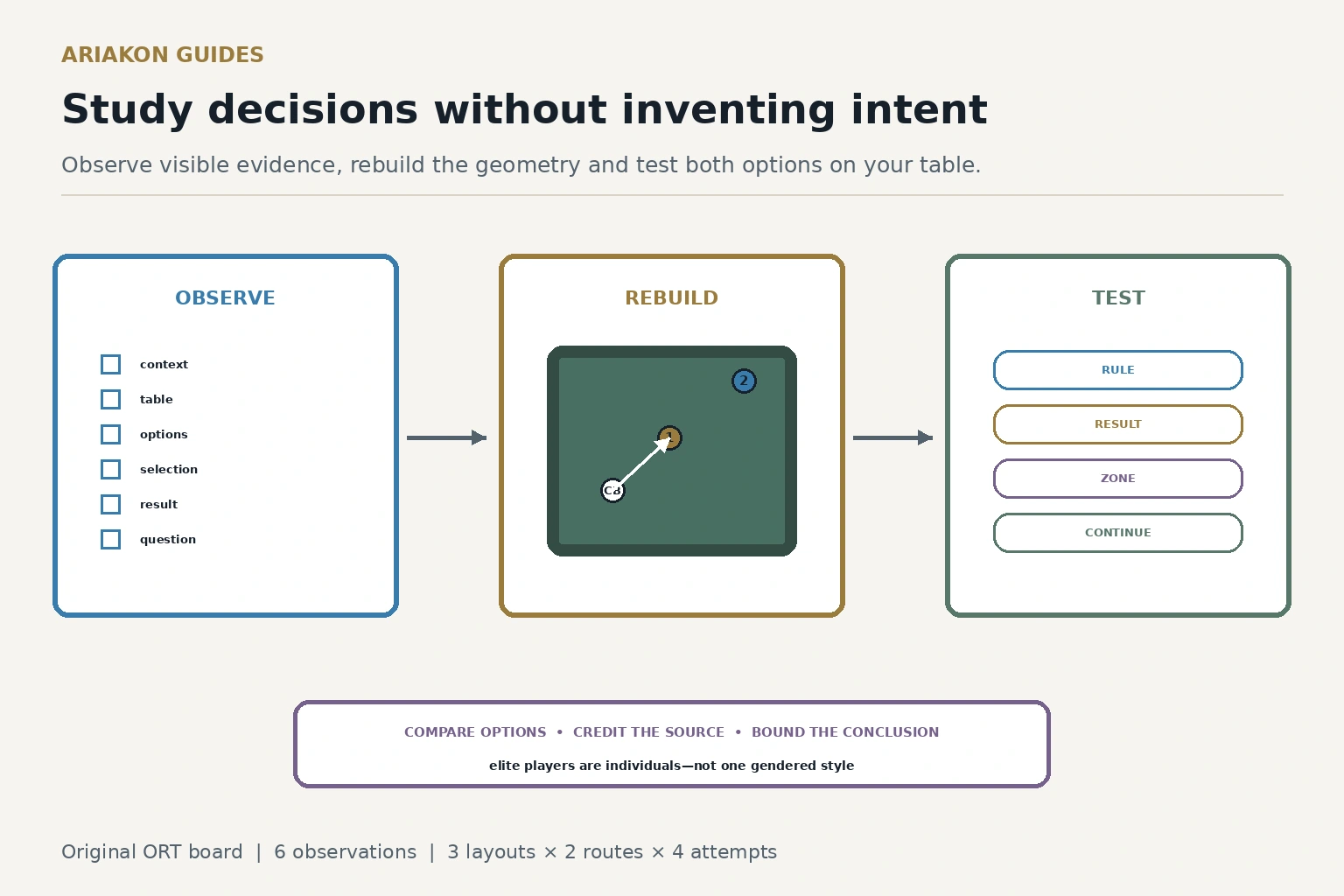
OBSERVE six decisions without inventing intent
The WPBA publishes current events, results, players and tour rules; use those pages to identify the match context and then verify that the video is from an official or authorized channel. The current WPA rules can provide a separate rules reference when an event adopts them. Save the source and access date with every clip time.
Select two offensive choices, two safety choices and two transition choices. This produces a broader notebook than collecting only spectacular shots. A commentator's explanation is a useful hypothesis, not direct access to the player's thoughts.
| Field | Record | Avoid |
|---|---|---|
| Context | Event, date, discipline, rule source, score and inning | Assuming rules from another tour |
| Table | Ball coordinates, pockets, blockers and cue-ball access | Describing personality from one layout |
| Options | At least two plausible offense, safety or two-way choices | Claiming the player considered your list |
| Selection | Observed shot, speed family and route | Guessing emotion or private strategy |
| Result | Pocket, cue-ball zone, leave and opponent response | Treating a good outcome as proof of the only good decision |
| Question | What table fact most changed the tradeoff? | Generalizing a gendered playing style |
Use the general professional-match study method for video selection and note-taking basics.
Build a three-ball position plan before reconstructing longer sequences.
REBUILD three exact layouts
Normalize a reconstructed table to x=0 to 4 across and y=0 to 8 along the length. For each of three selected layouts, record approximate ball centers, the intended legal first contact and a real pocket. Compare two genuinely available options from that layout. Establish each route with unscored trials on your table, then freeze its cushion gates and one-diamond position zone. If a proposed route is not feasible, record that finding and choose another route before scoring.
This example is not attributed to a named player or match. For a real reconstruction, accept that broadcast perspective creates measurement uncertainty. Mark approximate coordinates, cushion contacts and zone boundaries, then keep them fixed across attempts. Rebuild the decision geometry, not the player's exact speed or equipment response.
TEST both options over 24 attempts
Alternate routes A and B rather than completing all easy-looking attempts first. Record the first failure: selection, pocket/contact, first route gate, speed zone or continuation. If one route scores higher, describe the conditions—your table, your marks, that session—instead of claiming the professional should have chosen it.
Game transfer: during six ordinary racks, pause once when two materially different options exist. Sketch the layout, choose using table and score facts, then play without a second guess. Review after the rack. The exercise builds observation and option comparison; it does not rank players or imply that elite women should be studied differently from other elite competitors.
| Point | Observable condition |
|---|---|
| 1 — Rule | Chosen option is legal in the verified discipline |
| 1 — First result | Object ball is pocketed or the safety contact is completed |
| 1 — Position | Cue ball reaches the declared zone or leave |
| 1 — Continuation | Next shot or opponent difficulty matches the plan |
| Maximum | 96 points across 24 attempts |
Sources and further reading
References support the specific factual information above. The practical checklists are Ariakon editorial guidance.