
Match study · 4 min read
Watch Amateur Pool Finals With a Tactical Observation Sheet
An amateur final can teach decisions you are likely to face: imperfect layouts, time pressure, safeties, rule questions and recoveries after mistakes. Passive viewing remembers highlights. A tactical observation sheet captures what the table allowed, what the player chose and whether the outcome supports or merely rewards that choice.
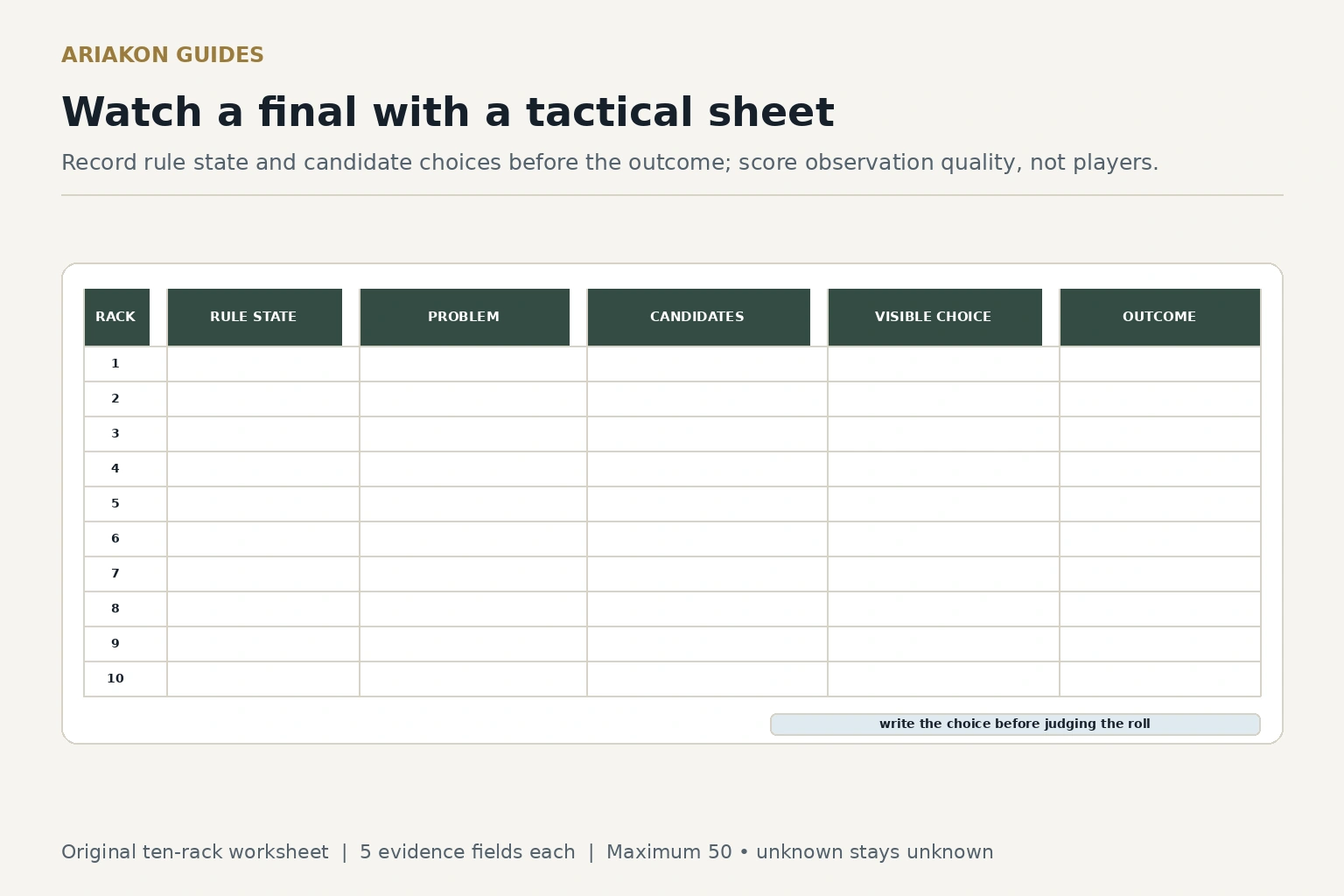
Verify the event and rules before scoring tactics
Write the event, discipline, match format, race or team context, table size if documented, source URL and viewing date. Use the event's official rules or program, not a commentator's shorthand. A shot that is mandatory, illegal or strategically shaped by format cannot be judged correctly under different rules.
Current APA event pages, rules and programs provide examples of official format context and streamed finals. This worksheet works for other organizers too, provided you cite that organizer's current source instead of mixing rule sets.
Learn the wider amateur-championship preparation lessons before using a final as evidence for your own event plan.
Choose ten racks, not ten highlights
Start at a documented match point and observe ten consecutive racks, or the rest of the match if fewer remain. Consecutive sampling keeps routine decisions and failed ideas in the record. If the video cuts away or omits a rack, mark unavailable rather than replacing it with a replay highlight.
Pause only after the balls stop. Before seeing the next shot, write the current rule state, the shooter's apparent problem and your own candidate. Then resume and record the visible choice.
Use one row per decisive turn
| Field | What to record | Allowed wording | Avoid |
|---|---|---|---|
| Rule state | Game, groups/order, ball in hand, push or foul state | Visible / official says / unknown | Assuming house rules |
| Problem | Cluster, blocked pocket, transition, safety or break recovery | One observable sentence | Player was nervous |
| Candidates | Your offense and safety options | At least two when available | Only copying the chosen shot |
| Visible choice | Shot, speed band and cue-ball route | Describe path and target zone | Claiming hidden intent |
| Outcome | Pocket, leave, hook, foul and next-player access | What the camera shows | Good because it went in |
| Transfer | One similar layout to practice | Exact balls and gate | Vague play smarter note |
Score observation quality, not player quality
For each rack, award one point for a verified rule state, one for a clearly written problem, one for two candidate choices, one for the actual cue-ball route, and one for an outcome stated without mind-reading. Ten racks produce a maximum of 50 points.
A low score means your evidence is incomplete, not that the players performed poorly. Rewatch only the missing fields. If the camera cannot show a contact or leave, write unknown and keep the honest zero.
Separate decision quality from the roll
| Before-shot case | After-shot outcome | Useful conclusion | Practice response |
|---|---|---|---|
| Clear route and large margin | Missed ball | Execution failed; choice may remain sound | Recreate line and speed |
| Tiny margin with safer option | Ball made | Success does not erase exposure | Compare both options |
| Safety contains two escape routes | Opponent kicks safe | Good reply does not prove poor safety | Map return risks |
| Rule state uncertain | Any result | No tactical verdict yet | Verify official rule first |
Work one rack into a practice card
Example: with three balls remaining, the shooter can cut the first ball and send the cue ball across two rails, or play safe behind the last ball. The cut succeeds but leaves a thin next shot. Your note should preserve both candidates, the intended zone visible from the path, the actual thin leave and the opponent's access—without declaring what the shooter felt.
Recreate only the table problem, not the player's identity. Shoot five offensive attempts and five safety attempts. Score 0 for illegal or missed first contact, 1 for the primary result, 2 for the called cue-ball zone, and 3 when the opponent's reply is also constrained. Maximum 30 points.
Finish with three transferable patterns
After ten racks, group your rows into opening decisions, mid-rack transitions and end-pattern or safety decisions. Choose one repeated pattern from each group and write an exact table setup, target zone and five-attempt score. Do not turn one final into a universal style ranking or a claim about all amateur players.
Repeat the sheet on another final under the same rule set. A pattern that appears in both samples is a stronger practice candidate than one memorable shot, but it is still an observation sample rather than measured population research.
Use a general professional-match observation method when comparing elite pattern choices with your own options.
Sources and further reading
References support the specific factual information above. The practical checklists are Ariakon editorial guidance.