
Learning skills · 3 min read
Learn From Professional Pool Matches Without Copying Everything
Watching excellent pool can teach more than admiration, but only when you decide what to watch. A professional's choices reflect that player's skill, equipment, table and match situation. Isolate one observable behavior, explain the problem it solves and test a scaled version before adopting it.
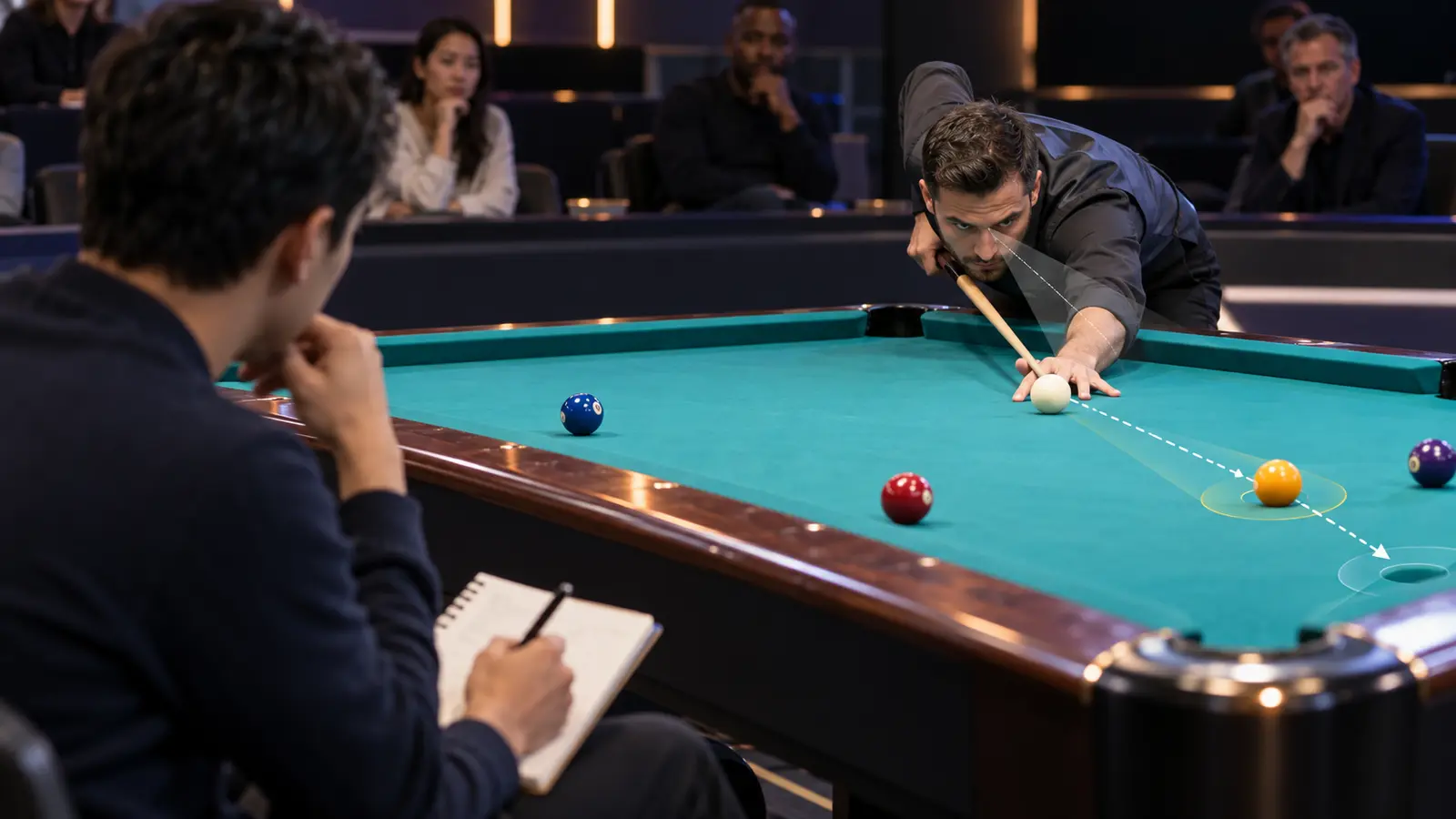
Give one viewing session one question
Choose a narrow question before the match starts: How does the player enter the stance? Where do they accept a longer shot to protect position? When do they choose a safety instead of a low-percentage attack? A single question keeps highlights from becoming a blur of impressive outcomes.
Use a full rack or several visits, not one spectacular shot. Observational-learning research supports modeled demonstrations as a motor-learning tool, but the value depends on what the learner attends to and how the observation is used.
Separate decisions from execution
Before the cue moves, record the chosen ball, intended pocket, cue-ball zone and obvious alternative. After the shot, separately note speed, spin, bridge length and finish. This prevents a fortunate result from disguising a weak decision—or a miss from erasing a sound plan.
Pause before commentary when possible and make your own prediction. Comparing that prediction with the player's choice reveals gaps in pattern recognition instead of merely repeating an explanation after the fact.
Watch the routine between shots
Count the behaviors that repeat: standing evaluation, chalking, final look, approach, warm-up strokes, pause and finish. Do not copy the exact count or tempo automatically. Look for the stable sequence that helps the player separate planning from delivery.
Also watch the chair. Notice whether the player stays engaged with the table, resets after an error and prepares before returning. Those behaviors are easier to scale than an elite power break or extreme spin shot.
Choose a model close enough to learn from
An elite player may solve a layout with speed, spin or pocketing accuracy you do not yet own. When that happens, copy the decision principle rather than the shot: favor the open side of the position zone, avoid crossing a scratch line or remove the blocker early.
Use several players when studying style-dependent choices. A single champion is evidence that an approach can work for that person, not proof that one stance, rhythm or cue is universal.
Turn the observation into a table test
Recreate one ordinary position from memory or a legal screenshot diagram of your own making. Mark a generous cue-ball zone and try the observed decision ten times with your normal cue. Record pocket success, zone success and the most common miss.
Then test a simpler alternative. Keep the observation only if it improves a result you can measure or makes the decision clearer. Watching becomes practice when it produces a repeatable experiment.
Use a three-line match note
- Problem: the specific layout or pressure decision you observed.
- Principle: the repeatable idea behind the player's choice.
- Test: one setup you can run at your present skill level.
- Do not infer product claims from a player's equipment on screen.
- Respect event footage, broadcast rights and venue recording rules.
- Review the note after practice and discard what did not transfer.
Sources and further reading
References support the specific factual information above. The practical checklists are Ariakon editorial guidance.