
Learning skills · 3 min read
Assess an Entertainment Pool Clip Without Mistaking It for Instruction
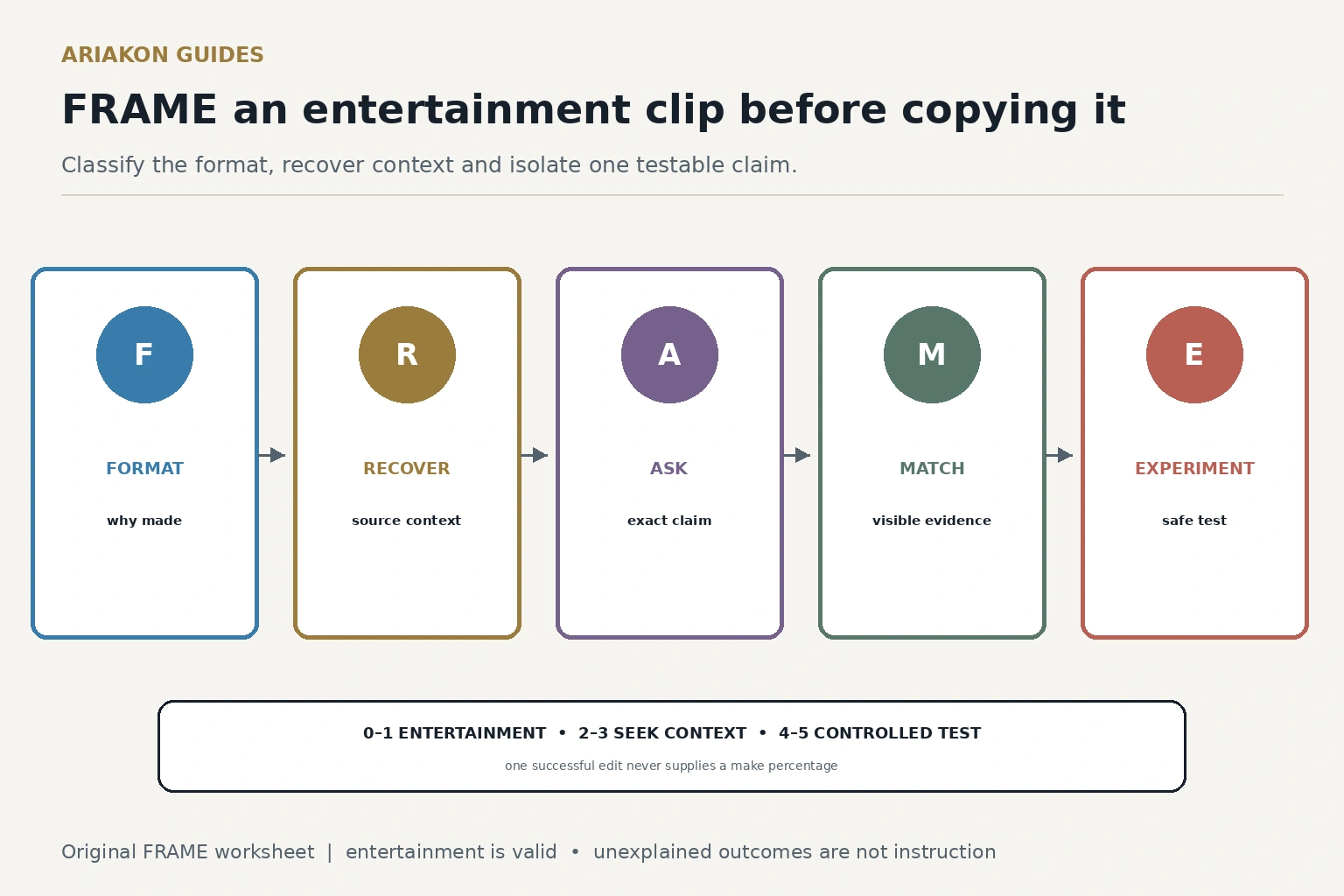
A short pool clip can be funny, impressive, edited, sponsored or genuinely instructional—and sometimes several at once. The viewer’s task is not to dislike entertainment. It is to avoid turning an unexplained outcome into a universal technique. Use the FRAME worksheet to identify the format, recover context, isolate the actual claim and decide whether any safe test belongs on your table.
Start with format, not the outcome
| Visible format | Reasonable use | Missing before instruction |
|---|---|---|
| Highlight or montage | Inspiration and shot awareness | Full attempts, setup and failure rate |
| Comedy or celebrity segment | Entertainment and cultural context | Teaching purpose, repeatable method and conditions |
| Product or sponsored clip | A claim to verify | Clear relationship disclosure and controlled comparison |
| Instructional demonstration | Candidate technique | Exact setup, safety, limits and transferable results |
Learn from full professional matches when decisions and several visits are visible.
Evaluate a product demonstration video when the clip makes equipment claims.
Use the FRAME worksheet
Lateral reading means leaving the clip briefly to learn about the uploader and locate independent or original context. It is especially useful when a repost removes a caption, sponsorship, failed attempts or the longer sequence.
| Step | Question | Evidence to capture |
|---|---|---|
| F — Format | What was this made to do? | Entertainment, promotion, match record or lesson |
| R — Recover context | Who posted it and where is the longer source? | Original uploader, date, full sequence and stated conditions |
| A — Ask for the claim | What exactly would a viewer copy? | One sentence about setup, action and expected result |
| M — Match evidence | Does the clip show repeated support? | Attempts, misses, comparison and ball result |
| E — Experiment safely | Can the idea be tested at lower risk? | Registered setup, stop rule and one observable score |
Distinguish observation from inference
For endorsement content, current FTC guidance says material connections should be clear and conspicuous; video disclosures should appear in the video rather than relying only on a description. That check identifies context. It does not validate the performance claim itself.
| You can observe | You cannot conclude from the clip alone |
|---|---|
| Ball positions visible in the chosen frame | That positions were unchanged between edits |
| One successful outcome | The make percentage or best technique |
| Visible cue and bridge movement | The player’s intention, force or cause of success |
| Brand or product appearance | Inventory, endorsement, payment or comparative performance |
| A disclosure in the clip | That every relevant relationship or claim is verified |
Score the clip before practicing it
Give one point for each FRAME step supported by observable evidence. A score of 0–1 means entertainment only. At 2–3, record the idea but seek the original context or a technical source. At 4–5, the claim may earn a controlled test; it still has not become fact for your game.
Do not recreate jumps, masse shots, airborne balls, crowded-room stunts or equipment modifications without suitable instruction, permission and safe conditions. A safe lower-risk test may capture the underlying principle without copying the spectacle.
Worked example: a jump-cut combination
A hypothetical fifteen-second clip shows a three-ball combination, a reaction shot and a product logo. FRAME finds entertainment format, a repost rather than the original source, no exact technique claim, one successful result and no safe setup details: 1/5. The honest note is “interesting ball-path idea; not instruction.”
The viewer later finds an original longer post with the layout, several attempts and a sponsorship disclosure. The idea is reduced to a normal-speed two-ball combination on a clear table, attempted six times with pocket and cue-ball finish recorded. The test measures the viewer’s result; it does not certify the original clip or create an Ariakon endorsement.
Sources and further reading
References support the specific factual information above. The practical checklists are Ariakon editorial guidance.