
Runout practice · 4 min read
A Three Ball Runout Drill With Progressive Position Targets
Random three-ball runouts are valuable, but a changing layout makes it hard to tell whether position control improved. This drill fixes the same three-ball route and shrinks the cue-ball targets in three stages. The player must pocket in order, enter the called side of each zone and diagnose the first route error rather than treating every failed run as a pocketing problem.
Build one repeatable three-ball pattern
Coordinates are ball centers on an illustrative 100 by 50 inch bed: x=0..8 along length, y=0..4 across width, origin at the lower left cushion nose. One unit is 12.5 inches. For 2.25 inch equal balls, radius is 0.09 and diameter 0.18 units. Intact cushion center boundaries are x=0.09,7.91 and y=0.09,3.91; pockets interrupt the physical boundary at the four corners and (4,0),(4,4). Measure actual bed, balls and jaws before scaling. Remove every measuring aid before shooting; never mark a competition table.
Use three numbered balls and real pockets. Nominal straight-stop chain: O1(3.280465,1.948675) to P1(8,4), contact G1(3.115385,1.876923), cue C(2.014845,1.398578). O2(3.569231,2.966154) to P2(4,4), contact G2(3.5,2.8). O3(1.75,1.4) to P3(0,0), contact G3(1.890556,1.512445). Nominal starts for shots 2 and 3 are G1 and G2; continue from the actual leave, never move the cue between shots.
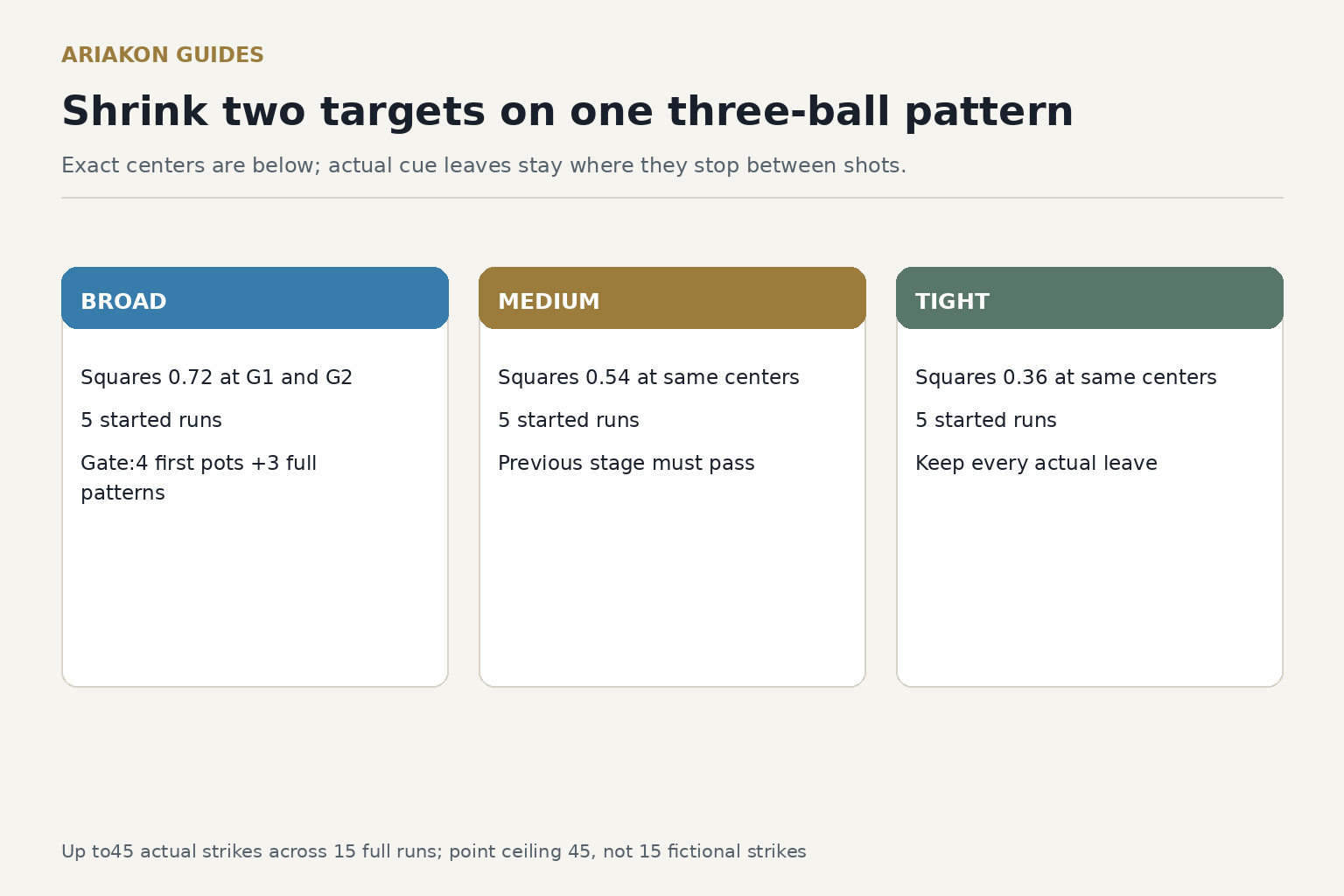
Center the 2-zone on G1 and the 3-zone on G2. Broad is a square total side 0.72 units; medium 0.54; tight 0.36. The rings are chosen tolerances, not proof that the next actual leave remains straight. Use ordinary no-intentional-sidespin delivery and inspect each actual next line. This task changes target size; the separate linked-stop resource works backward through component gates.
Plan patterns backward from the final transition before choosing a different route.
Shrink only the position targets
| Stage | 2-ball zone | 3-ball zone | Attempts | Advance gate |
|---|---|---|---|---|
| A: Broad | 0.72 square at G1 | 0.72 square at G2 | 5 runs | ≥4 first pots;≥3 complete patterns through both zones |
| B: Medium | 0.54 square at G1 | 0.54 square at G2 | 5 runs | Same gate |
| C: Tight | 0.36 square at G1 | 0.36 square at G2 | 5 runs | Same gate |
Score each run in order
| Points | Result | Record |
|---|---|---|
| 0 | Known foul or 1 miss | End run |
| 1 | 1 potted but first zone missed, or next 2 shot missed | Record first observed failure |
| 2 | 1 and 2 potted through first zone; second zone or final 3 pot fails | Record first observed failure |
| 3 | All 3 legally potted through both zones | Completed pattern |
| Unscored | Legality, required zone or later outcome unknown | Keep known pots; end run if continuation unresolved |
Use a forty-five-point progression
Five started runs per stage, at most 15 actual strikes. End a run at its first miss, foul, failed required zone or unresolved continuation. Five fully known run scores have ceiling 15 per stage,45 only if all three stages are reached and known; actual strikes across all stages can be up to 45. Unused later shots are not misses. Evaluate the stated gate only after five safe runs; an incomplete stage cannot pass.
If Stage B fails, return to its full five attempts next session rather than widening one target after each miss. This original worksheet isolates target size as the progression variable; no named training program or ability rating is implied.
Diagnose the first route error
| First error | Evidence | One next action | Hold fixed |
|---|---|---|---|
| First pocket miss | Observed pocketing line, pace and required first contact | Retest one change supported by the record | Exact original centers |
| 2-zone short or long | Actual cue rest relative to G1; arrival rotation if visible | Check the stop input before one bounded retest | Aim and original target size |
| Wrong side of 2-zone | Actual rest and resulting next-shot line | Compare one supported input in a new setup version | Object centers; never change the baseline midcard |
| 3-zone miss after good first route | Actual second start and second contact evidence | Rehearse five separate 2-to-3 attempts | Keep those results outside the scored stage |
Work one scorecard example
Hypothetical Stage A scores 3,3,2,3,3=14: four complete runs and five first pots pass. Stage B scores 2,1,3,2,1=9: one completion fails the gate. There are two failures in the first transition and two in the second/final branch. Record which actual event produced each 2 before prescribing a 2-to-3 speed block. Stage C remains unused.
When Stage B passes, keep the same route for Stage C. A different spin route may be valuable later, but it is a new comparison and needs its own baseline.
Transfer the target ladder to a new layout
After passing Tight twice, throw three balls into open positions and plan backward. Draw broad zones for the first attempt, medium zones after one success and tight zones only after two complete runs. Preserve the same 0-to-3 score.
The fixed drill measures delivery; the random transfer checks recognition and route choice. Keep their scores separate so a planning mistake does not erase evidence that the practiced route improved.
Sources and further reading
References support the specific factual information above. The practical checklists are Ariakon editorial guidance.