
Straight pool · 3 min read
Study Straight Pool Footage With a Source Observe Test Worksheet
A long run becomes useful study when visible decisions are separated from commentary and your own inference. Choose a complete authorized recording with a clear source and date. Study one rack, preserve what cannot be seen and test one original practice hypothesis on your own table.
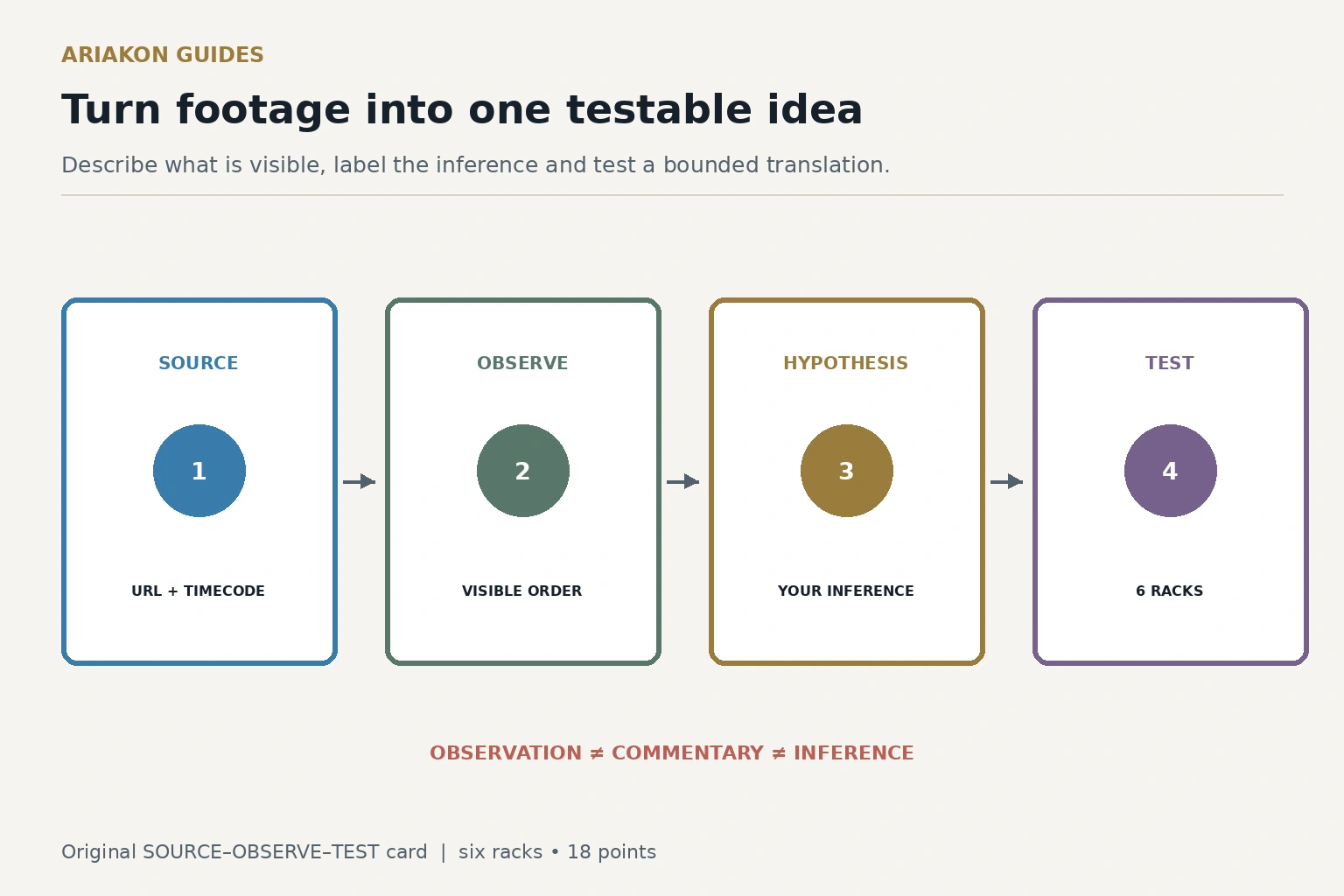
Build a source ladder before taking notes
Use the full recording from its rights holder or an authorized event channel. Save its URL, date and timecodes, and record whether commentary was captured during play or added later. Keep that detailed research in your personal study log; this worksheet claims no ownership of the footage or another instructor’s exercise.
Separate observation from explanation: an available break ball remained while three nearby balls were removed. That visible order can support the hypothesis that preserving access reduced end-rack traffic. It cannot establish an unstated motive or a universal player rule.
| Level | Example | What it can support |
|---|---|---|
| A. Direct recording | Continuous or clearly identified run footage | Visible ball positions, shot order and outcomes |
| B. Player commentary | The player explicitly explains a choice | The stated reason in that bounded context |
| C. Analyst commentary | A named instructor interprets the sequence | Attributed analysis, not the player's words |
| D. Your inference | You identify a possible key-ball or insurance-ball pattern | A hypothesis to test |
| E. Rule source | Current straight-pool rules | Legal scoring, rack and foul conditions |
Learn from professional pool matches for the general one-question viewing method.
Plan straight-pool key balls before testing the final-three-ball pattern.
Observe one rack through five decisions
Watch the chosen segment once without pausing, a second time to map the final five balls and a third time to check your notes. If the camera cannot show a contact point or the layout is obscured, label it unobserved.
Current WPA straight-pool rules explain that fourteen balls are reracked when one object ball and the cue ball remain, subject to position rules. Use the current rulebook for legal reconstruction rather than copying a casual practice convention.
| Decision | Write only what is visible | Possible test |
|---|---|---|
| Break ball | Which ball and angle remain as the rack thins | Preserve one marked break-ball zone |
| Key ball | Which shot creates the break-ball angle | Build the final three backward |
| Insurance | Which open ball remains when a route is uncertain | Compare keeping versus spending it |
| Cue-ball route | Rails, speed window and traffic actually used | Mark a generous landing zone |
| Recovery | First position error and next selected shot | Practice the recovery, not the whole run |
Run a six-rack hypothesis test
Worked example: a viewer observes a preserved break ball and tests whether naming the final-three plan earlier helps. Baseline rack scores 1, 2 and 1 total 4/9; trial scores 2, 3 and 2 total 7/9. The combined record is 11/18, but the two block profiles matter more. This small hypothetical result calls for another test; it does not reproduce a professional’s complete method.
If the trial fails because the layout differs, narrow the claim. Test a single final-three pattern placed by hand, then return to natural racks. Report your own score as personal practice evidence and keep the source attribution separate.
| Block | Constraint | Score per rack |
|---|---|---|
| Baseline | Play three practice racks with your normal planning | 1 break ball retained; 1 key-ball angle; 1 legal rack entry |
| Trial | Play three racks while naming the final-three plan early | Same three points |
| Maximum | Six racks | 18 points; note first planning failure |
| Decision | Compare decision process with your own baseline, not a high-run total | Keep, revise or reject the hypothesis |
Sources and further reading
References support the specific factual information above. The practical checklists are Ariakon editorial guidance.