
Straight pool · 3 min read
Study Straight Pool Tournament Patterns With a Break Ball Notebook
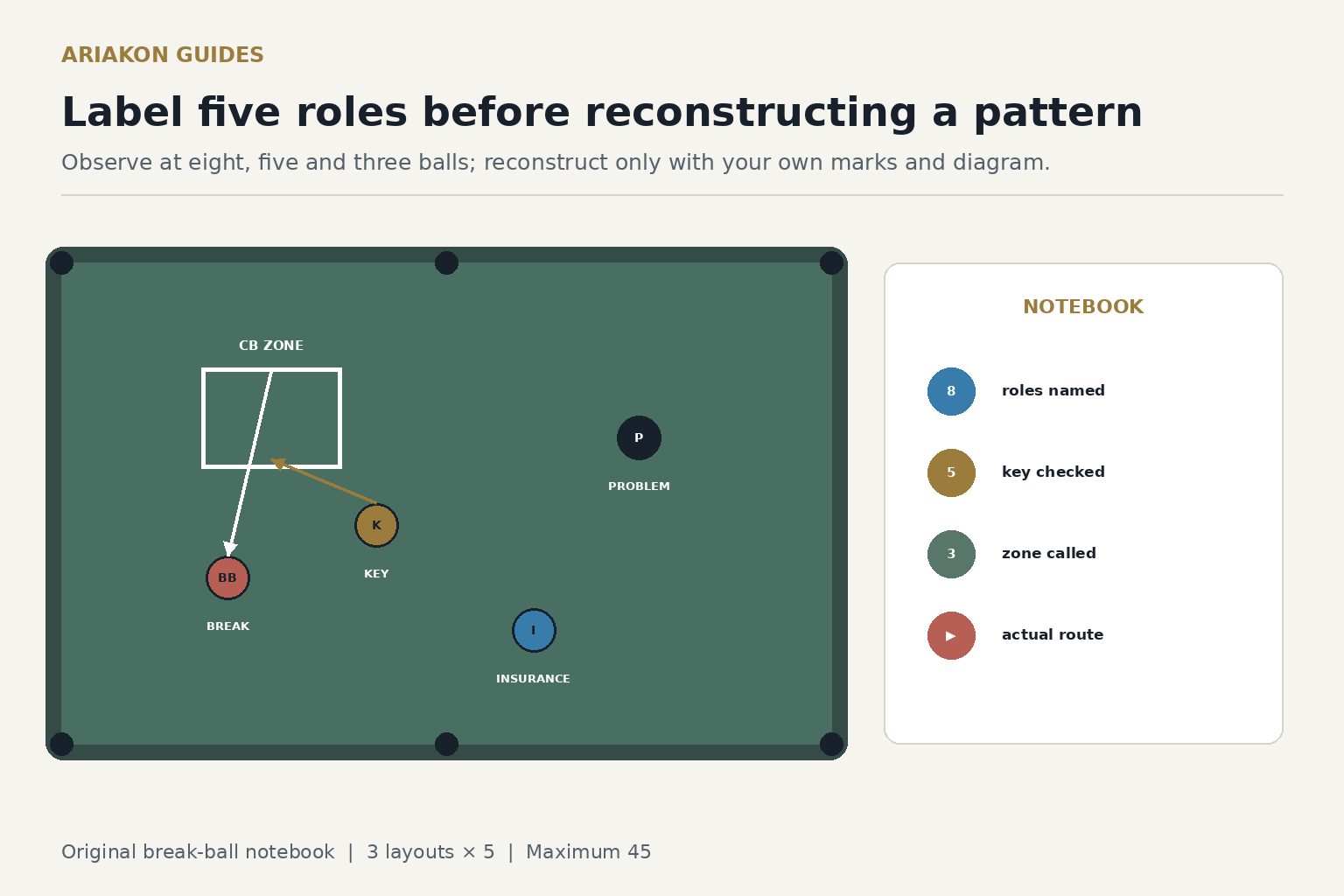
Watching a high run is not the same as studying it. A break-ball notebook makes observation active: identify the intended break ball, work backward to its key ball, record insurance and problem balls, then check where the cue ball actually finishes. Use footage you are entitled to view and your own diagrams; do not copy someone else's commentary, graphics or tournament story.
Anchor the notebook to current straight-pool rules
Under the WPA's current 14.1 Continuous rules, called balls count, play continues after a legal called shot and fourteen balls are reracked while the fifteenth remains in position. The exact rerack exceptions and penalties matter, so keep the current rule page beside the notebook instead of relying on memory.
This guide assumes the general rules are already familiar. Its task is narrower: observe how a player preserves a candidate break ball and reaches it through the final few balls.
Review straight-pool rules and basic planning before studying tournament pattern choices.
Assign five roles at three checkpoints
| Role | Question | Checkpoint |
|---|---|---|
| Break ball | Which ball can open the next rack? | 8, 5 and 3 balls left |
| Key ball | Which ball reaches the break-ball zone naturally? | 5 and 3 left |
| Insurance | Which ball can repair an imperfect leave? | 8 and 5 left |
| Problem | Which ball blocks or has one pocket? | 8 left |
| Cue-ball zone | Where must the cue ball finish for the break ball? | Before the final transition |
Observe ten racks without judging the player
Pause only at the 8-, 5- and 3-ball checkpoints. Draw ball centers approximately, label the five roles and predict the next two shots. Then resume and record the player's actual choice. A different choice is evidence for comparison, not proof that either plan was wrong; camera angle can hide exact clearance and cue-ball position.
For each rack, record whether the initial break-ball candidate survived, changed or disappeared; whether the key ball was used as predicted; and whether the cue ball entered the predicted zone. Avoid invented percentages. Ten observed racks create ten cases, not a claim about tournament-wide frequency.
Reconstruct three useful layouts
| Layout | What to reproduce | Attempts | Success condition |
|---|---|---|---|
| A Clean | Break ball, key ball and open route | 5 | Reach called break-ball zone |
| B Repair | Same roles plus insurance ball | 5 | Recover once and reach zone |
| C Choice | Two break-ball candidates plus problem ball | 5 | Choose one plan and preserve it |
Score the pattern, not the name on the video
Fifteen attempts have a maximum of 45 points. Keep each layout subtotal out of 15 and preserve the signed cue-ball finish so a pocketed sequence cannot hide a poor break-ball angle.
| Points | Pattern result | Record |
|---|---|---|
| 0 | Foul or chosen break ball lost immediately | First failure |
| 1 | Legal sequence but no usable break shot | Wrong side, blocked or flat |
| 2 | Break ball preserved; zone missed | Signed finish |
| 3 | Break ball preserved and cue ball reaches called zone | Route completed |
Diagnose one role at a time
| Repeated failure | Notebook question | Next five attempts |
|---|---|---|
| Break ball disappears early | Was it used for convenience? | Circle it and forbid it until last three |
| Key-ball leave is flat | Was its ideal cue-ball side drawn? | Mark a two-ball landing zone |
| Repair route collapses | Was insurance removed too soon? | Keep insurance until problem ball is solved |
| Zone misses one direction | Was speed or route wrong? | Repeat final two balls only |
Transfer the notebook to a live rack
Play one full solo rack. At eight balls, stop once and write the five roles without moving anything. Continue without another pause, then compare the planned and actual last-five sequence. Score only the final transition using the same 0–3 scale.
If the live rack produces no suitable break ball, record that honestly and practice preserving a candidate earlier. The notebook is a planning tool, not a claim that every rack offers the same solution.
Sources and further reading
References support the specific factual information above. The practical checklists are Ariakon editorial guidance.