
Cue ball control · 4 min read
Recognize Stun at Object Ball Contact With a Tangent Line Test
Stun describes the cue ball's state at object-ball contact: it is sliding with no top or bottom spin. On a cut shot, a stunned cue ball initially travels along the tangent line, perpendicular to the object ball's line of motion. Tip position alone cannot prove stun because drag changes the cue ball on the way to contact. This drill makes the departure direction observable.
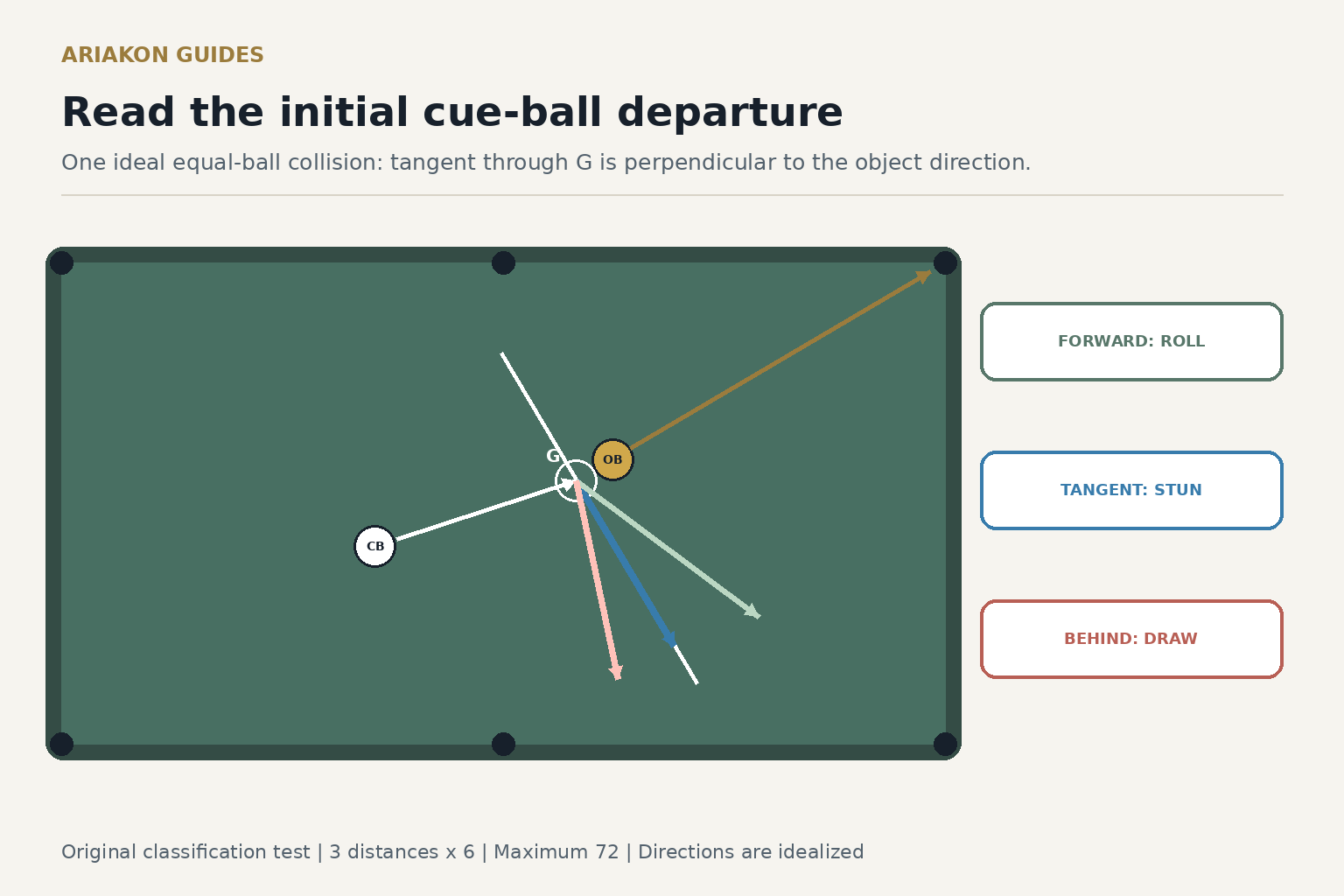
Draw the tangent line from the collision
Set a moderate cut to a corner pocket. Mark the object-ball center, cue-ball start and estimated ghost-ball center. Draw the object-ball line from its center to the pocket. Through the ghost-ball center, imagine a line at ninety degrees to that object-ball line. That is the tangent reference.
Place two safe visual markers outside the ball paths to extend the line; remove anything that could be struck. The cue ball may curve away after its initial departure because cloth friction converts sliding to rolling. Judge only the first short segment after contact, not the final cushion destination.
Control the cue ball with stun shots for the full technique and stun-follow/draw extensions.
Train the tangent line after you can classify impact state.
Classify three visible departures
A tangent-line result does not certify perfect physics or exact degrees. Pocket cut, throw, cloth, speed and observation error remain. It is a practical classification under one setup. Keep the cue on the vertical axis so sidespin does not add avoidable object-ball throw or cushion effects.
| Departure | Impact state | Next adjustment |
|---|---|---|
| Along tangent line | Stun or close practical stun | Retain contact and speed |
| Forward of tangent line | Forward roll present | More initial backspin or less travel time |
| Behind tangent line | Backspin remains | Less initial backspin or more travel time |
| Sideways curve or unexpected throw | Possible sidespin/contact error | Restore vertical axis before judging stun |
Run an eighteen-shot distance test
Keep the object ball and cut fixed. Mark cue-ball stations about one, two and three diamonds from the ghost-ball position on the same approach line. At each station, shoot six attempts using your normal stun plan. Start with a below-center hit and enough speed that drag can remove the backspin by object-ball contact.
Do not assume the same tip height and speed will stun from all three distances. The longer path gives cloth more time to change spin. The exercise measures whether you can recognize the resulting state, then build a separate reliable input for each distance.
| Point | Requirement |
|---|---|
| 1 | Object ball pocketed in the called corner |
| 1 | Pre-shot impact-state call made |
| 1 | Observer-supported departure classification recorded; unknown earns no point |
| 1 | Cue ball travels inside a one-ball-wide tangent corridor initially |
| Maximum 72 | 18 attempts; record forward or behind on misses |
Worked example: the same hit rolls at long distance
At one diamond, a player sends five of six cue balls inside the tangent corridor. At two diamonds, four qualify. At three diamonds, only one qualifies and four leave forward of the line even though the same low aiming point was used. The observed change is consistent with backspin wearing off before contact, not evidence that the tangent line moved.
The player keeps the three-diamond setup and tests a slightly lower safe contact with the same controlled speed for six unscored calibration shots. Four now leave inside the corridor without a miscue. The next scored block uses that input only at the long station. No universal tip coordinate is claimed; it is a table-specific calibration.
Transfer the test to position play
Place a broad landing zone along the tangent line before a cushion and a second zone forward of it. Shoot twelve attempts in shuffled calls: six practical stun routes to the tangent zone and six rolling routes to the forward zone. Score one for pocket, one for correct departure and one for called zone; maximum thirty-six.
If departure is correct but the final zone is wrong, work on speed rather than changing the impact state. If the object ball misses consistently, recheck cut aim and throw. When the route is stable, compare it with rolling cue-ball paths on the same cut instead of treating stun as the default for every position shot.
Compare tangent and rolling routes for the next matched-route exercise.