
Fundamentals · 3 min read
Pool English, Stun, Draw and Follow: A Cue Ball Vocabulary Guide
Pool vocabulary is useful only when two players mean the same observable thing. Follow, stun and draw describe the cue ball's forward, sliding or backward rotation at object-ball contact. English usually means sidespin around a near-vertical axis. Tip placement starts the shot, but cloth friction, speed and distance determine which spin state survives to contact.
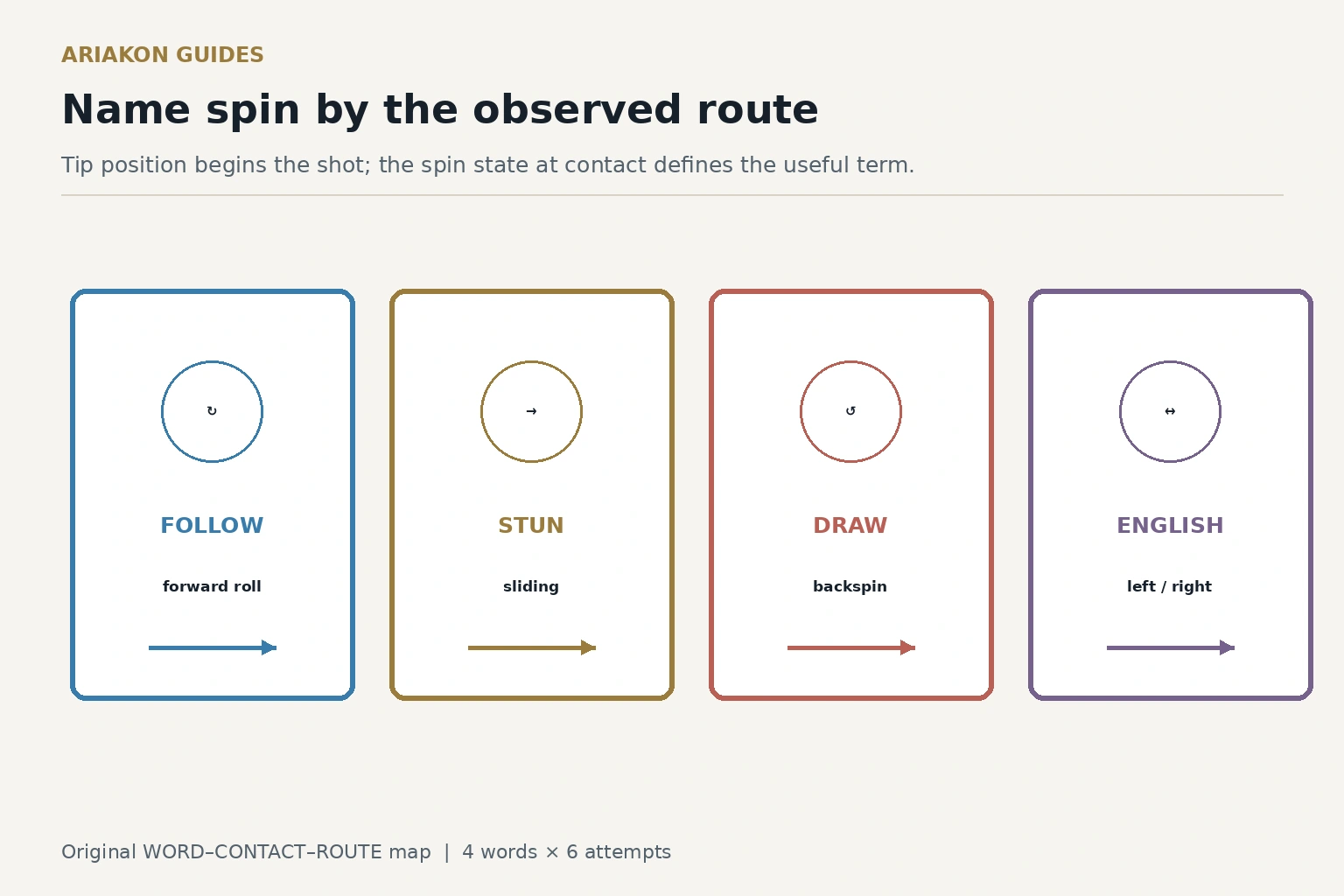
Name the state, not only the tip position
A low hit is not automatically a draw shot. If distance and cloth friction convert the backspin to sliding or rolling before contact, the result may be stun or follow. Judge the term from the contact state and route.
Do not use English as a blanket label for every kind of spin. State top, bottom, left or right explicitly when teaching, and record speed because sidespin can also introduce squirt, swerve and throw.
| Term | State at contact | First useful observation |
|---|---|---|
| Follow | Forward roll remains at object-ball contact | Cue ball bends forward of the stun tangent route |
| Stun | Cue ball is sliding at object-ball contact | Cue ball initially follows the tangent line on a cut |
| Draw | Backspin remains at object-ball contact | Cue ball curves back from the tangent route |
| English | Left or right sidespin remains | Rail rebound, cue-ball curve and collision effects can change |
Review beginner pool terms for table, foul and match language.
Compare tangent-line and rolling routes before adding sidespin.
Score the 24-shot WORD–CONTACT–ROUTE progression
Use comfortable speed and no more spin than the block needs. The English block isolates a cushion response so a missed object ball cannot hide the cue-ball observation. Stop if repeated miscues suggest the tip or technique needs attention.
Worked example: the player scores 23/24 on follow, 18 on stun, 21 on draw and 14 on English. Five English misses cross the wrong side of the finish zone. Her next action is six center-ball rail baselines before another right-English block, not adding more tip offset.
| Block | Marked setup | Four points |
|---|---|---|
| Follow | Straight-in object ball; cue ball one diamond away; finish beyond contact | Declare, center line, pocket, finish zone |
| Stun | About a 30-degree cut; cue ball one diamond away; tangent corridor | Declare, center line, pocket, corridor |
| Draw | Straight-in; cue ball one diamond away; return zone behind start | Declare, center line, pocket, return zone |
| English | Cue ball to one cushion and a wide finish zone; no object ball | Declare side, cue delivery, rail target, finish zone |
| Maximum | 24 attempts | 96 process points |
Use the word to predict one game route
Say the intended word and finish zone before the shot. Afterward, record the observed route rather than renaming the shot to match the outcome.
| Position need | First vocabulary choice | Verification question |
|---|---|---|
| Hold near the tangent line | Stun | Was the cue ball still sliding at contact? |
| Move forward after contact | Follow | Did rolling begin before contact? |
| Return toward the shooter | Draw | Did backspin survive the distance? |
| Change a rail route | English after center-ball baseline | Was sidespin needed, and which direction? |
Sources and further reading
References support the specific factual information above. The practical checklists are Ariakon editorial guidance.