
Position play · 3 min read
Plan Center Table Position From Different Cut Angles
Center table is valuable only when the arriving angle preserves the next shot. A route that touches the physical center but crosses the useful window at ninety degrees can be less forgiving than one that enters along the window's long axis. This drill holds the target still and changes the cut angle so the choice becomes visible.
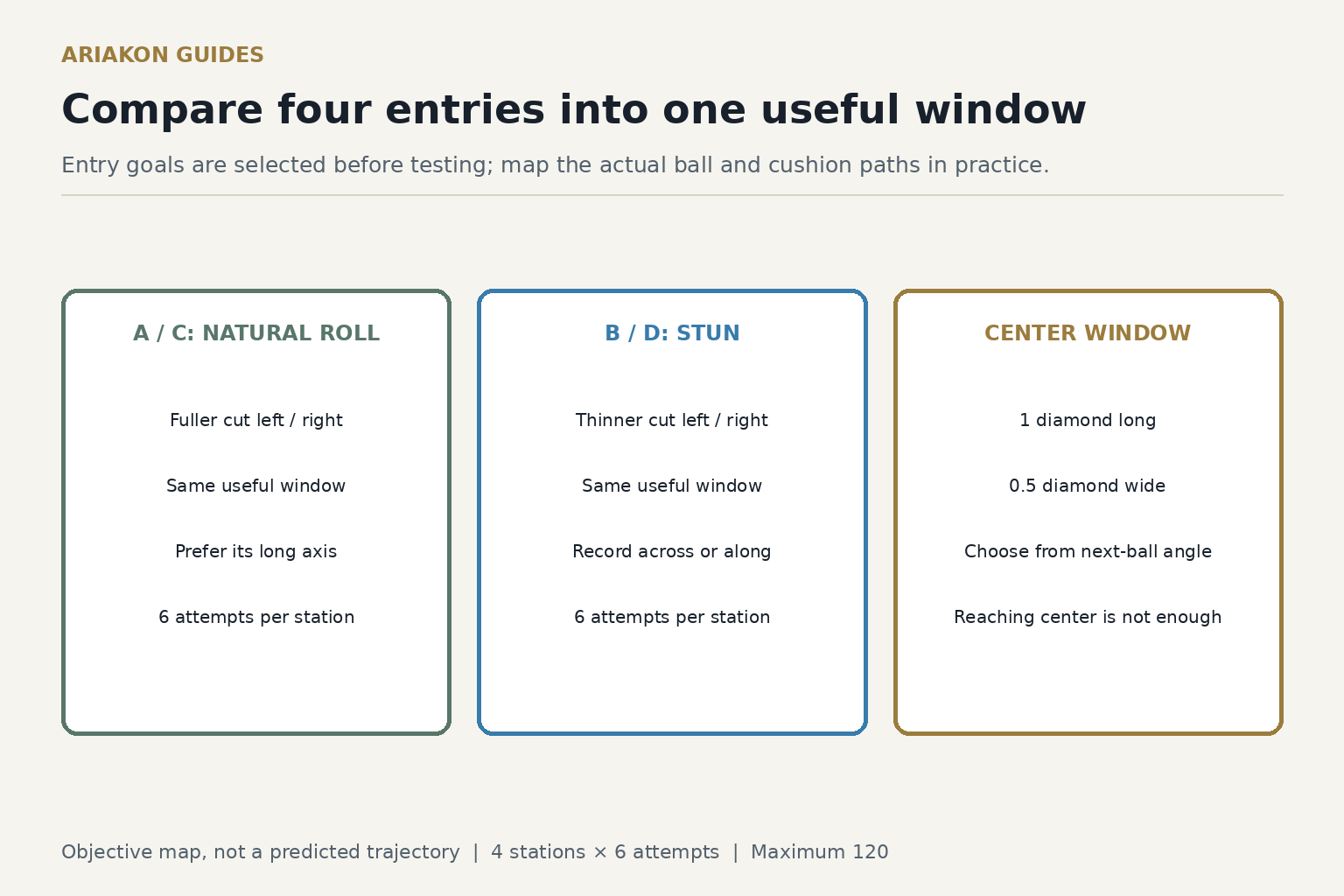
Define the useful center window from the next ball
Place a next ball near a side rail and choose its pocket. Mark a one-diamond-long by half-diamond-wide rectangle near table center on the side that leaves a comfortable cut. The rectangle is the target; the table's exact geometric center may sit outside it.
Draw an arrow along the window's long axis. A cue-ball route that enters along this arrow tolerates more speed error than one that cuts across the narrow dimension. The broad center-table guide explains why central options matter; this exercise measures how different cut angles approach one fixed option.
Use center table as a decision zone before comparing entry angles.
Choose the correct side of the next ball before drawing the center window.
Create four cut-angle stations
Keep the object ball and called corner pocket fixed. Build each cue-ball station with ball-in-hand, mark its center and make the shot first at center ball. Use the 30-degree natural-roll direction as a broad reference for roughly quarter- to three-quarter-ball hits, and the 90-degree tangent line for stun. Those rules predict initial direction; rails, speed and the transition between sliding and rolling still change the full route.
Do not add sidespin during the first map. If a route cannot reach the window without sidespin, record that limitation instead of changing the test.
| Station | Visual reference | Impact state | Attempts |
|---|---|---|---|
| A | Fuller cut from left | Natural roll | 6 |
| B | Thinner cut from left | Stun or near-stun | 6 |
| C | Fuller cut from right | Natural roll | 6 |
| D | Thinner cut from right | Stun or near-stun | 6 |
Score entry quality, not merely contact with center
Write short, ideal or long for every miss. Also mark across if the cue ball crosses the window's narrow side and along if it travels with the long side. Two routes can earn the same score while offering very different speed margins.
| Point | Requirement |
|---|---|
| 1 | Station and impact state called before the shot |
| 1 | Object ball reaches the called pocket |
| 1 | Cue ball follows the predicted initial route |
| 1 | Cue ball enters the marked center window |
| 1 | Cue ball stops with a playable next-ball angle |
| Maximum 120 | Six attempts at each of four stations |
Choose a route from its evidence
| Observed pattern | Decision |
|---|---|
| Natural roll enters along the window | Prefer it when pocket and scratch risk are acceptable |
| Stun crosses the narrow side | Reduce speed sensitivity or widen the target by changing the previous shot |
| Both routes pass through traffic | Center table is not the right destination for this layout |
| One side repeatedly leaves straight | Shift the target window before changing spin |
| Only a forced-speed route arrives | Choose a different pocket or previous position |
Worked map and pattern transfer
A hypothetical player scores 28/30 from fuller-left natural roll, 20/30 from thinner-left stun, 25/30 from fuller-right natural roll and 18/30 from thinner-right stun. Both stun routes cross the short side and finish long. The next pattern uses the fuller-left route; the player does not average all four results into a vague center-table preference.
For transfer, add a ball before the tested object ball. Run the three-ball pattern five times while choosing the opening leave that creates the best measured center entry. Reevaluate from the actual cue-ball position after every shot; the map informs the plan but does not override the table.