
Aiming · 2 min read
Object Ball Pocket Entry: Aim for the Useful Part of a Corner Pocket
The geometric middle of a pocket opening is not always the most useful target for every approach. Pocket facing, entry angle, speed and table condition change the acceptance window. The whole-pocket guide uses that window to shape cue-ball position; this guide first calibrates where the object ball can enter reliably.
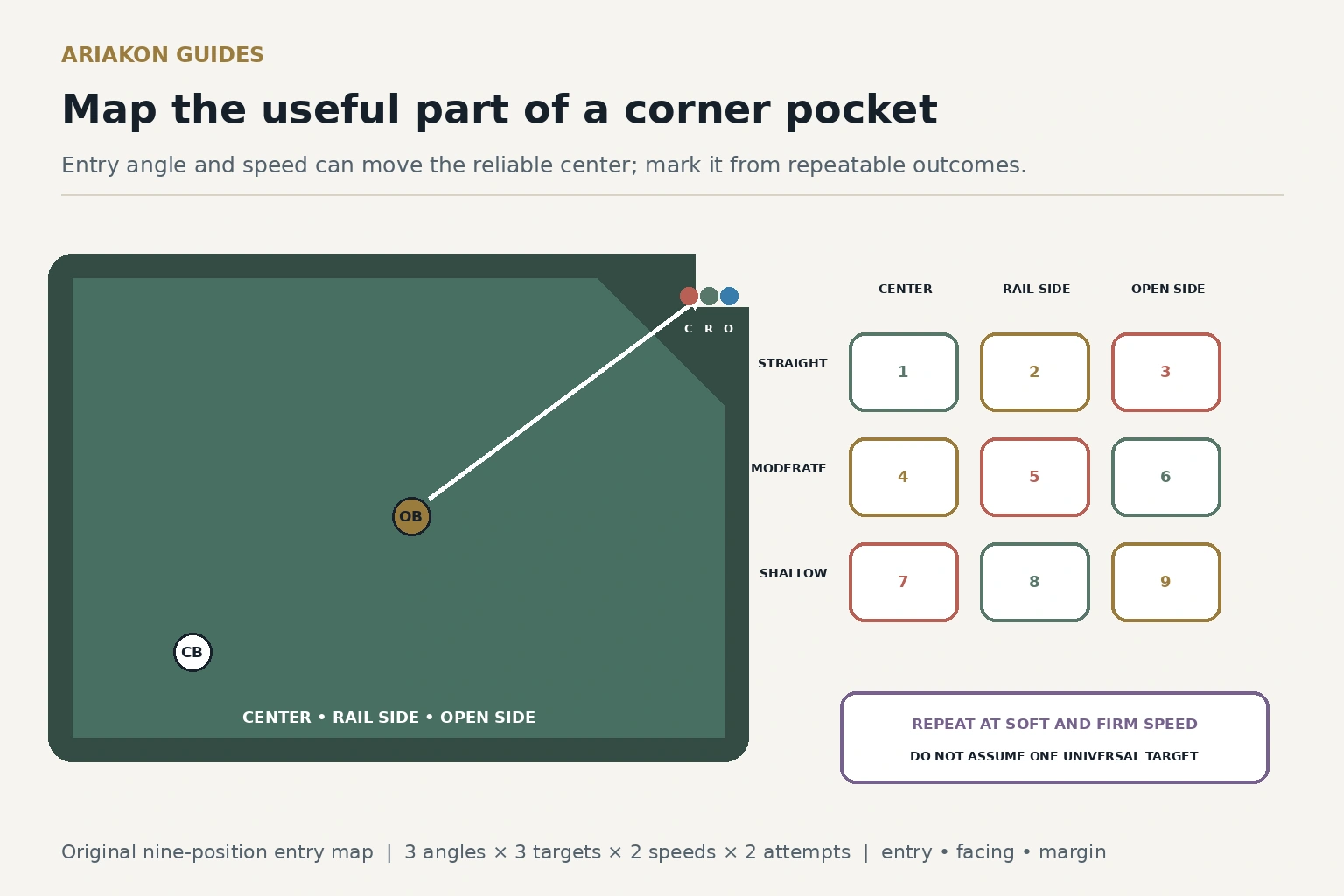
Mark three references without pretending they are universal
| Reference | Purpose |
|---|---|
| Geometric center | Starting line at the leading rail edge |
| Rail-side window | Tests a slow approach that can accept rail-first margin |
| Open-side window | Protects against the far facing at firmer speed |
Use the whole pocket for cue-ball position after mapping the acceptance window.
Understand why unusual pocket-point rebounds are unreliable before treating the facing as a planned bank surface.
Build a nine-position entry map
Place the object ball one diamond from a corner pocket at three approach angles: nearly straight, moderate cut and shallow along the long rail. For each angle, mark a cue-ball position that preserves the line. Shoot three targets—geometric center, rail-side and open-side—at slow pocket speed.
Repeat at a firmer but controlled speed. Use self-adhesive markers only where the venue permits and remove them cleanly. Do not move the pocket target after getting down.
Score entry, facing contact and usable margin
Shoot two attempts at each of three targets, three angles and two speeds: 36 attempts, 108 component points. Record misses by near facing, far facing or short rail. The score describes this table and setup only.
| Point | Earn it when |
|---|---|
| Object ball falls legally | |
| Entry | Ball crosses the intended third of the opening |
| Clean margin | No accidental double-facing rescue or jaw rattle |
Read the pattern before changing aim
| Pattern | Check first |
|---|---|
| Slow rail-side succeeds; firm rail-side rattles | Speed-dependent target shift |
| Both speeds miss the same facing | Alignment or cut calibration |
| Entry is right but cue-ball route fails | Move to whole-pocket position planning |
| Random sides alternate | Delivery and vision baseline |
| Table changes the map | Recalibrate instead of carrying fixed offsets |
Worked transfer: choose margin, then position
Across two comparable sessions, one hypothetical table accepts four of four shallow, slow rail-side attempts, while the same target at firm speed rattles three of four. Each individual session supplies two attempts per combination. The observation suggests a local speed-and-entry interaction; it does not establish a universal aiming shift.
In a three-ball pattern, the player first chooses the firm-speed open-side window that scored cleanly, then predicts the cue-ball route. Pocket-entry evidence remains the first constraint; position does not justify a target that the table rejected.
Sources and further reading
References support the specific factual information above. The practical checklists are Ariakon editorial guidance.