
Equipment guides · 4 min read
Match a Pool Cue to Reach, Balance and Grip Preferences
Cue fit is the relationship between your normal stance, support, hand and the complete assembled cue. A legal length or listed mass does not establish personal reach, balance or grip comfort. This repeatable fit session records those observations separately; different complete cues remain different configurations, not an experiment isolating one component.
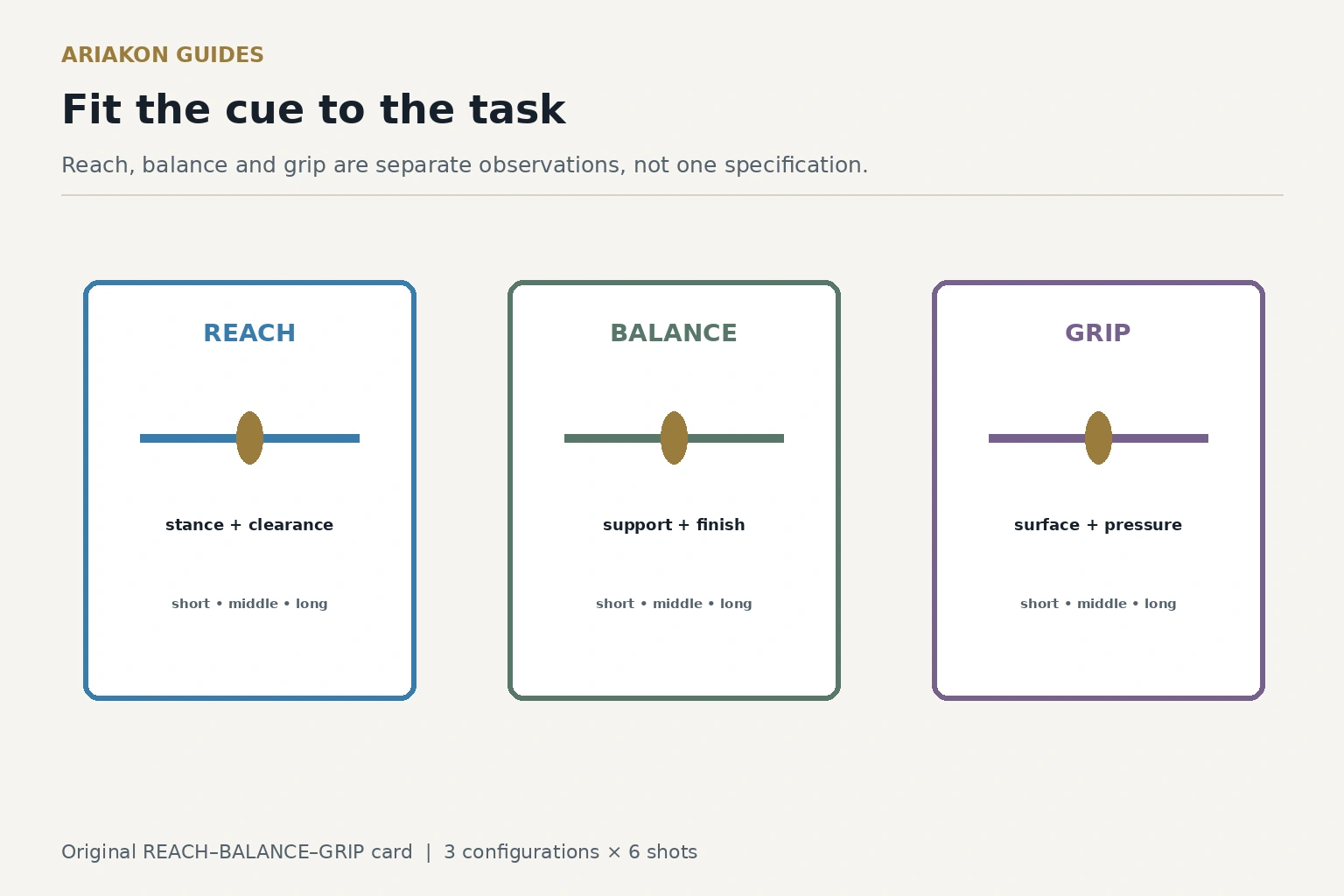
Record the complete configuration before the table trial
Do not balance a cue precariously on a finger or dismantle an unfamiliar adjustment system. If a balance location cannot be measured safely, keep a qualitative observation. Use only permitted configurations. The current WPA-linked equipment document gives broad event limits including minimum 40 inch length, maximum 25 ounce mass and maximum 14 mm tip width; these are eligibility boundaries, not personal-fit recommendations.
| Field | Record safely | Do not infer |
|---|---|---|
| Reach | Assembled length, normal bridge/grip positions and any documented extension | Body height alone determines cue length |
| Balance | Actual mass and balance location if safely measured with a stable support | Equal mass means equal balance |
| Grip | Surface identity, diameter where held and ordinary pressure | A wrap description proves your hand preference |
| Compatibility | Exact shaft, support, joint and permitted adjustment setting | Similar parts fit by appearance |
| Clearance | Room, rail and body allow a normal controlled delivery | A standing showroom waggle proves fit |
Choose a cue for its intended job for the broader budget and ownership decision.
Compare actual handle surfaces when grip is the specific variable you need to study.
Set three exact layouts from the same approach rail
For this example use a 100 ×50 inch playing area and 2.25 inch balls. Coordinates are centers in units of 12.5 inches; x=0–8 along length, y=0–4 across width. The object ball stays O=(6,2) and the real corner pocket is P=(8,4). Approach from the long rail y=0. All three cue-ball centers below share the same straight object-ball/pocket line. The contact center is G=(6−0.18/√2,2−0.18/√2).
Short hand reach uses C=(4.25,0.25); middle uses C=(5,1); longer uses C=(5.5,1.5). These names describe cue-ball depth from the approach rail, not shot distance: the shallow position has the longest cue-ball travel. The respective depths are 3.125,12.5 and 18.75 inches. Use normal support and a mechanical bridge when needed; record which support you use and repeat it for every candidate. Never lean unsafely or let a fit score require pain.
| Attempts | Cue-ball center | Approach depth |
|---|---|---|
| 1–2 | (4.25,0.25) | 3.125 inches from y=0 |
| 3–4 | (5,1) | 12.5 inches from y=0 |
| 5–6 | (5.5,1.5) | 18.75 inches from y=0 |
Score process and outcome without confusing them
Six attempts produce 18 process points plus 6 outcome points:24 total. Three configurations produce 18 attempts,54 process points plus 18 outcome points:72 total. A maximum 24 is not all process points. Stop any unsafe attempt and record why; do not shoot it for a pot. Use comfortable familiar speed, no side spin and no prescribed cushion route.
If comparing three configurations, take one pair from each in rotation at the shallow layout, then rotate at the middle and deeper layouts. Reset identical centers. Keep tip condition and chalking consistent; document every unavoidable shaft, tip, length, balance or grip difference. This session evaluates whole-configuration fit, not causal performance differences.
| Point | Earn only when | Maximum per six-attempt configuration |
|---|---|---|
| Grip | Normal hand pressure; no unintended grab/slip | 6 process |
| Support/clearance | Stable permitted support; cue and body clear | 6 process |
| Delivery | Controlled finish on the intended line without a compensating lift | 6 process |
| Outcome | Target-pocket pot without a scratch | 6 outcome |
Work a fit-first decision instead of buying the largest total
A has the largest total, but its reach failures remain unresolved. C pots equally well while its grip pressure changes. The next action is not a winner claim. Recheck support for A and handle fit for C using separate documented changes. If the support failure is unsafe, do not repeat it until a safe method is established.
For a safe A-versus-C follow-up, repeat all three layouts with two attempts each per configuration:6 each,12 attempts total and 48 possible points. State exactly what changed and which support remains fixed. Retest on another day if fatigue or familiarity dominates. Scores within two points are a reason to preserve uncertainty, not a universal equivalence threshold.
| Configuration | Process | Outcome | Total and finding |
|---|---|---|---|
| A | 16/18 | 6/6 | 22/24; two support/clearance failures at deeper reach |
| B | 15/18 | 4/6 | 19/24; mixed grip and delivery observations |
| C | 15/18 | 6/6 | 21/24; three grip-pressure failures |
Confirm ownership details after fit is usable
Keep the preferred exact configuration, raw pair scores, support method and unresolved findings. Verify permitted adjustment, future tip service, case fit and current seller terms before purchasing. Do not assume an available option or documented adjustment system lets you move balance in an arbitrary way.
A role-specific break or jump trial is separate from this ordinary playing-cue fit session. A current Ariakon listing can supply configuration information, not a guarantee that the cue suits every stance. Check actual choices and ask for missing compatibility details rather than borrowing another maker’s system specifications.
Verify current Ariakon playing-cue information for the exact listing and configuration, without an invented stock or performance claim.
Test break-cue weight separately when the intended job is a break, not routine cue fit.
Check case fit for the complete assembled equipment record.
Sources and further reading
References support the specific factual information above. The practical checklists are Ariakon editorial guidance.