
Cue ball control · 3 min read
Inside and Outside English: Read the Cue Ball Route
Inside and outside English are relative names. On a cut shot, inside English is applied on the cue-ball side toward the cut direction; outside English is on the opposite side. Reverse the cut and the labels reverse. Sidespin can change both the aim before object-ball contact and the cue-ball rebound after a cushion, so this drill scores pocketing and route as separate events.
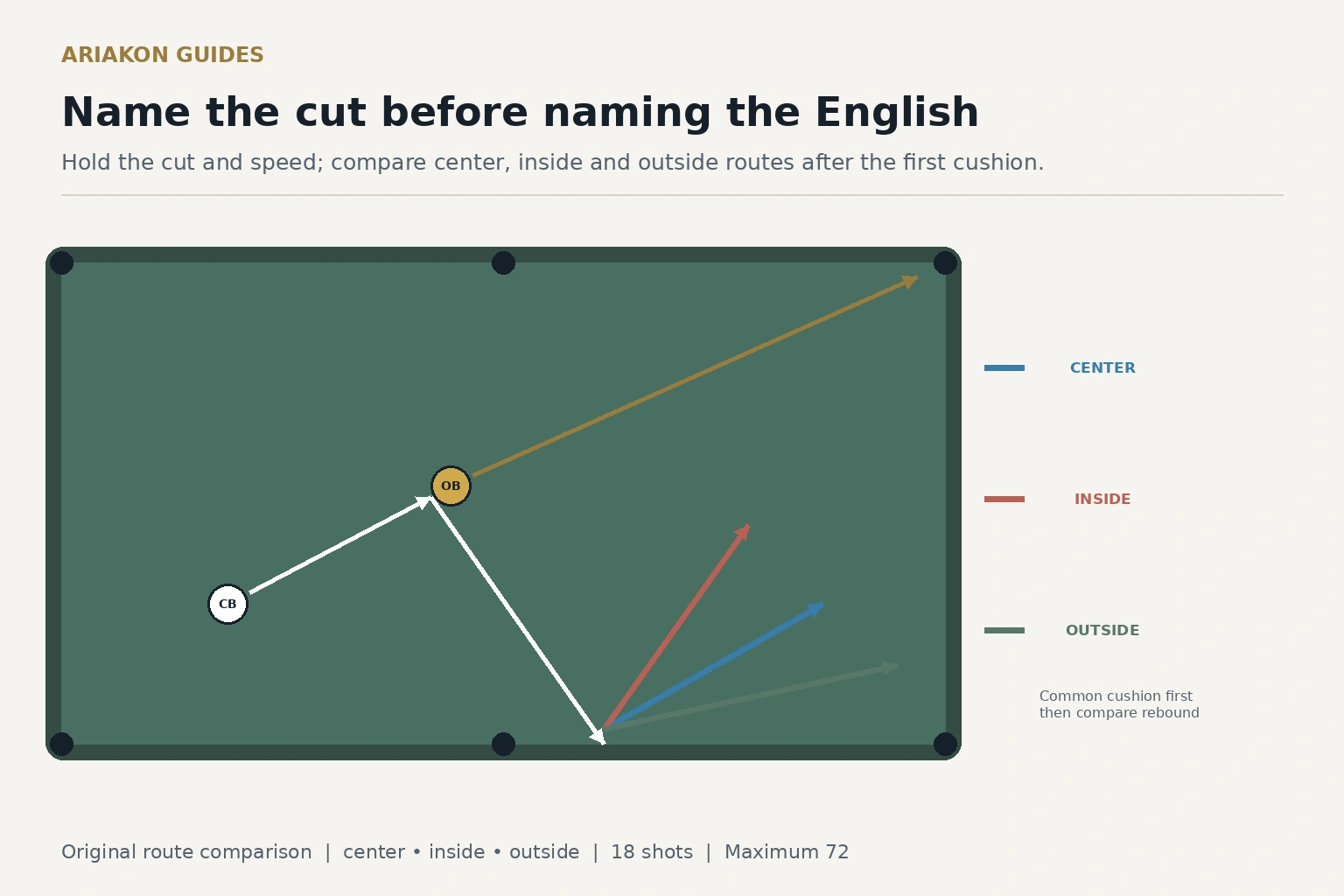
Label the cut before labeling the spin
Set an object ball one diamond from a corner pocket and the cue ball about two diamonds away on a mild cut. Stand behind the cue ball and call the cut direction. Mark center, a small inside offset and the mirrored outside offset on a practice cue-ball diagram; use a conservative offset within your reliable miscue limit.
Do not define inside by the nearby rail or by left and right English alone. For a cut to the player's right, right sidespin is inside; for the mirrored cut, left is inside. This convention keeps the route notes meaningful.
Separate squirt, swerve and throw before treating the route as a cushion-only effect.
Decide whether the shot needs sidespin after the comparison is calibrated.
Mark three route bands after the first cushion
Choose a cut that sends the cue ball naturally to a long cushion. Place three removable visual markers on the opposite half of the table, outside every ball path: one center-route reference and one band on each side. Remove loose markers before shooting. The bands are observations, not promised destinations.
Shoot six center-ball attempts first and use their median path to name the center band. Then test inside and outside. Keep speed, elevation, bridge length and object-ball setup fixed. Compensate aim only enough to pocket the object ball; record the compensation rather than hiding it.
Run an eighteen-shot matched comparison
Each attempt earns one point for calling cut and spin correctly, one for pocketing, one for reaching the called first-cushion band, and one for finishing inside a two-ball-wide down-table corridor. Maximum 72. A miss is still useful when the actual route and compensation are recorded.
| Condition | Call | Record |
|---|---|---|
| Center | Vertical-axis contact | Pocket result and route band |
| Inside | Small offset toward cut | Aim compensation and route band |
| Outside | Equal offset away from cut | Aim compensation and route band |
| Order | C-I-O repeated six times | Prevents one condition owning all warm-up shots |
Diagnose aim before route
| Pattern | Next action |
|---|---|
| Object ball misses only with spin | Calibrate squirt, swerve and throw compensation before judging route |
| Pocketing holds; cushion band scatters | Stabilize speed and spin amount |
| Inside and outside labels swap | Call cut direction while standing on every attempt |
| Route changes but finish speed varies | Add a separate speed score; keep spin offset fixed |
| Center route already solves position | Use center ball and remove the extra variable |
Worked example and mirrored transfer
A player pockets six center, four inside and five outside attempts. The four pocketed inside shots all reach the wider route band, but the two misses go to the same pocket jaw. That pattern supports recalibrating inside-spin aim; it does not support adding more spin. The player runs six unscored aim trials with the same offset before repeating the inside block.
For transfer, mirror the entire layout to the other side of the table. Call cut direction, inside side and outside side before placing the bridge. Shoot three center, three inside and three outside attempts. Passing means the labels reverse correctly and the route relationships remain recognizable; identical diamond finishes are not required on a different line or table.
Calibrate speed and sidespin on the current table for a compact pre-match follow-up.