
Eight ball basics · 4 min read
Eight Ball for Complete Beginners: A Worked First Rack
Eight ball becomes easier to learn when one rack is followed from beginning to end. This walkthrough uses the current WPA Rules of Play. League and house rules can differ, so confirm the rules before the break and treat the example as a decision model rather than a script for every layout.
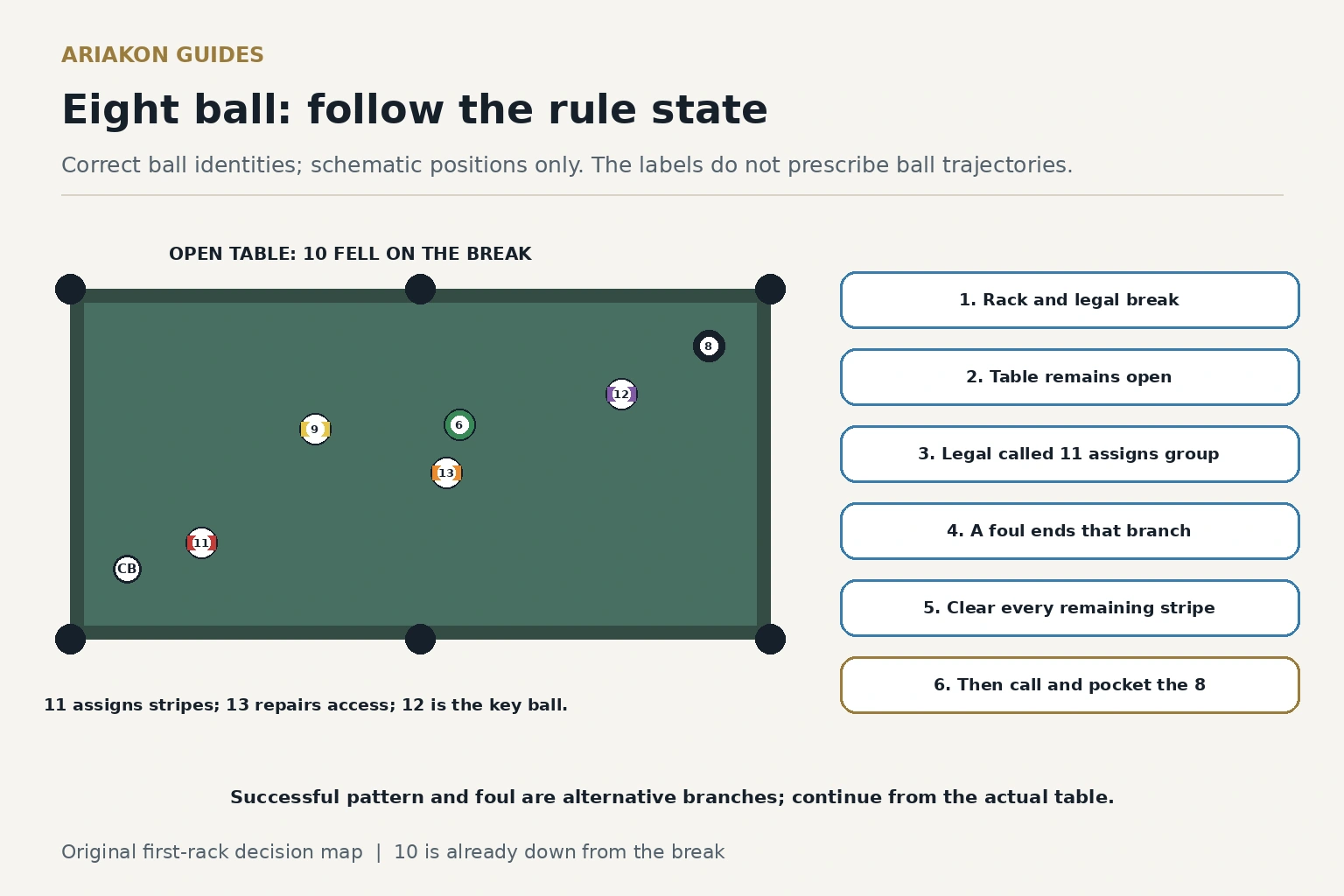
Rack and break under the named ruleset
For WPA eight ball, rack all fifteen object balls tightly with the apex ball on the foot spot, the 8-ball at the center of the third row and one solid and one stripe in the two rear corners. The breaker uses the cue ball behind the head string. A legal break must pocket a ball or drive at least four object balls to cushions; otherwise the opponent receives the rule choices specified for an illegal break.
A pocketed ball on a legal break does not assign solids or stripes. The table remains open. If the breaker legally pockets a ball, the inning continues; if not, the other player comes to an open table.
Check five common eight-ball rule assumptions before applying a familiar house rule to this walkthrough.
Read the open table before choosing a group
In the example, the breaker makes the 10-ball but no group is assigned. Solids have an easy 2-ball, but the 6-ball is tied to the 14 near a pocket. Stripes have a makeable 11-ball and the 13 can later open that cluster. The player calls the 11 in the side and pockets it legally, so stripes become that player's group.
A beginner should name the first ball, its pocket, the problem ball and a possible key ball to the 8 before shooting. That four-item plan is more useful than choosing the group with the largest number of easy balls.
Compare both groups across the whole layout when the open-table choice is not obvious.
Play a short pattern instead of clearing random balls
After the 10 has fallen on the break and the 11 assigns stripes, one possible remaining order is 9, 13, 14, 15, 12, then 8. Here 13 opens access near the 6,14 is cleared next,15 preserves a route to 12, and 12 is the key ball. This accounts for all seven stripes: 10, 11, 9, 13, 14, 15, 12. Rebuild actual pockets and cue-ball zones from the table before using the order; it is a planning illustration, not a guaranteed route.
You may contact only a legal ball first once groups are assigned. A shot that pockets a called ball but begins with the wrong group is a foul, not a successful shortcut.
Build better eight-ball patterns after the first-rack sequence feels familiar.
Know what happens after a foul
Alternative branch: suppose the attempted 13 contacts solid 6 first. Under the named WPA rules that is a foul and the opponent receives cue ball in hand anywhere on the playing surface. The planned continuation stops. The incoming player must play a legal ball from the assigned group first; the successful-stripe sequence above is not continued through this foul.
Identify every ball that actually fell. A numbered ball pocketed on a foul normally stays down under these WPA provisions; the 8 has separate loss-of-rack consequences. Do not retrieve a fallen stripe to restore the illustration. Let the incoming player place the cue ball and continue from the real table.
Call and pocket the eight only after clearing the group
When all stripes are gone, the 8-ball becomes the legal object ball. The player calls the 8 in a specific pocket and plays it there without fouling. Pocketing the 8 early, pocketing it in an uncalled pocket or fouling while pocketing it loses the rack under the applicable WPA provisions.
If the planned pocket becomes blocked before the last stripe, change the key ball and finish route. The 8-ball decision begins several shots before the 8 itself.
Use a first-rack decision card
| Rack moment | Beginner question | Illustrative answer | Rule or action check |
|---|---|---|---|
| Before break | Which rules are we using? | Current WPA eight ball | Agree before racking |
| After break | Is the table open? | Yes, even though the 10 fell | Confirm legal break |
| Group choice | Which group has a repair and key ball? | Stripes: 13 repairs, 12 keys to 8 | Call 11 in side |
| Pattern | Where must the cue ball finish? | Named zone for the next stripe | Replan after a missed zone |
| Foul | Who has ball in hand and where? | Opponent, anywhere on playing surface | Place cue ball before shooting |
| Eight ball | What ball and pocket are called? | 8 in named corner | Group cleared and no foul |
Practice the decisions before keeping score
Play six racks with a more experienced rules reader. Before each shot, say legal group, called ball and pocket, and cue-ball target. Award one point for each correct statement and one more when the shot preserves the stated plan. Stop and explain every foul before continuing.
The first goal is not a break-and-run. It is to finish six racks knowing why the turn continued, ended or changed hands.
Sources and further reading
References support the specific factual information above. The practical checklists are Ariakon editorial guidance.