
Game rules · 3 min read
Check Five Eight-Ball Rule Assumptions Before You Play
Eight-ball is played under several legitimate rulesets, so a rule remembered from a bar, app or league may not govern today's match. The useful habit is not declaring one version universal. Identify the authority, read the event variations and settle predictable questions before anyone breaks.
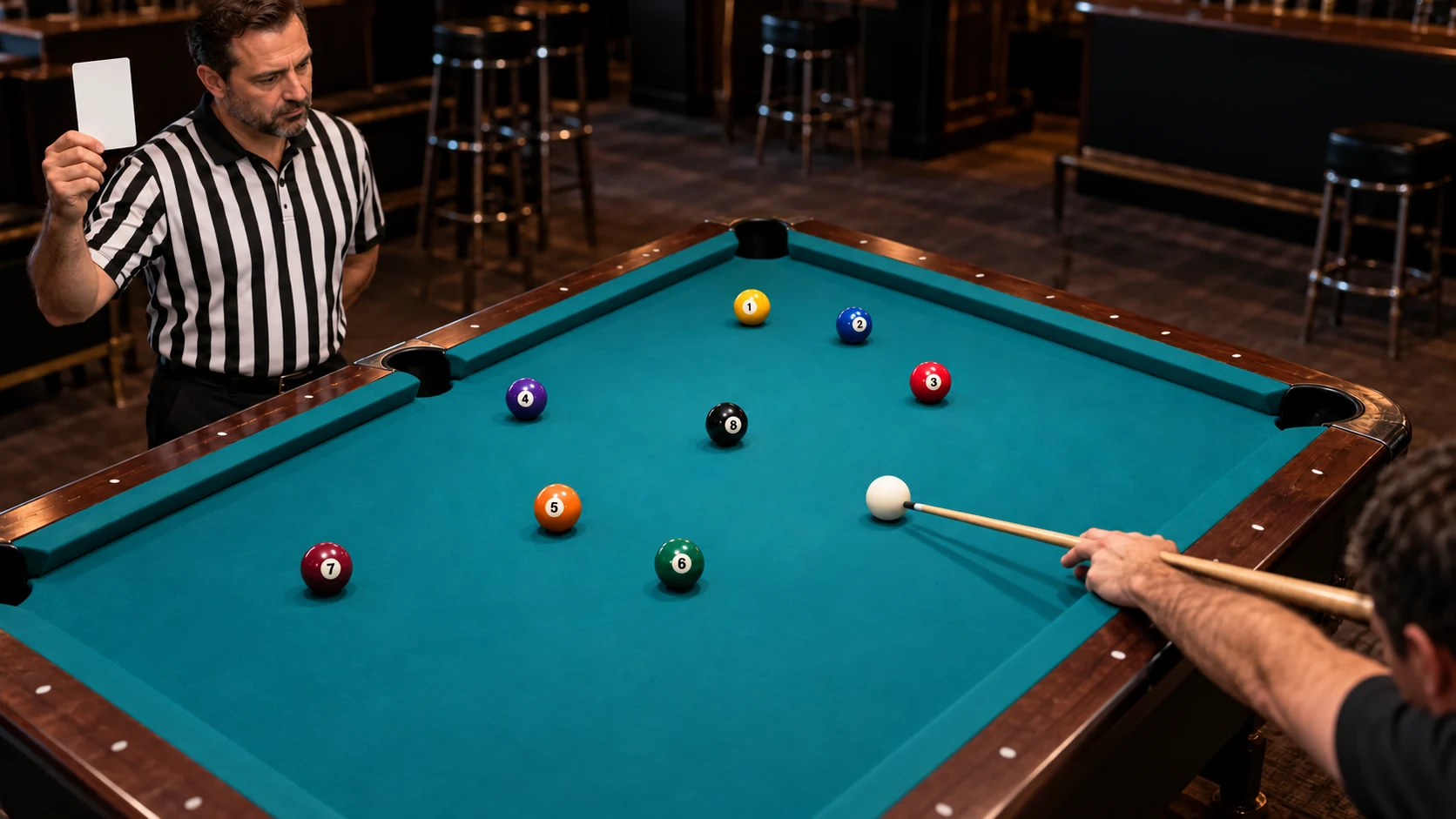
Assumption one: a ball on the break chooses your group
Under current WPA rules, the table remains open after the break even when one or more object balls are pocketed. Groups are determined when a player legally pockets the called ball after the break. Other leagues can define group assignment differently.
Ask exactly when solids or stripes become assigned. That is more useful than asking whether the table is open in the abstract.
Assumption two: anything is a legal first hit on an open table
An open table does not automatically make the 8-ball a legal first object ball. Under WPA eight-ball, the shooter may first contact a solid or stripe while the table is open; first contacting the 8-ball is a foul unless the rules specifically provide otherwise.
Confirm both the first-contact rule and what must happen after contact, such as a ball reaching a cushion when nothing is pocketed.
The current WPA exception is when an entire group has already been pocketed while the table is still open: the shooter may temporarily claim that cleared group and play the 8. Do not apply that unusual exception to an ordinary open table with both groups still present.
Assumption three: every detail must be called—or none of it
WPA eight-ball is a call-shot game. The intended ball and pocket must be indicated when they are not obvious; cushions, kisses and other details do not all need to be called. League and house formats may use different conventions.
When in doubt, clearly name and point to the ball and pocket before getting down. A simple declaration prevents a dispute without slowing ordinary obvious shots.
Assumption four: the 8-ball on the break always wins or loses
In current WPA eight-ball, pocketing the 8-ball on a legal break is not an automatic win or loss. The breaker chooses to re-spot the 8-ball and accept the position or to re-break. A league or local tournament may handle this differently.
Confirm the 8-on-break procedure and the scratch combination before the match. Those two facts often travel together in players' memories even when the written rules separate them.
Assumption five: every foul gives the same ball in hand
Standard WPA fouls generally give the incoming player cue ball in hand anywhere on the playing surface, subject to the game's specific provisions. Informal rules may restrict placement behind a line, and league rules can add operational details.
Do not move the cue ball until the ruling is clear. If a referee is available, describe what occurred rather than arguing from a nickname such as kitchen rules.
Run a sixty-second rules check
- Name the governing organization or written house rules.
- Confirm group assignment after the break.
- Confirm call-shot and slop conventions.
- Confirm 8-ball-on-break and early-8 consequences.
- Confirm ball-in-hand location after standard and break fouls.
- Ask how to stop play and request a ruling before a close shot.
Sources and further reading
References support the specific factual information above. The practical checklists are Ariakon editorial guidance.