
Eight ball strategy · 4 min read
Eight Ball Endgame Decisions When Both Players Are on the Eight
When both players have cleared their groups, every legal shot is about the eight ball—but not every open pocket is an automatic attack. The correct choice depends on the event rules, the full cue-ball path, the opponent's next view and what a miss leaves behind. Slow the decision down with one written card, then train it with layouts whose result can be scored.
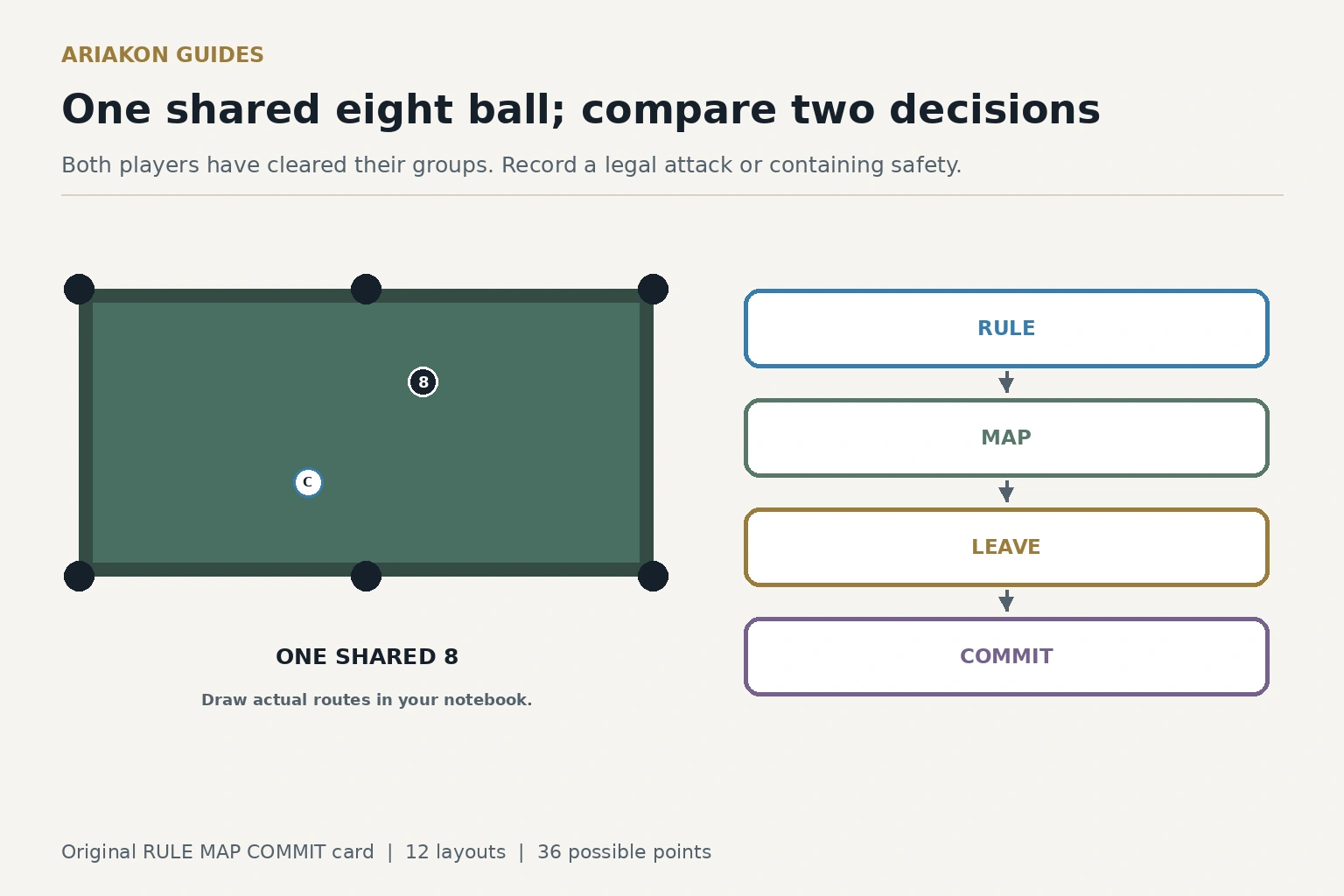
Write the RULE–MAP–COMMIT card
The WPA rulebook effective September 15, 2025 requires the shooter to call the intended ball and pocket when they are not obvious. In eight ball, legally pocketing the eight wins; pocketing it in an uncalled pocket, pocketing it with a foul, pocketing it before the group is cleared, or driving it off the table loses the rack. Confirm the rules actually governing your match before using this guide.
A containing safety must still be a legal shot. Under current WPA general rules, after first contacting a legal object ball, a ball must be pocketed or the cue ball or an object ball must contact a cushion. Do not plan a soft roll that merely touches the eight and stops unless the applicable rules make it legal.
| Check | Write or point to | Why it changes the choice |
|---|---|---|
| RULE | Called pocket, legal first contact, foul and loss-of-rack conditions | A familiar house rule may differ from the event rule |
| MAP | Available pocket lines from the single eight ball, every pocket and the cue-ball path after contact | An open object-ball line can hide a scratch |
| LEAVE | What the opponent sees after your miss or safety | A low make percentage can also concede an easy table |
| COMMIT | Attack, containing safety or rules clarification | One plan prevents a steering stroke |
Review broader eight-ball table decisions before isolating the final-ball endgame.
Practice simple percentage safeties when a legal containing shot is the better option.
Compare attack and containment on the same map
Score a plan, not confidence. Trace the cue ball through at least the first rail and mark a scratch corridor. For a safety, mark two landing zones: the cue-ball zone and the eight-ball zone. If neither zone is realistic, it is not yet a plan.
Both players shoot the same single eight ball once their groups are cleared. A safety may legally move that eight while controlling the cue ball; its purpose is to make the opponent’s next shot difficult. Do not treat the layout as two owned eight balls. If the position or rule is disputed, call the designated official before shooting.
| Question | Attack evidence | Safety evidence |
|---|---|---|
| First contact | Full legal hit on the eight | Legal thin or full hit on the eight |
| Cue-ball danger | Scratch, double kiss and rail trap marked | Scratch and accidental pocket marked |
| Failure leave | Opponent's next line to the same eight ball after a miss | Opponent's line after the intended leave |
| Execution demand | Pocket and speed window you have practiced | Cue-ball and eight-ball zones you can name |
| Choice | Attack only with a complete route | Safety only with a legal, observable leave |
Run a twelve-layout endgame drill
Worked example: the eight is near a corner, but the cue ball lies close to the same-rail scratch line. The player marks the scratch corridor, sees that a miss sells out the opponent's straight shot on the same eight ball and chooses a legal thin hit that sends the eight up-table while leaving the cue ball on the end rail. The shot earns a planning point only if both intended zones were named before the stroke.
If most lost points are rule or first-contact errors, rehearse four legal safety contacts. If the map is correct but outcomes miss both zones, widen the zones and practice speed. If open attacks fail from one angle, isolate that shot rather than changing the entire decision system.
| Block | Layout condition | Score one point for each |
|---|---|---|
| Open | Four makeable eight balls with different cue-ball angles | Legal plan; correct scratch map; intended result |
| Contain | Four thin or distance safeties with no comfortable attack | Legal contact; both leave zones named; intended result |
| Risk | Four tempting shots with a side-pocket, corner or double-kiss scratch | Danger named; choice committed; danger avoided |
| Total | Twelve layouts | Maximum 36; record the first lost point |
Sources and further reading
References support the specific factual information above. The practical checklists are Ariakon editorial guidance.