
Equipment guides · 3 min read
Design a Fair Cue Tip Comparison Without Claiming Lab Results
A useful personal cue-tip comparison begins before either result is known. Write the question, control the cue and shot conditions, choose observable outcomes, alternate order and disclose every mismatch. The result can guide your own preference; it cannot establish a universal ranking or laboratory claim.
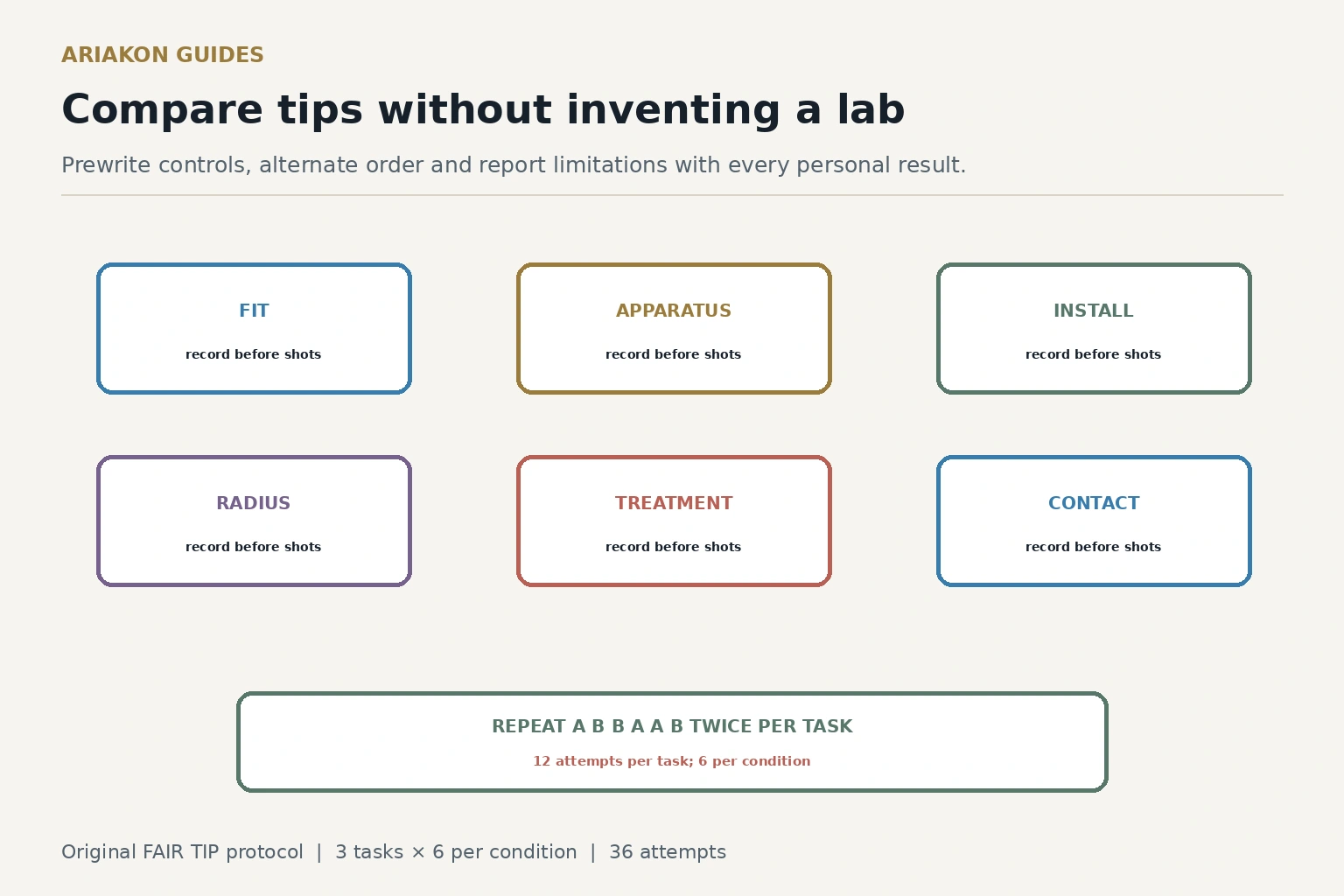
Write the FAIR TIP protocol first
Do not swap tips repeatedly on one shaft just to create a comparison; removal and installation can damage components or introduce large order effects. Two manufacturer-compatible shafts reduce that issue only if their construction and condition are genuinely comparable. Otherwise label the test a whole-shaft comparison.
The WPA equipment specifications set general legal boundaries, not a performance ranking among commercial tips. Manufacturer pages document their own construction and grades; they are not independent test results.
| Control | Hold constant or record | Uncontrolled means |
|---|---|---|
| F — Fit | Compatible shaft, diameter and qualified installation | Do not shoot an unsafe assembly |
| A — Apparatus | Same butt; matched shafts if available | Shaft difference is a confound |
| I — Installation | Installer, installed height and settling period | Order and service effects remain |
| R — Radius | Same documented tip shape before blocks | Shape may explain the result |
| T — Treatment | Same chalk, cleaning and care | Surface condition differs |
| I — Intended contact | Same declared center/vertical-axis zones | Stroke scatter differs |
| P — Pattern | Same marked balls, speed zones and alternating order | Table task differs |
| Report | All misses, miscues, exclusions and limitations | No fair conclusion |
Understand cue-tip hardness and spin before choosing what the trial should measure.
Decide whether a replacement addresses the problem before servicing sound equipment.
Run 36 alternating attempts
Use a helper or shuffled cards to set order when possible. Count every valid attempt and state exclusion rules before shooting. Rest between blocks. Stop for loose components, pain or unsafe table access.
Worked example: Condition A records 16/18 declared contacts and B records 15/18. Stop and draw zones overlap, while the player writes that B feels firmer. The honest conclusion is a personal feel preference with no demonstrated outcome difference in this small trial—not proof that one tip performs better.
| Task | Condition A and B record | Primary observation |
|---|---|---|
| Straight center ball | Repeat A-B-B-A-A-B twice: six A and six B | Contact mark, pocket and cue line |
| Stop-zone shot | Reverse the order | Contact mark and stop-zone finish |
| Controlled draw zone | Draw a new concealed order | Contact mark, draw zone and miscue |
| Total | 18 attempts per condition | 36 total attempts; 18 per condition; log contact and outcome per attempt |
Publish a truthful personal result
| Line | Required statement |
|---|---|
| Question | The exact personal choice being examined |
| Conditions | Cue, shafts, tips, care, chalk, table and date |
| Observations | Complete counts and personal ratings in separate columns |
| Limitations | Sample size, unmatched parts, order and no blinding |
| Decision | Keep, retest or stop; never universalize |