
Equipment guides · 3 min read
Decide Whether a Cue Tip Upgrade Solves Your Actual Problem
A new cue tip is appropriate when the current tip is damaged, dangerously thin, loose, incompatible with the shaft or no longer maintainable. It is not an automatic cure for miscues, inconsistent draw or poor speed control. Diagnose the actual failure first, then compare a replacement by documented construction, fit, care and repeatability rather than promises of free spin.
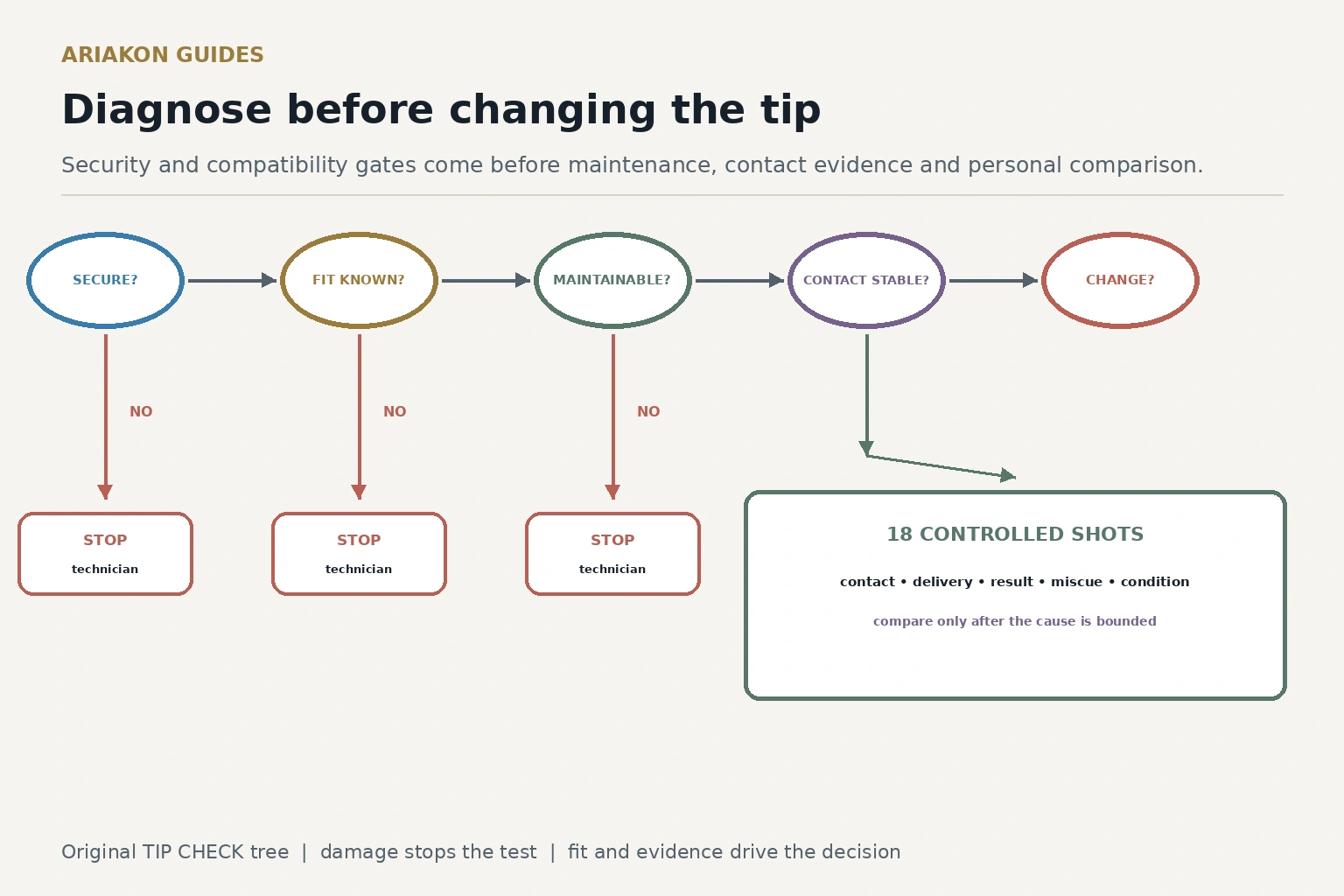
Run TIP CHECK before shopping
Do not sand into a ferrule or carbon-fiber wall, reglue a failed tip during play or continue with a loose component. Use the shaft maker's service instructions or an experienced cue technician when construction is unknown. A tip marketed as soft, medium or hard should be treated as that maker's category; labels are not a universal cross-brand scale.
A hardness grade, tip construction and playing result are separate observations. Do not assume that a softer grade supplies more spin. Compare secure, properly installed tips only within a declared personal trial, and keep tip-contact errors separate from material claims.
| Check | Proceed when | Stop or hand off when |
|---|---|---|
| T — Tip security | Bond is secure and tip is intact | Loose tip, lifting layer, split, deep crack or very thin material |
| I — Interface | Diameter and ferrule are known and undamaged | Ferrule crack, unknown construction or prior over-cutting |
| P — Profile | Curvature is even and usable | Shape cannot be restored without excessive removal |
| C — Chalk | Surface accepts an even, light coat | Glazing or contamination persists after approved care |
| H — Hit record | Miscue location and shot are recorded | Only vague memory or one spectacular miss |
| E — Execution | Contact mark and delivery are repeatable | Tip lands in different places across attempts |
| C — Compatibility | Maker/installer confirms size and service | Replacement conflicts with shaft instructions |
| K — Keep/change | Evidence identifies a tip limitation | Stroke, chalk or setup remains the likelier cause |
Compare cue-tip construction and care after identifying a genuine replacement need.
Inspect and maintain the current tip when the tip is sound but its surface or shape needs routine attention.
Use a controlled 18-shot diagnosis
If contact marks scatter, work on delivery before attributing the result to the tip. If contact is repeatable but a secure, properly chalked tip repeatedly fails under ordinary legal contact, document the pattern for the installer. Do not use extreme edge contact as a purchasing test; it confounds aim, stroke and miscue limit.
Worked example: the player pockets 16 of 18 but seven contact marks are outside the intended vertical strip and all four poor draw results follow those marks. The next action is contact calibration, not a tip purchase. A second player with a lifting layered tip stops immediately and requests service; no shooting test is warranted.
| Record | Observable evidence |
|---|---|
| Contact | Chalk mark lands in the intended center or vertical-axis zone |
| Delivery | Cue finishes through the marked line without lateral steering |
| Result | Pocket, stop zone or draw zone is recorded separately |
| Miscue | Yes/no plus exact intended and observed tip location |
| Condition | Tip shape, chalk, ball and setup remain fixed |
Compare replacements with a no-hype worksheet
Choose only after the worksheet identifies a real tradeoff you value, such as care frequency, feel or availability of qualified installation. Ariakon does not claim that a named tip is stocked, endorsed or proven faster because it appears in a source.
| Field | Evidence to collect | Do not infer |
|---|---|---|
| Construction | Solid or layered; maker and exact model | That one construction is universally superior |
| Nominal size | Diameter and installer fit plan | That trimming is harmless on every shaft |
| Hardness | Maker's named grade or published measure | Cross-brand equivalence from the word medium |
| Care | Shaping, scuffing and replacement directions | Unlimited maintenance life |
| Personal trial | Same cue, chalk, shots and 18-field log | Laboratory proof or performance for every player |